
A brewing storm
Nigeria’s police chief warned against Kenyan-style protests planned for 1 August, sparked by online calls for demonstrations against poor…

Nigeria’s police chief warned against Kenyan-style protests planned for 1 August, sparked by online calls for demonstrations against poor governance and the cost of living crisis. The protests aim to be peaceful, inspired by Kenya’s successful anti-tax hike movement. Meanwhile, a recent Afrobarometer report titled “African insights 2024: Democracy at risk — the people’s perspective,” shows only 44% of Nigerians would reject a military takeover if leaders abuse power, contrasting with 66% of Africans across 39 countries who prefer democracy. However, 53% of Africans would accept a military takeover if leaders abuse power, highlighting a democracy crisis. The report underscores concerns about democratic stability in Nigeria and Africa.
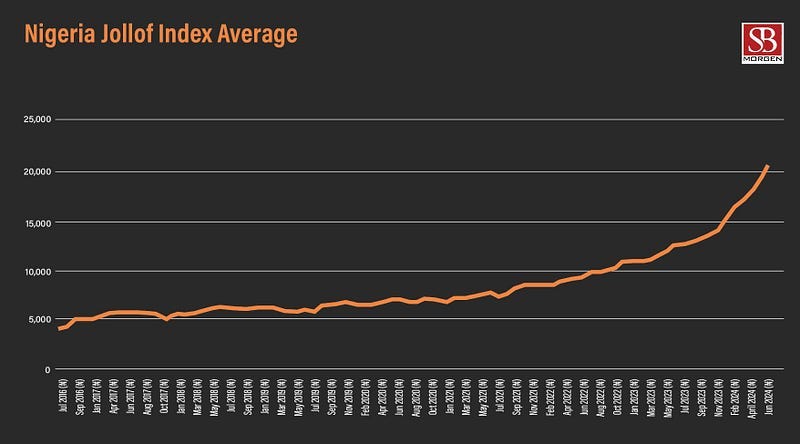
Nigeria finds itself at a critical juncture, with economic hardships fuelling widespread discontent and a growing call for change. The most recent SBM Jollof Index published just yesterday shows that a family on the minimum wage of ₦30,000 ($18.87) a month will spend 67% of their income on a single pot of jollof rice, and with the proposed new minimum wage (₦70,00), this proportion of income on a single pot of Nigeria’s favourite meal will fall to 30%. A single meal in a month of meals. In response, Nigerians have taken to social media platforms, urging for protests and demanding government accountability with a fervour that echoes recent events in Kenya. The country’s police chief, seemingly stuck in an outdated paradigm, and against rights enshrined in the 1999 Constitution, has issued a stern warning against these planned demonstrations. However, this top-down approach reveals a fundamental misunderstanding of the shifting power dynamics in the digital age. Gone are the days when official statements could effectively quell dissent through sheer authority. Platforms like X and Facebook have become digital town squares where hundreds of thousands of Nigerian youths rally around shared grievances. The government’s mouthpieces have issued barely veiled threats of violence against potential protesters. These statements, laden with references to the brutal crackdown on the EndSARS movement, seem intended to instil fear and deter civil disobedience. However, this heavy-handed approach may push an already frustrated populace to a dangerous breaking point. The authorities would do well to remember that desperation can breed courage, and a population with nothing left to lose becomes ungovernable. There is a tipping point where the sheer numbers of protesters could overwhelm even the most prepared security apparatus. It would be far wiser for the government to engage in meaningful dialogue, address the root causes of discontent, and implement genuine reforms. The path of threats and violence is treacherous, often leading to outcomes neither side truly desires. Nigeria’s leadership can either heed the voices calling for change or risk pushing their country towards a confrontation that may spiral beyond anyone’s control.