
A deadly déjà vu
16 killed in Kenya's anti-government protests, largely by police. Seven died in Togo's economic protests amid excessive force claims.

16 people were killed during anti-government protests in Kenya on Wednesday, mostly by police gunfire, according to Amnesty Kenya and the Kenya National Commission on Human Rights. The protests marked the anniversary of last year's deadly tax demonstrations, where over 60 died. Police used tear gas and water cannons in Nairobi to disperse crowds. Meanwhile, in Togo, seven people died during recent protests against President Faure Gnassingbé, sparked by economic hardship. Human rights groups accused security forces of using excessive violence, arbitrary arrests, and property destruction. Several bodies, including minors, were found in Lome’s districts and surrounding areas following the unrest.
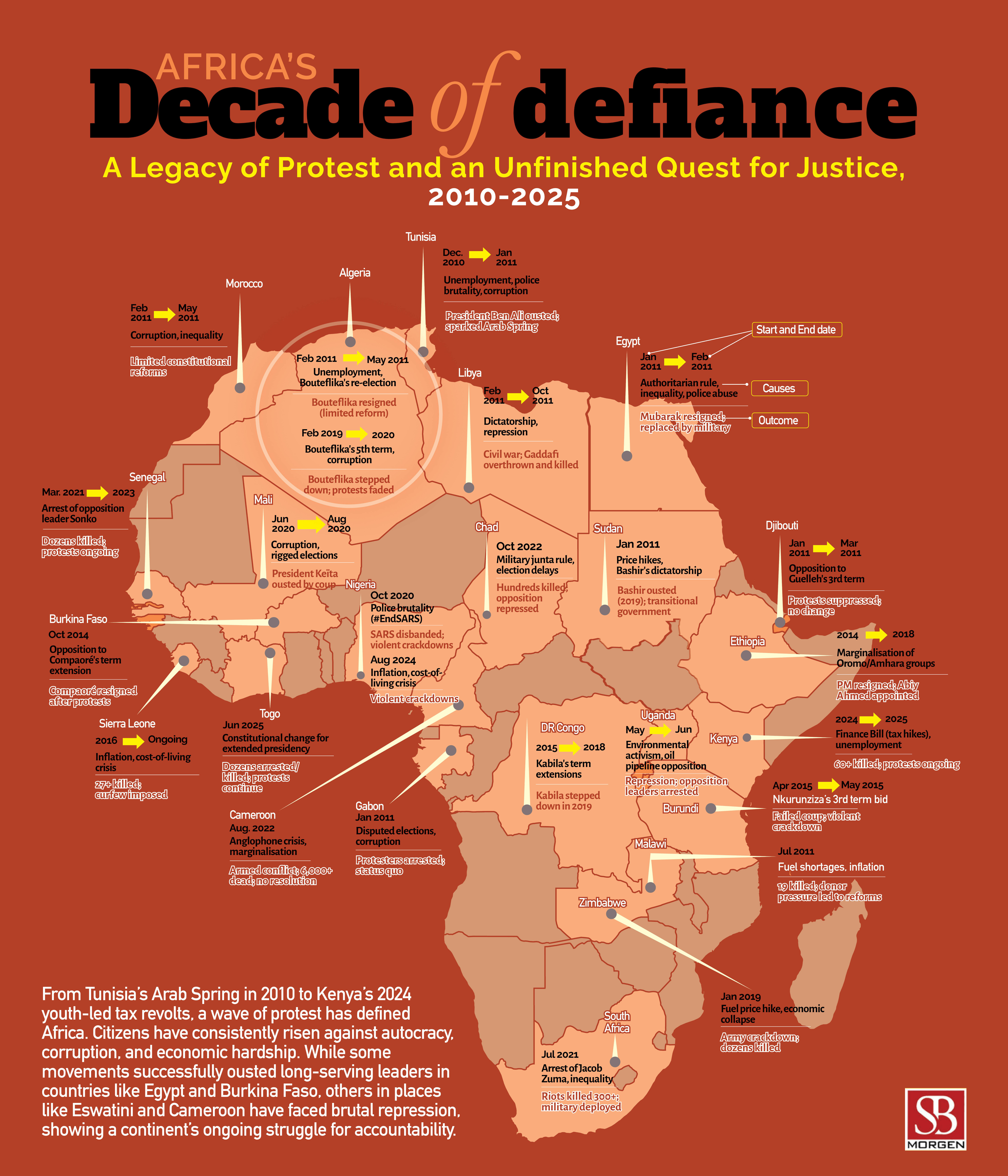
Kenya and Togo are currently grappling with significant political and economic challenges, marked by public discontent and state crackdowns. While their specific triggers differ, both nations highlight the delicate balance between governance, public trust, and the state's use of force. This dynamic is part of a broader wave of protest that has defined Africa since Tunisia's Arab Spring in 2010, with citizens consistently rising against autocracy, corruption, and economic hardship across the continent, from Egypt to Burkina Faso.
In Kenya, public anger over police brutality remains potent, even though the initial tax hike protests triggered by President William Ruto were withdrawn in mid-2024. This enduring frustration was tragically reignited in June with the death of 31-year-old blogger and educator Albert Ojwang in police custody. His murder has intensified calls for accountability over numerous unresolved abductions linked to security forces and reopened wounds from last year's protests, which claimed over 60 lives. Last week, six individuals, including three police officers, were charged with Ojwang’s murder, all pleading not guilty. These protests routinely expose the long-standing tension between the Kenyan public and its police force, which rarely hesitates to suppress dissent with violence. Originally established as a colonial instrument of repression, the police have undergone little meaningful reform since independence in 1963. Successive governments have weaponised the institution to quash opposition, reinforcing a culture of impunity. From Moi’s authoritarian era to the 2007 post-election violence and recent crackdowns on constitutionally protected protests, the trend has remained unchanged. The June 2024 crackdown reflected the state’s instinctive view of protest as a threat. Brutality endures due to weak internal oversight and a pervasive "blue code" culture that shields misconduct. Promotions based on political loyalty rather than merit have entrenched systemic dysfunction, now compounded by growing economic pressures.
Kenya's IMF-backed programme collapsed after the country failed to meet its tax and deficit targets—a predictable outcome given the ambition of its benchmarks. A new deal is expected ahead of the 2027 elections to help regain access to international credit markets. An IMF team is currently in Nairobi evaluating the role of corruption in public finance, signalling continued engagement. The latest budget projects $2.23 billion in external borrowing, though growing reliance on domestic borrowing—alongside falling interest rates—should ease pressure on debt servicing, which now consumes over 53% of total revenue. Capital spending has fallen to a two-decade low due to tight fiscal conditions. Public-private partnerships (PPPs) may spur a revival as politically connected actors adapt to new financing models. Two key projects—the extension of the standard gauge railway to Mombasa and the Mombasa–Malaba road upgrade—are expected to proceed and could significantly impact regional logistics. Meanwhile, the government is focusing on visible, low-risk projects like affordable housing, market construction, and occasional stadium upgrades. However, as with the KES 25 billion industrial parks plan, many risk delays or cost overruns. To bridge funding gaps, the government may turn to financial repression—steering private savings toward public securities or infrastructure investments. Done creatively, this could unlock vital capital. Still, the Ruto administration’s fiscal strategy suffers from two key flaws: an overwhelming focus on revenue mobilisation at the expense of growth sectors like agriculture and manufacturing, and an overreliance on informalisation as a development model. Rather than embracing broad-based, pro-poor reforms, the government seems to sideline the formal middle class while rhetorically elevating the informal sector as the nation’s economic backbone.
Similar overreach and political tone-deafness, albeit within a different context, can be seen in Togo, where the adoption of a new constitutional framework in June effectively allows President Faure Gnassingbé to rule indefinitely. A recent spike in electricity tariffs sparked fresh protests, largely directed at the Gnassingbé family’s 60-year hold on power. The state’s response was swift and harsh: over 80 arrests and heavy-handed policing marked the early June rallies. This is not unfamiliar territory for Togo. In 2005, after his father’s death, Faure assumed power through a blend of military support and constitutional manipulation, sparking protests that reportedly left over 1,000 dead. ECOWAS condemned the power grab, suspended Togo, and applied sanctions. But under pressure, Faure stepped aside briefly—only to win a rushed election that ECOWAS later legitimised, allowing Togo’s return to the bloc. Since then, Faure and his ruling party have entrenched power through calculated constitutional revisions. In this context, ECOWAS again risks repeating its 2020 misstep in Mali, when its weak response to President Ibrahim Keïta’s judicial overreach failed to prevent a coup, ultimately leading to Mali’s exit from the bloc. A 2024 Afrobarometer poll shows 54% of Togolese support leaving ECOWAS, perceiving it as disconnected from their daily realities. Many now favour joining the Alliance of Sahel States (AES)—a sentiment echoed by Foreign Minister Robert Dussey in April, who publicly flirted with alignment to the AES, noting the strategic potential of Lomé’s port for landlocked members. Ultimately, the 58-year Gnassingbé dynasty, compounded by ECOWAS inaction and muted international pressure, makes regime change unlikely without a serious rupture—such as a military defection or wider regional shift. In the short term, repression may quell unrest or lead to sporadic violence, but a coordinated youth-led uprising could yet emerge. Still, without a defining catalyst—a coup or internal collapse—Faure is unlikely to step down.