
A few more decibels
The Electoral Commission of Ghana (EC) began registering new voters before the 19 December District Level Elections. The 21-day exercise…

The Electoral Commission of Ghana (EC) began registering new voters before the 19 December District Level Elections. The 21-day exercise will take place at the 268 District Offices of the Commission — a departure from the old system where limited registration exercises were done at the electoral areas. Five opposition political parties led by the National Democratic Congress (NDC) have sued the EC over the upcoming limited voter registration exercise, saying the EC’s decision to restrict the voter registration centres to their district offices could deprive many eligible voters of their right to be registered as voters and to vote in public elections.
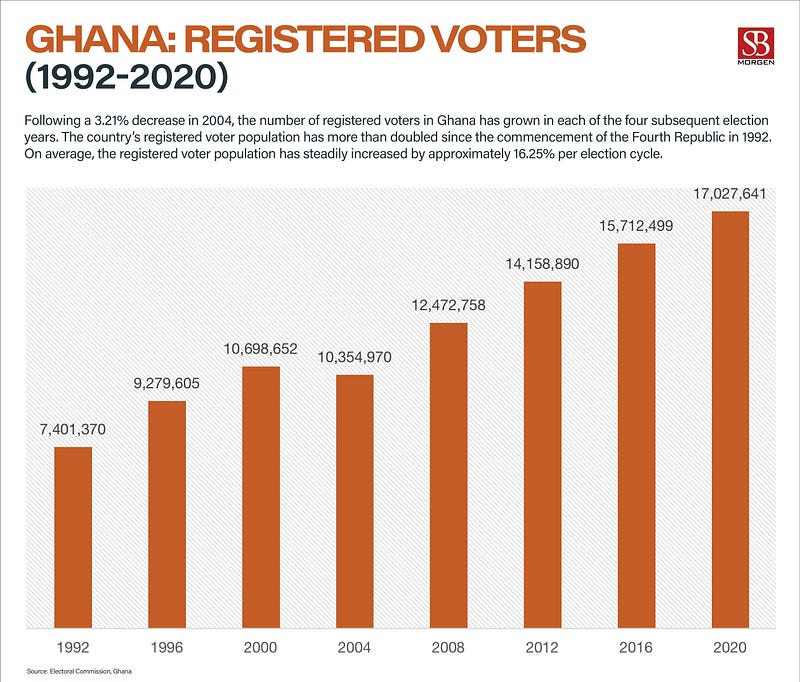
Opposition political parties in Ghana have vehemently criticised the Electoral Commission (EC) after introducing a new Constitutional Instrument (CI) to guide the 2024 general elections. This new CI aims to narrow the list of acceptable documents for voter registration to only the Ghana Card, eliminating options like driver’s licence and passports. However, the concerns extend beyond the issues with the Ghana Card. One major point of contention is the reduction in voter registration centres nationwide. With close to 20 million Ghanaians expected to be 18 years or older by 2024, the proximity and availability of centres have been of great concern. The ongoing limited voter registration intends to enrol over 1.3 million individuals who turned 18 since the last registration exercise in 2020. This means that Ghanaians in the 18 to 21 age group have not had the opportunity to have their names added to the voters’ register since 2020. According to the EC’s plan, the registration process will occur in all 268 district offices of the Commission. However, a quick examination of non-urban constituencies reveals that many eligible registrants will need to spend more than $5 on transportation just to reach the constituency or district capitals where they can register. This amount is nearly four times Ghana’s prevailing minimum wage. The combination of distance, time, and transportation costs could discourage new voters and create an additional financial burden. Opposition parties have alleged that these actions represent government and EC strategies to disenfranchise certain voters, labelling it as a form of manipulation. Additionally, the minority has accused the EC of sending faulty registration machines to their strongholds, further frustrating new voters attempting to obtain a voter’s ID for the 2024 presidential and parliamentary elections. Despite filing a lawsuit against the Electoral Commission, the leading opposition party, the National Democratic Congress (NDC), asserts that it is closely monitoring the ongoing limited voter registration exercise. As we stated when we last commented on this subject in March, Ghana typically has free, fair and plain elections, but this will be one of its most closely fought. The current government, largely viewed as profligate and wasteful, has a parliamentary majority of one propped by an independent MP whose loyalty is up for grabs in this cycle. The temperature just increased a few notches as West Africa’s second most important electoral exercise draws near.