
A long time coming
The ECOWAS Court of Justice in Abuja found Nigeria culpable for violating citizens’ rights during the 2020 anti-police brutality…

The ECOWAS Court of Justice in Abuja found Nigeria culpable for violating citizens’ rights during the 2020 anti-police brutality demonstrations, popularly tagged EndSARS protests, where security forces killed and injured at least 46 unarmed demonstrators at the Lekki Toll Gate in Lagos. In a separate ruling, the Court determined that Ghana breached Isaac Mensah’s right to information regarding his father’s enforced disappearance in 2005, ordering the disclosure of specific investigation documents. However, claims related to broader investigations into West African migrants’ disappearances in The Gambia were dismissed.
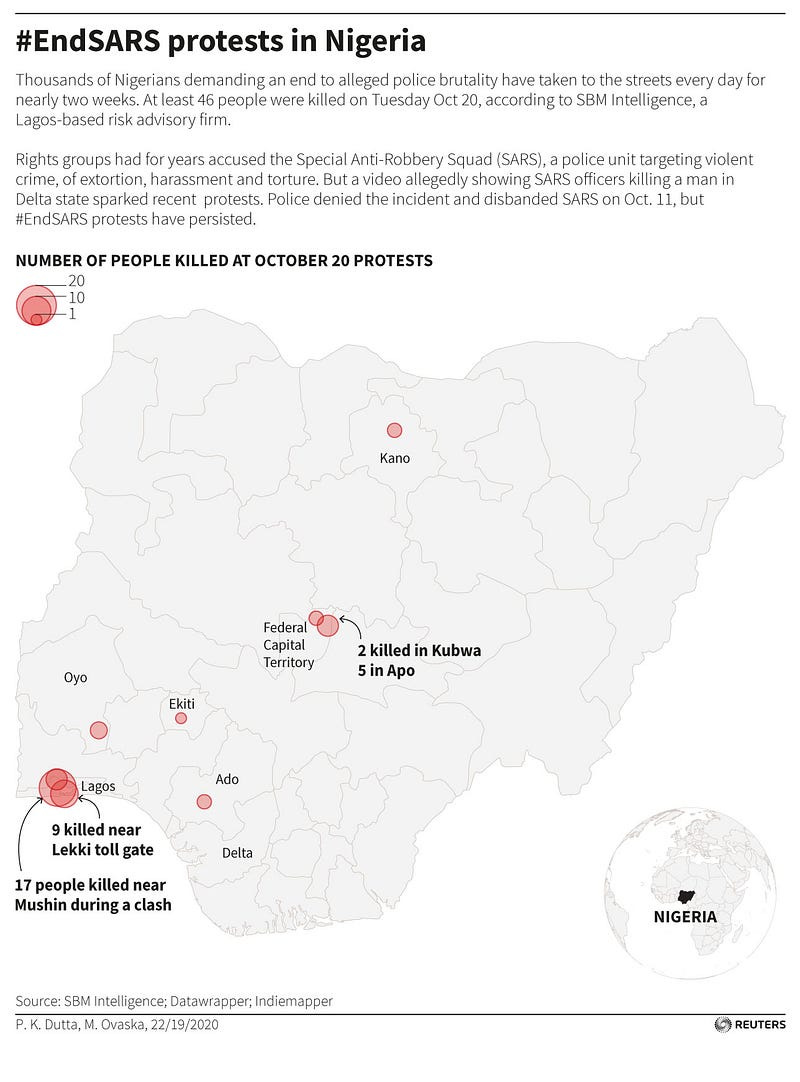
The primary reason the adjudication of state-sanctioned killings took an international dimension is due to the almost comical manner in which the Nigerian government tried to deny what people witnessed. The deployment of the military to the Lekki Toll Gate on the night of 20 October 2020 was evident to everyone who watched the live Instagram video of Nigerian Army soldiers from the 82nd Division shooting at unarmed protesters. Several investigations by media outlets such as Premium Times, the Foundation for Investigative Journalism, and CNN have uncovered evidence, as did the Lagos State Panel, confirming that the military was responsible for the killings. However, it would be naive to expect the Nigerian state, which has a history of committing atrocities in broad daylight, to acknowledge its atrocities. The significance of the Lekki Toll Gate Massacre, prompting denials from the government and the military, lies firstly in the location of the killings (Lekki, a prime real estate suburb for foreigners, including many Western diplomats and expatriates) and secondly in the international context of the protests, occurring just months after the Black Lives Matter protests in the US and the UK, two countries with sizeable Nigerian diasporas. International pressure on the government, which needed funds but wanted to maintain its stance, ensured that civil society organisations in Nigeria had the endurance to pursue this through the ECOWAS Court. However, the path forward, beyond internationalising these atrocities, does not paint a rosy picture regarding the respect for human rights. The state has continued to commit several other atrocities, notably the Okuama siege and massacre of March 2024. In Ghana’s Right to Information (RTI) law, information officers have 14 days to process requests and notify applicants of a grant or refusal of access. However, if the information is necessary to safeguard a person’s life or liberty, the request must be processed within 48 hours. Beyond the applicant’s decision to request $1.5 million in compensation, the primary concern has been the inability to use Ghana’s RTI law to access information, despite the existence of a 2009 UN/ECOWAS investigation report on the alleged detention and enforced disappearance of Peter Mensah and others. After the case dragged on for more than three years, the court ruled that Ghana had failed to release the report to Isaac Mensah, highlighting why many Ghanaians believe Ghana’s RTI system has not fulfilled its purpose, especially regarding freedom and human rights. The court ruling indicated that the Republic of Ghana breached Isaac Mensah’s right to information, contrary to Article 9(1) of the African Charter and Article 19(2) of the ICCPR. In fact, the current ruling means the ball is now in Ghana’s court, and international human rights organisations will be closely monitoring Ghana’s compliance with its domestic RTI law following the ruling, which mandates that Isaac Mensah be furnished with all relevant documents concerning his father’s death in The Gambia.