
A note on the insurgency
Jihadists have killed at least 37 fishermen in Borno State, militia sources and a local told AFP on Thursday. On Wednesday evening, three…

Jihadists have killed at least 37 fishermen in Borno State, militia sources and a local told AFP on Thursday. On Wednesday evening, three sources said a dozen fighters believed to be with Boko Haram opened fire on some fishermen outside Guggo village. “We have recovered 37 bodies last night along the river bank and nearby bushes,” militia leader Babakura Kolo told the news agency. “The figure is not exhaustive, and search for more bodies is ongoing in surrounding bushes,” Kolo said. The fishermen were sorting out their catch on the riverbank when they were ambushed.
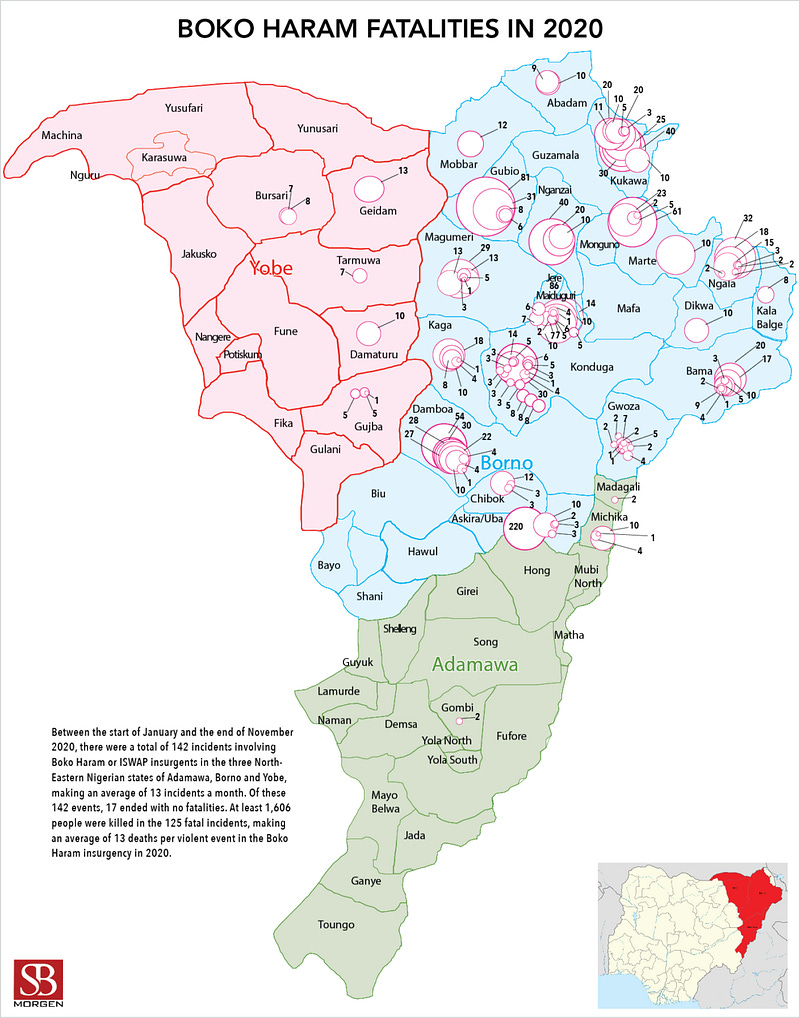
For Boko Haram, this action is very much part of what it has done effectively over the past decade: seek scapegoats, often civilians, during downtimes. The group has a well-documented history of targeting and killing ordinary people in droves. Over the past few years, farmers, fishers and loggers have comprised a sizable portion of that demographic. A similar incident occurred in late November 2020 when 81 farmers were murdered at a rice plantation in Kwashabe village, about 20 kilometres north of Maiduguri, in what is now known as the Zabamari Massacre. The military’s explanation for that event was that the farmers did not seek government permission before visiting the farms, given how highly volatile most of the state was. A year later, the state governor Babagana Zulum embarked on a push to close Internally Displaced Persons (IDP) camps in the state and resettle displaced people in their towns of origin. This latest massacre has proved him wrong. Boko Haram’s targeting of farmers sits within the group’s well-known modus operandi of viewing civilians in occupied territory as potential spies for the Nigerian military. Murdering farmers, herders, loggers and fishermen also kills off competition in the places whose economic activities they seek to monopolise. The faction responsible for this attack is yet to be ascertained. However, if the Islamic State carried this out, the most obvious explanation is that sustained pressure by the military is increasingly making the group desperate, making them abandon their long-held strategy of winning hearts and minds by protecting would-be victims from the excesses of both the Nigerian military and ISWAP’s rival, the old JAS faction of Boko Haram. The risk of wider regional contagion persists. The jihadist wave led by organisations like Boko Haram and ISWAP is increasingly being felt in relatively wealthier coastal parts of West Africa from the drier and poorer Sahel. Regional economic and security cooperation either through ECOWAS or ECOMOG should be deepened to counter these malign transboundary elements.