
A pre-election crackdown
A court has jailed protesters, sparking opposition outrage ahead of Ivory Coast’s election. The unrest stems from barred opposition candidates.

The Ivory Coast’s political climate is growing increasingly tense as a court sentenced 32 people to three years in prison for participating in a banned protest earlier this month, just days before the 25 October presidential election. The protesters were convicted of disturbing public order and blocking roads—charges similar to those levelled against 30 others last week. Authorities have arrested more than 700 people nationwide, accusing some demonstrators of engaging in “acts of terrorism.” Opposition groups have condemned the verdict as politically motivated, vowing to appeal. The crackdown follows violent clashes that left three people dead and the torching of an electoral commission office in Yamoussoukro. The unrest stems from the exclusion of key opposition figures, Laurent Gbagbo and Tidjane Thiam, from the ballot. Meanwhile, Thiam, now a businessman, faces a separate defamation lawsuit filed by Benjamin Mauerberger over alleged links to scam operations, adding another layer of intrigue to the pre-election turmoil.
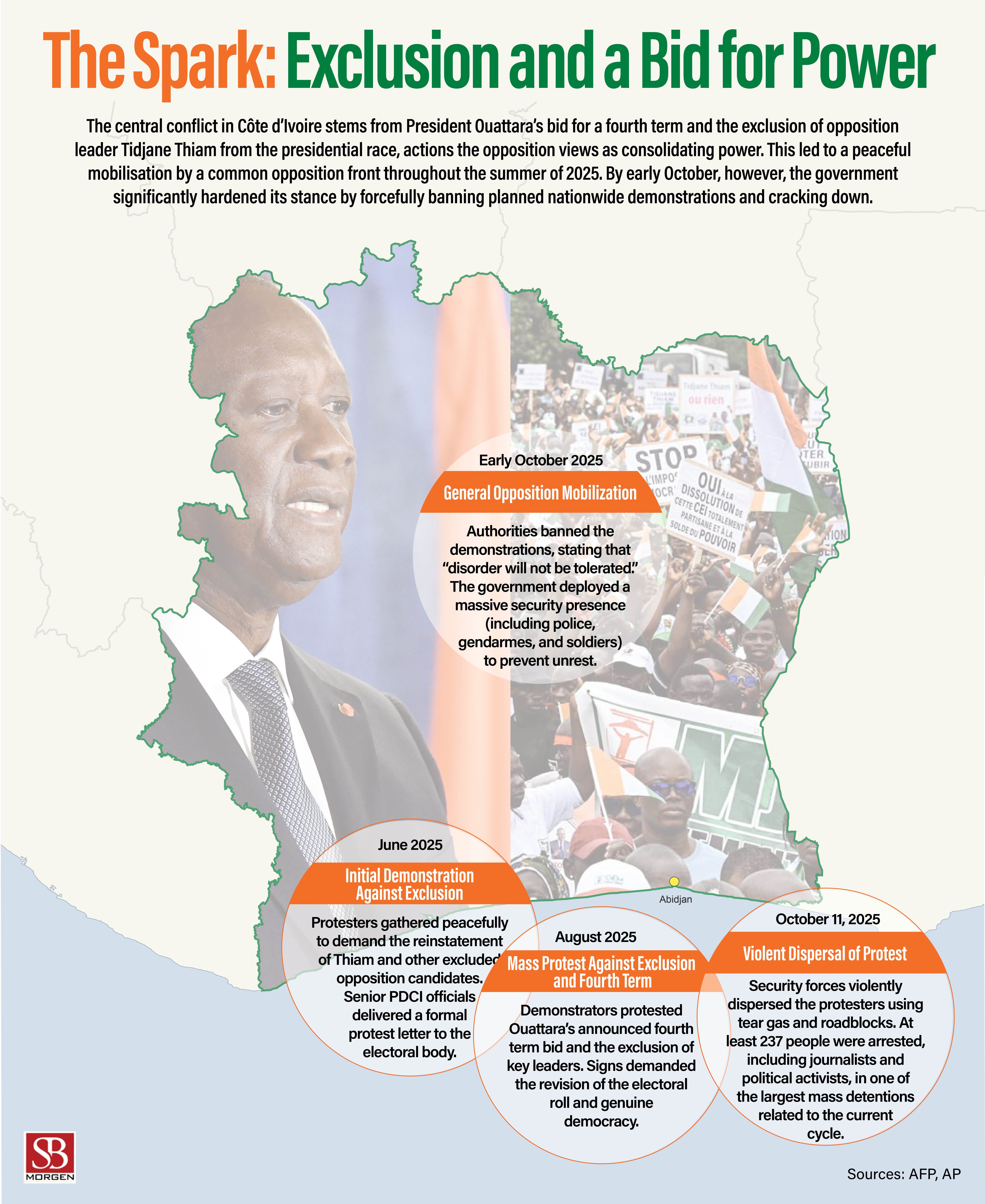
The Ivory Coast stands at a dangerous crossroads ahead of this weekend’s presidential election, with mounting political tension, systemic repression, and regional spillover risks threatening to unravel more than a decade of fragile stability. The government’s aggressive pre-election clampdown—marked by the exclusion of opposition figures, bans on public protests, and mass arrests—has been severe. The recent sentencing of 32 protesters to three years in prison, following similar convictions the week prior, illustrates how the state has weaponised the judiciary to silence dissent.
This strategy sends the electorate a message of intimidation and repression, intended to shrink the opposition spaces and disrupt their voters. The underlying intention is not to ensure peace but to grab power and hold on to it. This strategy follows the clear playbook of a classical authoritarian regime, starting with legalistic repression, which uses court rulings and selective prosecution to shut people up. If this fails, the regime transitions to aggressive policing and preemptive arrests, escalating the situation.
The pattern reflects a judiciary and security apparatus functioning as enforcers of regime stability rather than arbiters of justice. In cities such as Abidjan and Yamoussoukro, violent clashes signal rising public anger and a deep erosion of trust in institutions. Youth unemployment hovering near 70% and prolonged economic disenfranchisement add combustible energy to an already volatile environment. These flashpoints echo past crises—notably the 2010 election that claimed 3,000 lives, making the prospect of post-election violence highly plausible.
The consequences extend beyond politics. As the world’s largest cocoa producer, the Ivory Coast’s instability carries direct global implications, with potential disruptions to cocoa and coffee supply chains already unsettling markets. Neighbouring Ghana has already reported the arrival of over 1,500 Ivorian refugees, prompting tighter border surveillance.
President Alassane Ouattara’s insistence on seeking a fourth term at 83, following constitutional changes that removed term limits, has reinforced perceptions of an entrenched, ageing leadership unwilling to yield space for political renewal. Regional bodies such as ECOWAS and the African Union remain conspicuously muted, a silence that echoes past failures to intervene decisively before crises spiral. Ultimately, the country’s immediate future hinges on restraint and restoring confidence in democratic institutions that have been systematically weakened. If Ouattara proceeds with a heavily disputed election under current conditions, any victory may prove pyrrhic.