
A win among losses
The Nigerian Air Force’s Operation Whirl Punch conducted an air strike, eliminating scores of terrorists, including Yellow Jambros, a…

The Nigerian Air Force’s Operation Whirl Punch conducted an air strike, eliminating scores of terrorists, including Yellow Jambros, a notorious kidnap kingpin, in Niger State’s Shiroro LGA. The terrorists were targeted while crossing the Jikudna River towards Chikun LGA in neighbouring Kaduna State. In a separate incident, Nigerian senators donated ₦109 million (one-month salaries) to victims of the 3 December military drone mishap in Kaduna State. The drone operation killed 85 civilians gathered for a religious celebration in the community of Tudun Biri, Igabi LGA. Sen. Barau Jibrin, the Deputy Senate President, led a Senate delegation to commiserate with the state government and the people.
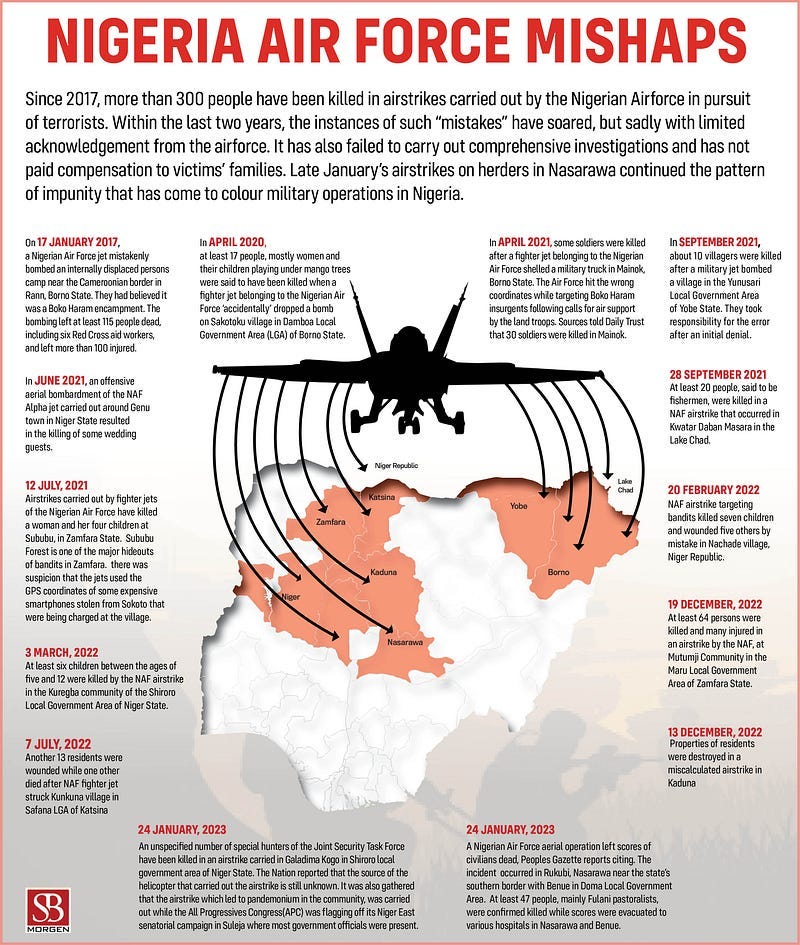
In the wake of the Kaduna bombing, the political response has highlighted a troubling reality in Nigerian society: a culture of impunity and lack of accountability among the political elite. Ever since the bombing two weeks ago, the best the military has done is to acknowledge that they carried out the strike. Since then, all talks and actions about compensation for the victims have been driven by the political class, who now fall over themselves to make pledges. This sends one key message to the security services: you are free to mess up because we will always be there to clean up after you. The army―responsible for this latest strike―is the most funded of all the security agencies in the country, with its budgetary allocation consistently taking the largest chunk of the national budget since 2013. Mandating compensation payments by the commander-in-chief can achieve two goals: first, it can establish a previously absent sense of institutional accountability, and second, it can ensure tangible financial consequences for settlements, serving as a deterrent against future misconduct. Without such decisive action, the planned investigation would likely yield inconsequential results even if it miraculously occurs and remains shrouded in secrecy. It is that outcome we fear. If there is no public revelation of the results of such an investigation and a reckoning for the guilty parties, things will continue as “normal”. On the other hand, it is good to see notorious figures like Yellow Jambros taken off the streets, if indeed he was, but this won’t solve Nigeria’s insecurity problem. The country needs a comprehensive strategy combining ground operations and institutional solutions. The government must tackle the root causes of insecurity, not just the symptoms. The alarming rise in kidnappings and extortion of farmers underscores the urgency for a comprehensive strategy beyond bombs. Combining air strikes with effective ground operations is crucial. Historical examples like successful campaigns in regions facing similar threats demonstrate the effectiveness of a multifaceted approach. Intelligence coordination, community engagement and cross-border collaboration have proven vital in disrupting terrorist networks. Strategies incorporating both military and socio-economic components have demonstrably reduced the appeal of extremism. Strengthening border security and fostering cooperation between neighbouring countries, like those in the Sahel region, have been critical in preventing the movement of terrorists. Nigeria needs to pursue these avenues actively with its neighbours. Instead of mopping up a flooded house with handkerchiefs, we must shut off the tap. We need to address the root causes of extremism through development initiatives that invest in education, job creation, irrigation to combat desertification, and poverty alleviation. This is a complex battle, and a one-dimensional approach won’t work. By fighting on multiple fronts―securing the sky, grounding the terror, and addressing the underlying issues―Nigeria can build a brighter future for its northern communities, one free from the grip of fear and violence.