
A win for the majority
Ghana’s Supreme Court ruled that Speaker Alban Bagbin’s declaration of four parliamentary seats as vacant was unconstitutional. NPP caucus…

Ghana’s Supreme Court ruled that Speaker Alban Bagbin’s declaration of four parliamentary seats as vacant was unconstitutional. NPP caucus leader Alexander Afenyo-Markin had appealed the decision, arguing that Bagbin’s move to declare seats vacant — after two NPP lawmakers, one National Democratic Congress lawmaker, and one NPP-aligned member registered for the 7 December election as independents or with the NPP — was unlawful. Chief Justice Gertrude Torkornoo announced the 5:2 majority ruling in favour of Afenyo-Markin, allowing parliament to resume normal operations. Parliament is now expected to approve a $250 million World Bank loan to support the financial sector and provide tax relief to businesses.
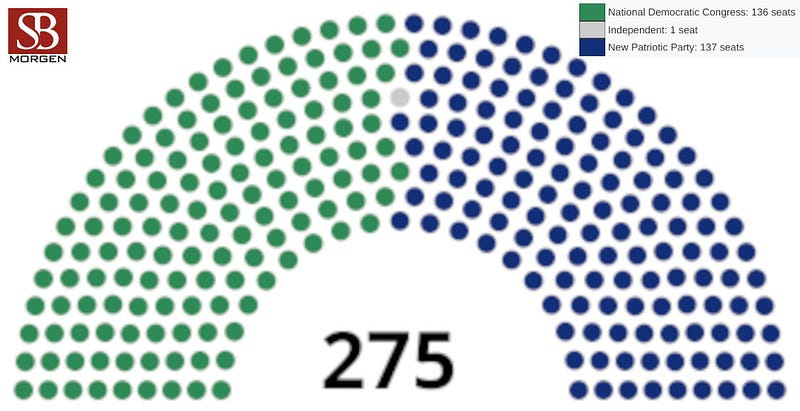
Ghana’s democracy has recently been tested on fundamental principles of the rule of law, separation of powers, and checks and balances, with the country’s Supreme Court playing a central role. This scrutiny peaked following a parliamentary directive by the Speaker of Parliament, which declared four parliamentary seats vacant. This move temporarily altered the balance of power in Ghana’s Parliament, giving the opposition National Democratic Congress (NDC) a slim majority and relegating the ruling New Patriotic Party (NPP) to a minority position. The apex court, however, ruled in a 5–2 decision that the Speaker’s directive was unconstitutional, effectively overturning the NDC’s short-lived majority status. This ruling has restored the previous composition, with the NPP as the majority party. In light of the court’s decision, the Speaker has suspended Ghana’s Parliament due to the ruling NPP’s series of boycotts, which have prevented the body from reaching a quorum to conduct business. Despite the Supreme Court’s clear ruling, some NDC Members of Parliament have expressed their intention to defy the decision and continue asserting their “majority” status, while the NPP is pushing for the Speaker to recall the House in compliance with the Supreme Court’s judgement. This standoff has significant implications for governance in Ghana, as the suspension of parliamentary activity has stalled government business, highlighting the political stakes involved as the country approaches its 7 December elections. Both parties recognise the political capital to be gained or lost in this high-stakes situation, with citizens and stakeholders watching the move closely.