
Accra swims against the tide
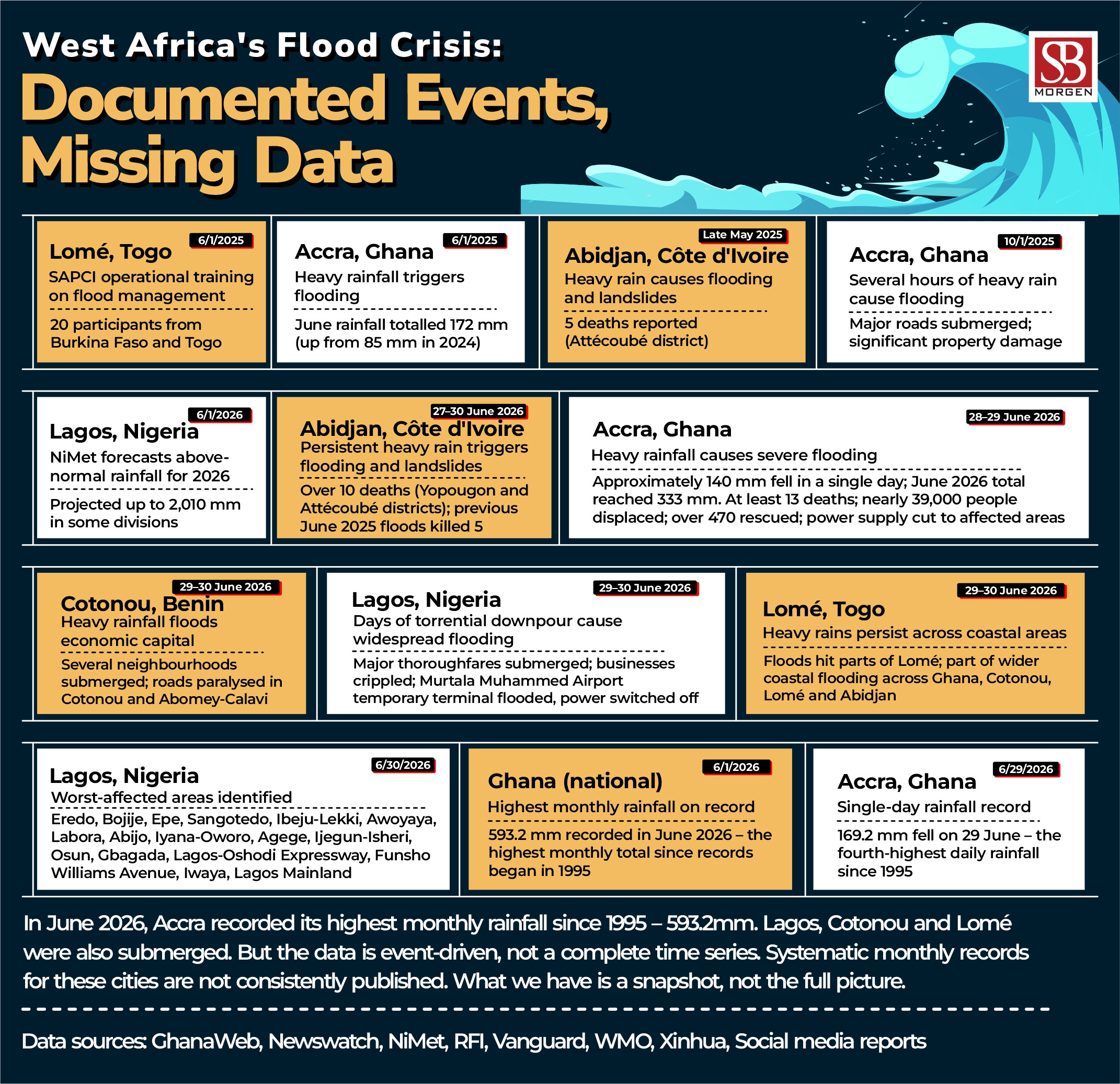
Ghana's record June rainfall of 593.2mm has killed 12 people and triggered devastating floods

Ghana is grappling with devastating floods after recording a historic 593.2mm of rainfall in June 2026, the highest monthly total on record. The flooding has killed at least 12 people, with authorities warning the toll could rise as search and rescue operations continue. Nearly 500 people have been rescued, while major roads, schools and businesses across the Greater Accra Region have been severely disrupted. In response, the Ghana Institution of Engineering has proposed a 19-point plan, including improved drainage, restoration of waste collection services, stricter enforcement of sanitation laws and nature-based flood management measures to strengthen the country’s resilience against future disasters.
Buried underneath the rainfall records is a far more damning number: only $137 million of the $350 million GARID flood-control project had actually been disbursed by mid-April, and for sixteen months straight, between November 2024 and March 2026, almost nothing moved at all. The World Bank has since marked the project “Moderately Unsatisfactory” and said so plainly, blaming Ghana’s own Finance Ministry for choking the account with disbursement ceilings and even for sweeping GH₵13.8 million from it. The early warning system that this money was meant to build never went live. So when the skies opened on June 29, nobody in Accra got a warning worth acting on. Ghana didn’t lack the money to prevent this. It sat on the money.
That’s really the whole story of Accra’s flooding, told over and over for a decade. GARID followed the Korle Lagoon Ecological Restoration Project, which followed the Odaw drainage works, each one funded, each one partially built, none of them finishing the job. Dredging on the Odaw has been “40 percent done” for what feels like years. 20 years of this have cost Ghana something like $1.7 billion in flood damage, a bill that dwarfs what proper execution of any single one of these projects would have needed. This isn’t a poor country failing to raise money for infrastructure. It’s institutions that get the money, then can’t get it to the ground.
Zoom out, and Accra’s problem is West Africa’s problem. Lagos eats roughly $4 billion a year in flood losses from the identical mix of blocked drains, swallowed wetlands and buildings that shouldn’t exist where they stand, and Nigeria’s own hydrological agency now ranks Lagos as its single riskiest city heading into this rainy season. Mahama’s answer, floated straight after his aerial tour of the wreckage, is a twenty-year plan to build a new administrative city and move government departments out of Accra entirely. It’s the same instinct Lagos has flirted with for years without ever quite doing it, and it conveniently sidesteps the harder, cheaper, faster fix: finish the drains that are already funded. The engineers said as much themselves, bluntly, in their 19-point statement: Ghana doesn’t have a knowledge problem.
What it has is a blame problem. The main opposition party, the NPP, is accusing the government of “fiddling with anti-flood interventions.” The government’s people are crediting the last administration with laying the groundwork that nobody finished. Mahama himself pointed at citizens dumping rubbish in gutters, which is true and conveniently not his ministry’s fault. This exact argument played out after 2015, after 2023, and it will play out again next June unless someone in the Finance Ministry stops treating ring-fenced resilience cash as a rainy-day slush fund to be raided whenever the budget gets tight. Until that changes, price Accra’s flood risk the way you would price a recurring cost, not a one-off shock, because that is what the last decade says it is.