
African headlines form a global mixing bowl
Somalis protested Israeli recognition of Somaliland as Botswana courted Russia, Ethiopia restructured debt, and China's foreign minister toured Africa.

In Somalia, thousands of protesters took to the streets in cities including Baaydhabo, Laascaanood, Hobyo, and Guriceel after Israel announced it would recognise Somaliland as an independent state. Demonstrators waved Somali flags and chanted unity slogans, describing the move as a violation of Somalia’s sovereignty and international law. Protesters said the decision undermines the country’s territorial integrity and risks encouraging foreign interference. Elsewhere, Botswana announced plans to open an embassy in Moscow and invited Russian investors to explore opportunities in rare earths and diamonds. Foreign Minister Phenyo Butale said Botswana’s political stability made it an attractive destination for investment. Separately, Ethiopia said it had reached a preliminary agreement with some holders of its $1 billion 2024 international bond, a key step in its debt restructuring efforts. Meanwhile, China’s foreign minister Wang Yi began his annual New Year tour of Africa, visiting Ethiopia, Somalia, Tanzania, and Lesotho, as Beijing seeks to strengthen trade access, secure shipping routes, and deepen resource partnerships across eastern and southern Africa.
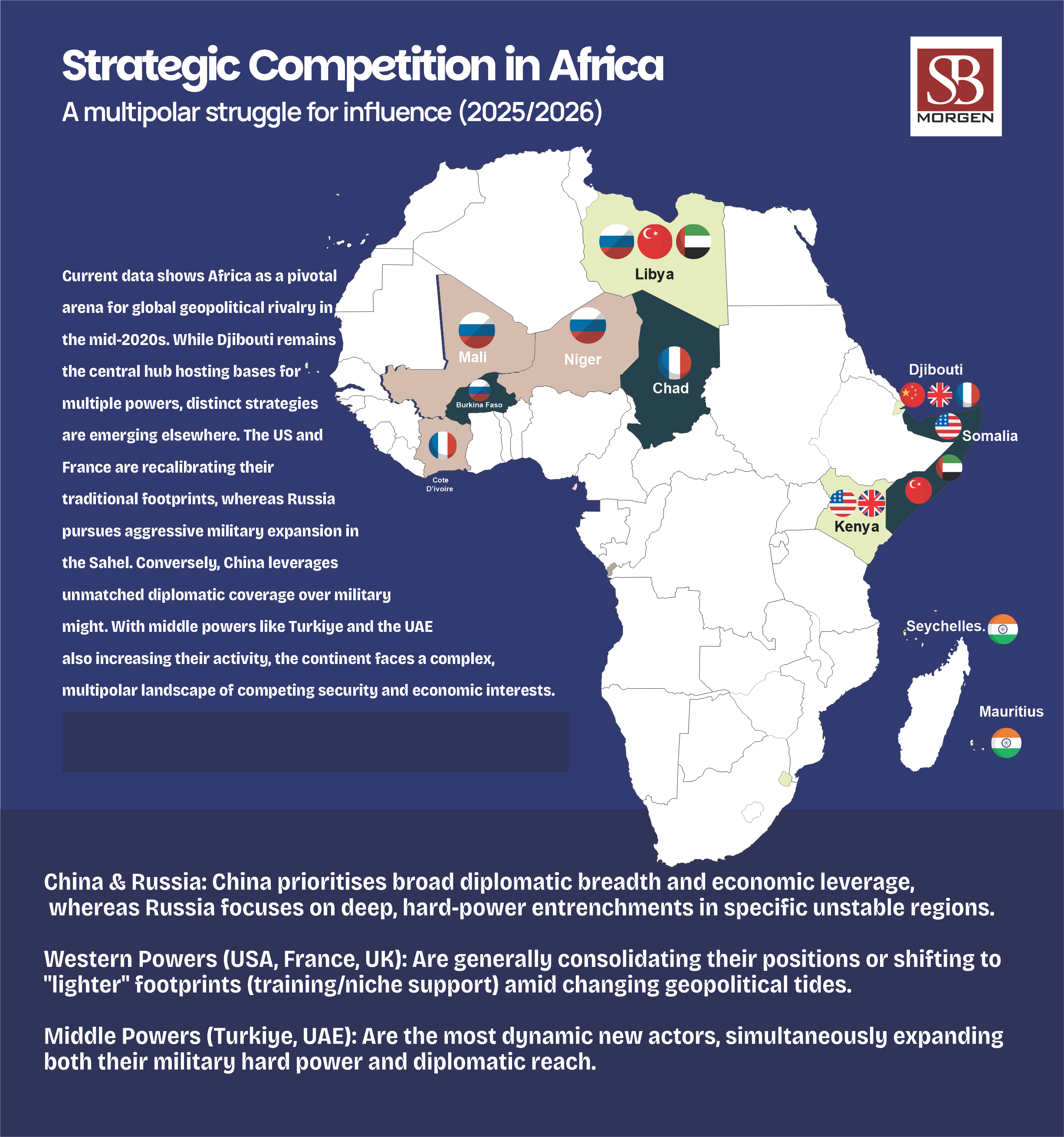
Africa’s current political landscape is shaped less by a single crisis than by a convergence of pressures exposing how deeply the continent is entangled in global power competition. From street protests in Somalia to diplomatic recalibration in Botswana, the common thread is one of constrained agency. African states are asserting their interests, yet they are doing so within an increasingly crowded and contested international system where external decisions frequently carry outsized domestic consequences.
This dynamic is starkly illustrated by the protests that erupted across Somali cities following Israel’s announcement that it would recognise Somaliland. For Mogadishu, this move is framed as an existential threat to territorial integrity rather than a mere diplomatic slight. Public anger reflects a rare moment of national consensus in a country where unity remains the core political currency after decades of state collapse. However, this reaction masks a more complex reality. Support for independence within Somaliland has long been overwhelming, anchored by the 2001 referendum in which 97 percent voted for separation and reinforced by relatively orderly elections in 2024 with a turnout of roughly 65 percent. The absence of fresh nationwide polling in 2025 or 2026 reflects Somalia’s enduring instability, leaving both sides to rely on historical data and assumptions that may no longer fully reflect evolving public sentiment.
Israel’s decision to move ahead of the broader Western consensus reflects hard security calculations rather than a concern for African political sensitivities. Recognition offers Tel Aviv quicker access to strategic assets such as the Berbera port, strengthening its ability to monitor Red Sea traffic and counter the Iranian and Houthi activity that has disrupted maritime trade since October 2023. This unilateral approach bypasses African Union norms on territorial integrity, which have historically constrained the United States and other partners wary of setting precedents for secession. While the move secures immediate strategic gains for Israel, it heightens the risk of unrest in Somalia and exposes the limited enforcement capacity of a federal government that lacks control over Somaliland’s borders.
China’s response to these events highlights how global rivalries intersect with African disputes. Beijing publicly opposed the recognition in late December 2025, framing it as support for separatism and linking the issue to its sensitivities regarding Taiwan. This stance reinforces China’s broader narrative of sovereignty and non-interference, even as it deepens its economic footprint across the continent. This strategy was evident during Foreign Minister Wang Yi’s annual Africa tour, where the selection of Ethiopia, Somalia, Tanzania and Lesotho reflected a deliberate focus on trade corridors and resource access.
Beijing’s approach remains systematic, blending diplomacy, infrastructure, trade and security in a way that contrasts with the often reactive posture of Western actors. In Tanzania, Chinese firms are advancing copper extraction at Kabanga to feed electric vehicle supply chains. In Ethiopia, Beijing prioritises rail infrastructure, including the Addis–Djibouti corridor, to lower export costs for commodities such as coffee under new trade arrangements. In Somalia, port upgrades at Berbera align with efforts to secure Red Sea shipping routes, while in Lesotho, textile investments expand manufacturing capacity but deepen dependence on Chinese machinery and inputs. These engagements demonstrate how economic leverage is built incrementally, tying fiscal and policy space to external financing in ways that leave limited room for alternative partners.
Elsewhere, African states are responding with strategic diversification rather than alignment. Botswana’s decision to open an embassy in Moscow and court Russian investment in diamonds and rare earths signals confidence rather than ideological drift. Long viewed as a stable Western partner, Gaborone is leveraging its governance credentials to widen diplomatic options in a world where critical minerals confer bargaining power. Stability, in this context, underpins leverage rather than loyalty.
A parallel reality is visible in Ethiopia’s tentative progress with holders of its 2024 Eurobond. Debt restructuring has become a political necessity rather than a purely technical exercise, as the government balances domestic pressures with negotiations with fragmented, geopolitically motivated creditors. Addis Ababa’s limited progress underscores both the possibilities and frustrations of a debt architecture in which relief is slow and conditional, and in which restoring investor confidence is inseparable from regaining policy autonomy.
Taken together, these developments reveal an Africa that is neither passive nor unified, but increasingly consequential in global competition. Protests, embassy openings, debt negotiations and diplomatic tours are all expressions of how multipolar rivalry is playing out on African soil. The central challenge for the continent is not engagement itself, which is unavoidable, but ensuring that sovereignty, economic resilience, and long-term development are not compromised as it navigates a world where power is diffuse and interests are rarely aligned.