
All out for Thiam
Tidjane Thiam's supporters protested in Ivory Coast, demanding his reinstatement on the presidential election list after his disqualification.

Thousands of supporters of opposition leader Tidjane Thiam protested in Abidjan, Ivory Coast, demanding his reinstatement on the October presidential election list. Thiam, a former Credit Suisse CEO and head of the Democratic Party of Ivory Coast (PDCI), was barred by the electoral commission on June 4 due to his former dual Ivorian-French nationality, despite having renounced his French citizenship in March. Protesters, clad in PDCI colours, accused the judiciary of bias, chanting slogans like “Corrupt justice” and “Thithi president.” Senior PDCI figures submitted a formal letter to the commission calling for the reinstatement of Thiam and three other excluded candidates.
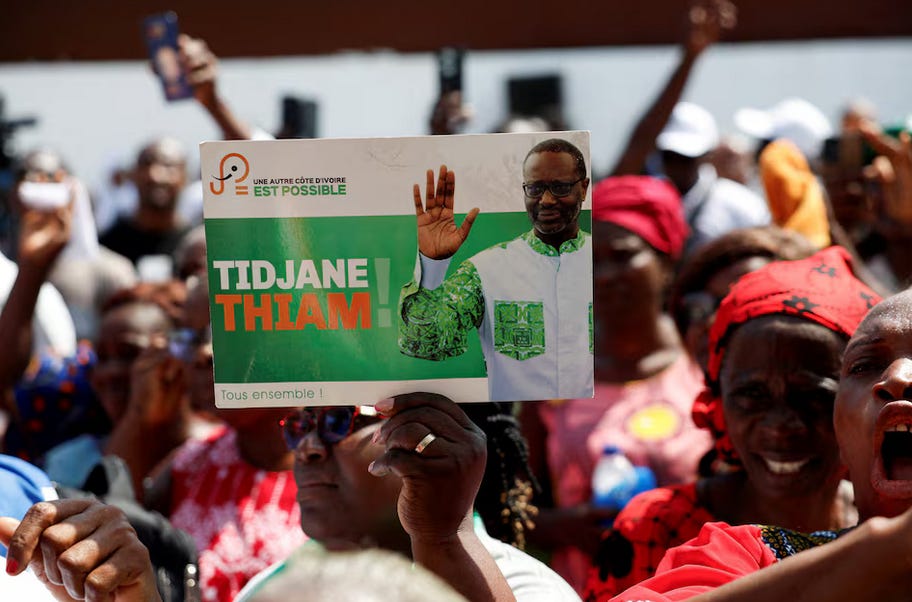
Last weekend, supporters of opposition leader Tidjane Thiam protested in Abidjan following the release of Ivory Coast’s final electoral list, which excluded him from the October presidential election. The government, however, has remained resolute, backing the electoral commission’s decision, which is grounded in a 1961 citizenship law. Thiam’s disqualification, due to his former dual Ivorian-French nationality, ironically echoes the barring of the current president, Alassane Ouattara, on similar grounds in the early 2000s. Today, Ouattara is rumoured to be seeking a controversial fourth term, despite constitutional term limits.
With key challengers like Thiam, Laurent Gbagbo, and Guillaume Soro all sidelined, the political landscape appears increasingly uncompetitive, fuelling concerns that the ruling RHDP party is consolidating power and edging the nation towards de facto one-party rule. Public frustration is growing, particularly among young voters, and memories of the 2010–2011 post-election violence that left 3,000 dead have stoked fears of renewed unrest. The government’s dismissal of the recent protests as mere “disorder” has only deepened this sense of alienation.
This trend of democratic backsliding has occurred despite a veneer of stability. Freedom House’s 2024 report rated Ivory Coast as “Partly Free,” noting that while multiparty elections have taken place, fundamental rights remain constrained by restrictions on assembly and harsh penalties for unauthorised protests. International concern has been muted, largely because the country’s strong economic performance has masked the erosion of its civic space. Internally, the RHDP itself faces simmering tensions over President Ouattara’s continued dominance and the unresolved issue of his succession, a problem starkly exposed by the death of his presumed heir in 2020. Nevertheless, with 139 parliamentary seats and access to state resources, the ruling party remains firmly in control.
Given this context, it is unlikely that the protests will succeed in reversing Thiam’s disqualification. The judiciary has delivered a final verdict with no domestic avenue for appeal, and the government has signalled its intent to suppress dissent with police blockades around key institutions. Thiam’s appeals to international bodies such as the UN and ECOWAS are progressing slowly and are unlikely to influence the electoral timeline, with regional actors reluctant to intervene for fear of triggering instability. While public demonstrations may keep Thiam’s candidacy in the spotlight, they risk escalating tensions without yielding concrete results.
The opposition Democratic Party of Côte d'Ivoire (PDCI) may ultimately be forced to pivot to an alternative candidate, such as Jean-Louis Billon. Yet with the opposition fragmented, mounting an effective challenge against the entrenched RHDP in October will be difficult. Ivory Coast’s political trajectory now hinges on whether its leadership can balance short-term, enforced stability with the longer-term imperative of democratic renewal. Without meaningful competition or institutional reform, the country risks a subtle but steady slide into authoritarianism.