
Alliances at odds
In Sudan’s North Darfur, a military transport plane with Russian crew members was reportedly shot down by the Rapid Support Forces (RSF)…

In Sudan’s North Darfur, a military transport plane with Russian crew members was reportedly shot down by the Rapid Support Forces (RSF) while resupplying the besieged city of al-Fashir. Social media and tracking data suggest the plane, previously supplying the RSF, switched to the army months ago. Evidence from Reuters indicates at least one Russian crew member had ties to arms trafficking. RSF shared images of documents identifying two Russians and three Sudanese soldiers on board. Meanwhile, Chad reported an attack by Boko Haram on a military base in the Lake region, resulting in around 40 soldiers killed.
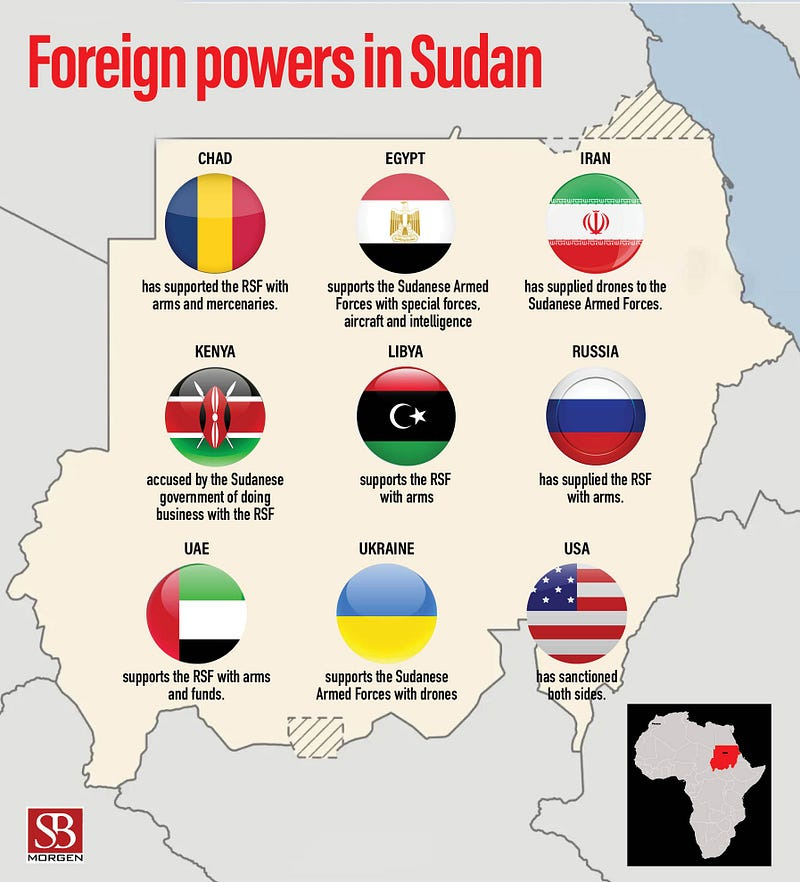
The plane crash in Sudan’s North Darfur State, reportedly downed by the RSF, underscores the ongoing volatility in Sudan and the heavy involvement of international actors, including Russian operatives with ties to arms trafficking. This incident further complicates the power struggle between Sudan’s army and the RSF, with each faction vying for control amid resource scarcity and ongoing conflict, especially in strategically important regions like al-Fashir. This is Russia’s first direct hit in the Sudan civil war, and also the first casualty since it switched support to the Sudanese Armed Forces. The Ilyushin Il-76 plane originally from Kyrgyzstan, with documents connecting it to the UAE, went down on 21 October after being shot at by Sudanese paramilitary forces in the west of the country. It was found to contain a Russian passport and IDs of ‘foreign mercenaries,’ as filmed by Sudan’s paramilitary Rapid Support Forces (RSF). The situation is more complicated than is being seen. Russia’s role, including its provision of skilled personnel with arms-trade backgrounds, highlights the layered foreign involvement in Sudan’s internal conflict and the shifting alliances impacting regional stability. Officially, the Russian government is allied with Sudan’s Armed Forces, a switch it made in the past year to secure a naval base in Sudan’s portion of the Red Sea. However, Wagner Forces, now under the direct control of the Russian defence ministry, is still allied with the RSF, and as such, the downing of the plane appears to be a friendly fire. This is more likely, considering the statement by the Russian embassy in Sudan that it is investigating the incident. Given how protracted the war in Sudan is, this incident indicates that Russia can no longer afford to play both sides–a posture it likely took given that despite its official support for the SAF, the Kremlin is unsure of the outcome but would like to see its strategic interests secure either way. However, the consequences are not likely to be domiciled in Sudan alone or in Darfur which is close to the border with Chad. The latter country continues to struggle with regime change seeking armed groups in the North and Islamist groups in the south of its border with Nigeria. This week’s attack may very well have been carried out by the Islamic State West Africa Province whose activities in recent weeks have been heavily concentrated in the Lake Chad Islands. The attack was possible because ever since then-President Idris Deby Sr oversaw a clearance operation in April 2021 that killed at least 1000 Boko Haram militants, the security services have not done much in that regard. Much of its attention has been focused on securing the survival of Mahmat Kaka Deby’s reign against opposition forces breathing down on the capital. Furthermore, the vital cross-border counterterrorism effort between Nigeria and Chad barely exists since the older Deby pulled his country out of the Multinational Joint Taskforce after that operation, giving ISWAP enough room to stage such a comeback. The exit of U.S. troops, who provided critical support through intelligence, logistics and training, leaves Chad’s forces with diminished resources to confront insurgent threats. This gap not only hampers Chad’s immediate response capability but also weakens regional counterinsurgency cooperation, potentially emboldening extremist groups like Boko Haram. Attacks of this nature signal the urgent need for Chad to urgently seek alternative partnerships to reinforce its defences and sustain stability within the volatile Sahel region.