
Ambushed
Islamist militants attacked a Nigerian army base in Borno, killing five soldiers, capturing others and ammunition before troops counter-attacked and retook it.

Islamist militants attacked a Nigerian army base in Borno’s Marte district, capturing soldiers and ammunition. The militants, arriving on motorbikes and gun trucks, laid siege to the 153 Task Force Battalion base around 0200 GMT. Nigerian troops retreated to a nearby base in Dikwa, regrouped, and launched a counter-attack that successfully retook the base. Five soldiers were confirmed dead, and others were reported missing. The militants also destroyed anti-mine vehicles. The attack, lasting about an hour, caught the base by surprise, with several soldiers still unidentified among the casualties. The fallen soldiers were reported to be within the ranks of private and lance corporal.
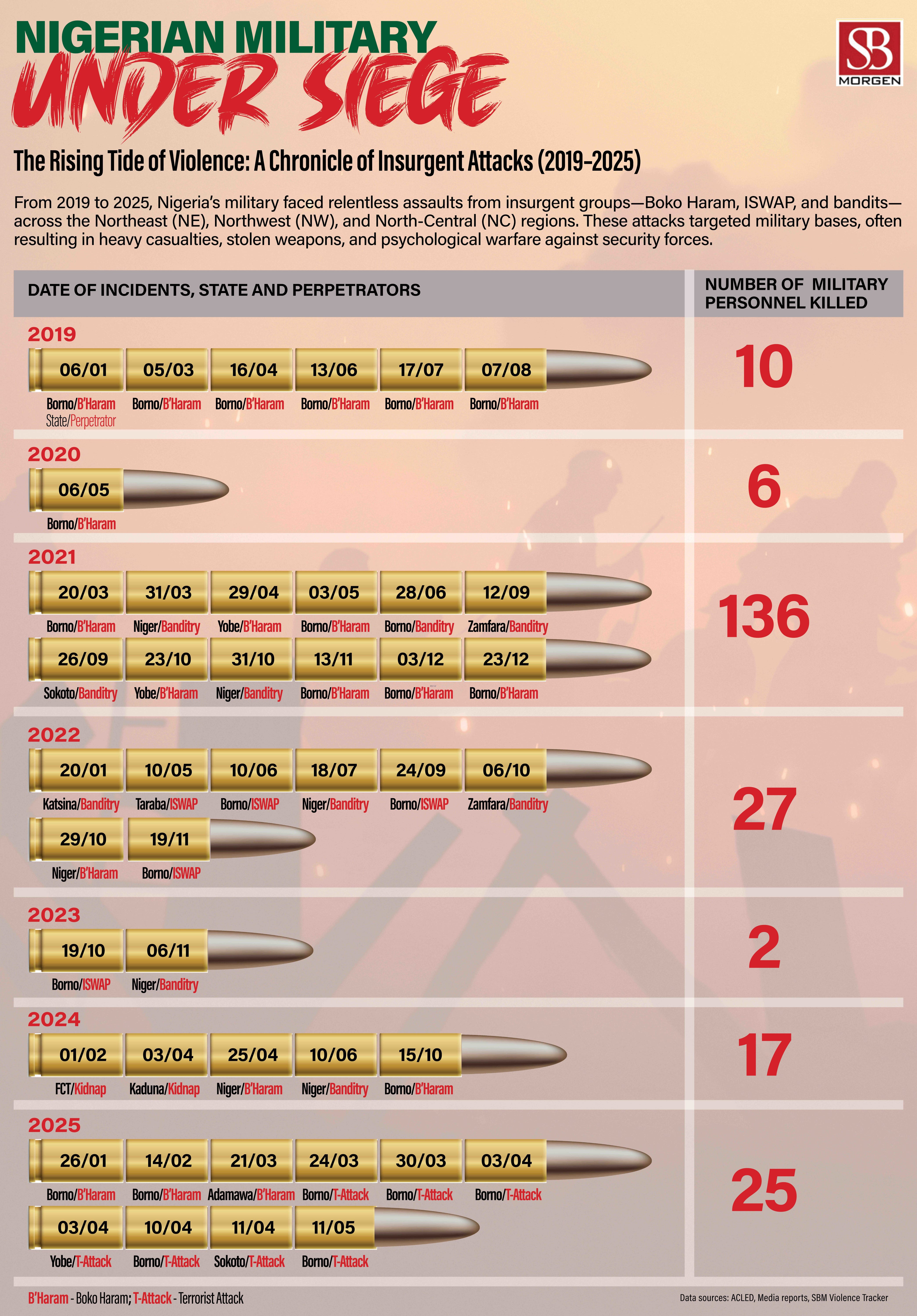
The recent attack by Islamist militants on the Nigerian Army's 153 Task Force Battalion base in Marte, Borno State, underscores the persistent and evolving threat posed by jihadist insurgents in Nigeria's northeast. This deadly operation, executed in the early hours and catching troops off guard, raises serious questions about the effectiveness of current intelligence gathering, surveillance capabilities, and the overall preparedness of soldiers stationed in this highly volatile region. The loss of life, particularly among junior ranks, further highlights the human cost of this enduring conflict.
This incident in Marte is not an isolated anomaly but rather a symptom of a larger, systemic issue: Nigeria's apparent reliance on stagnant strategies in combating an insurgency that has now spanned nearly 15 years. Since the last public unveiling of a national security strategy in 2019, one of whose few bright spots was the significant reduction in piracy in the Gulf of Guinea through coordinated international partnerships and the Deep Blue Project, there has been no visible update or rethink. ISWAP, after internal clashes with Boko Haram in 2024, has demonstrably rebounded with refined tactics and increased aggression, leading to the dislodgement of military bases in various locations across northern and central Borno, including this recent attack in Marte – a setback reminiscent of a similar ISWAP assault in January 2021.
The frequency and audacity of these attacks suggest multiple strategic objectives. Firstly, there appears to be a renewed push towards the restoration of the caliphate lost by Boko Haram following the military's counteroffensive (2015-2017), a goal seemingly gaining traction as indicated by recent statements from key regional figures. Secondly, these attacks serve as a form of psychological warfare, deliberately aiming to erode the morale of both military personnel and the civilian population. The retreat of soldiers from Marte to Dikwa for reinforcements exemplifies this impact. Finally, these operations enhance ISWAP's standing as the dominant Islamic State faction not only within the Sahel but across Sub-Saharan Africa, a dangerous development for Nigeria's counterterrorism efforts, especially given the breakdown of regional security cooperation following political instability in Niger since 2023.
Analyses of this and previous attacks reveal ISWAP employing a dual strategy: conventional assaults on forward operating bases (FOBs) and unconventional warfare tactics including IEDs, ambushes, and the sabotage of critical infrastructure. These actions aim to destabilise the region, generate funds through ransoms, and fuel propaganda for recruitment and legitimacy.
Addressing this complex challenge requires a comprehensive and multi-layered approach. On the conventional front, FOBs must be significantly reinforced with robust infrastructure capable of withstanding indirect fire, incorporating high-perimeter walls and fortified defensive positions. Crucially, proactive and consistent patrolling beyond immediate perimeters is essential to deny insurgents operational space and reconnaissance opportunities. A robust intelligence, surveillance, and reconnaissance (ISR) network, integrating various technologies and human intelligence sources, is vital for understanding the operational environment and enemy movements. Furthermore, securing logistics and supply corridors and establishing dominance across surrounding territories are paramount. Achieving this necessitates substantial investment in the recruitment, comprehensive training, and improved welfare of troops – priorities that should supersede political manoeuvring.
The broader picture is even more sobering. The Marte attack is not an isolated event but a clear marker of a deteriorating security dilemma in the Lake Chad Basin. Despite official claims of victory, insurgency in Nigeria has evolved into a protracted conflict with shifting frontlines, fragmented militant factions, and a military that is overstretched and under-equipped. Militants continue to take advantage of weak governance, broken trust, and ungoverned spaces. Until the Nigerian state re-establishes consistent authority over these contested territories—not just through a military footprint but also by restoring governance, delivering services, and rebuilding public confidence—it will continue to lose ground. Militants will keep exploiting every gap, leaving a trail of grief, displacement, and instability behind them. The cost of doing nothing new is becoming too high to ignore.