
An ever-flowing tap
The Federal Government said the amount spent on subsidising petrol between 2005 and 2021 was ₦13 trillion. An economist has advised the…

The Federal Government said the amount spent on subsidising petrol between 2005 and 2021 was ₦13 trillion. An economist has advised the incoming administration to remove the petrol subsidy in phases to reduce the severe socio-economic effects on Nigerians. The Chartered Institute of Taxation of Nigeria (CITN) president, Adesina Adedayo, said that the government should be transparent about their financial decisions on the subsidy and focus on economic development rather than palliatives. On crude oil theft, Nigeria lost 619.7 million barrels of crude oil valued at $46.16 billion or ₦16.25 trillion between 2009 and 2020.
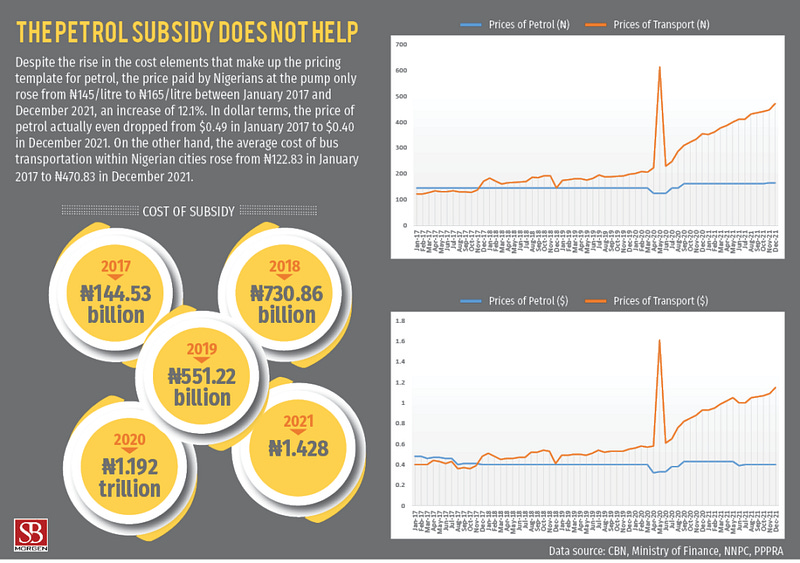
Nigeria’s subsidy programme has been a partially veiled slush fund for the Nigeria National Petroleum Corporation (NNPC), dating back to the institution of the Petroleum Subsidy Fund in 2006. Yet, justifications have been found to keep the cash-haemorrhaging policy. From the PDP days of blind stealing and mis-accounting to the Buhari era of conspiratorial silence, no one has been able to or willing to stop the NNPC from scooping freely out of the subsidy bounty. Between 2006 and 2015, for example, the company, in its old incarnation, paid itself ₦736.605 billion for importing petroleum products — diesel, kerosene and petrol — it refined locally. It also over-deducted ₦90.227 billion from the federation account for subsidy claims. During its famous 2014 audit, PwC said the NNPC reported lower figures to the Federal Accounts Allocation Committee (FAAC) on the exports it sold from the Domestic Crude Allocation (DCA). At that time, the corporation was refining around 100,000 barrels per day and swapping the remaining 345,000 for refined petrol, which it then claimed a subsidy on. In May 2016, the federal government announced that it had removed subsidies after the landing cost of importing petrol dropped below the artificial price ceiling of ₦145. By 2017, when global crude prices had gone back up, the government made no official announcement that subsidies had resumed, and only the NNPC was importing the product. With the return of subsidies came abuse. A key component of this chain was the crude swap mechanism, which the NNPC tweaked in 2016. Under the new deal, oil traders and, sometimes, governments lifted crude in exchange for refined petrol. Before then, the corporation would give oil to its traders and ask them to bring refined petroleum products to the country for the volume of oil given to them. The NNPC would then pay cash. Although it was not swapping up to its daily allotted 445,000 barrels per day (bpd) for oil, the corporation created another contract called the Extended Direct Sale Direct Purchase (EDSDP) through which it supplied extra volumes of oil to be swapped for refined products. Curiously, between January 2017 and June 2018, the corporation failed to swap up to 300,000 bpd for petrol. When it introduced the flush volumes, the corporation still failed to average up to 445,000 bpd. Somehow, the NNPC found a way to justify making subsidy charges on two fronts: first, direct withdrawals from the money it sends to the federation account, and second, withdrawals from a fund it created in 2018 — the National Fuel Support Fund (NFSF), which is sourced from the Nigeria Liquified Natural Gas (NLNG). Between July 2018 and October 2020, the corporation made these deductions without question or disturbance. One thing is clear: up to half of the subsidy spend and the oil theft numbers occurred within the last four years. The system is broken, and a complete reset is the only real solution. When we consider the opportunity cost of investment that could have been made with all these losses vis-a-vis the infrastructure, education and social deficits that plague Nigeria, it is doubly tragic. The country needs to move away from oil dependence, but this will not happen by frittering away or reducing current oil revenues. Instead, it will come from maintaining and growing current oil revenues while making the necessary investments to grow other industries and revenue sources even more rapidly. As it is not politically expedient, the incoming administration must bite the bullet of fuel subsidy removal early. It is the only way to avoid a fiscal disaster. When the subsidy account is ended, many wrongs need to be rewritten, and people need to be held accountable. We recognise it is a long checklist, but it is necessary.