
Atlantic tides
Nigeria and Brazil sign a bilateral air service agreement to launch direct flights, boosting trade, tourism, and investment between the two countries.

Nigeria and Brazil have signed a Bilateral Air Service Agreement (BASA) to establish direct flights between the two countries, marking a key step in strengthening bilateral relations. Signed by Nigeria’s Minister of Aviation, Festus Keyamo, and Brazil’s Minister of Transport, Silvio Costa Filho, the agreement aims to enhance trade, tourism, and investment through improved air connectivity. Designated Nigerian carriers—Air Peace and Caverton—may operate up to five weekly flights. The BASA forms part of President Bola Tinubu’s broader agenda to expand global partnerships and stimulate economic growth. Beyond aviation, the deal is expected to deepen cooperation in sectors such as agriculture, infrastructure, and cultural exchange.
The recent Bilateral Air Services Agreement (BASA) between Nigeria and Brazil marks a significant step in deepening South-South cooperation. Although framed as an aviation deal, its potential reaches far beyond air travel, as it is one of several accords covering trade, energy, science, and finance. For Nigeria, where international connectivity is shallow with just 38 airlines serving 56 airports across 30 countries, this agreement is a move towards strategic global integration.
Establishing direct flights between West Africa's largest economy and Latin America's biggest market could unlock underutilised trade corridors, cut transaction costs, and facilitate cultural, academic, and technological exchanges. For Air Peace, the Nigerian carrier designated to operate the Lagos–São Paulo route, the agreement presents both an opportunity to expand internationally and a challenge to maintain operational resilience on a long-haul route where many African airlines have struggled.
This focus on aviation and energy diplomacy highlights Nigeria’s ambition to reposition itself as a link between two of the Global South's largest democracies. Both Nigeria and Brazil are members of BRICS and share aspirations to reshape global economic governance. The timing is also geopolitically significant, coming at a time when both countries have seen a subtle cooling in their ties with Washington.
Enhanced ties with Brazil, particularly given its expertise in agro-industry and energy, could bolster Nigeria's own diversification goals. The recent call by President Bola Tinubu for Petrobras to resume operations in Nigeria further underscores Abuja's ambition to attract foreign investment and revitalise its energy sector. This pairing of air connectivity with investor outreach suggests a deliberate strategy aimed at more than symbolism; it’s about attracting capital inflows, technology transfer, and market diversification.
Despite the promise, the gap between policy and implementation remains wide. As we note in our podcast, many previous bilateral agreements, including those under the Jonathan government, were ultimately fruitless. They rarely moved beyond ceremonial announcements and failed to drive trade or growth meaningfully. For the new agreement to succeed, Nigeria must overcome significant structural constraints.
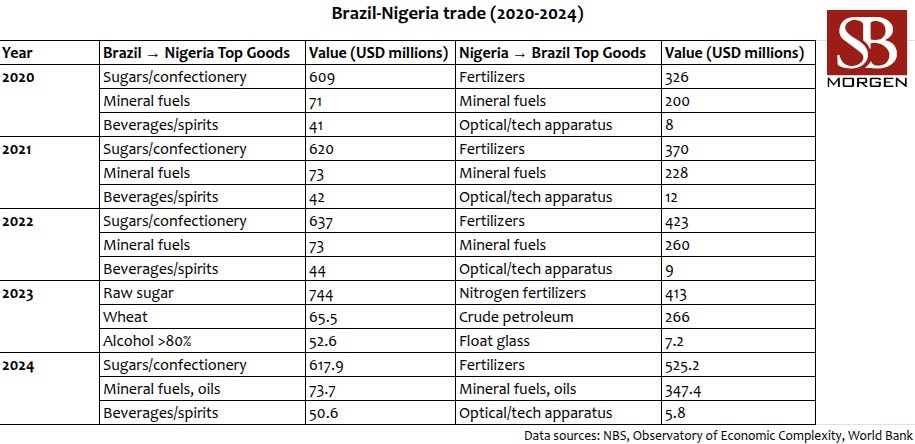
First, the focus must extend beyond just passenger movement to actively promoting cargo and trade. Data from 2020–2024 shows that trade between the two countries is primarily in commodities like fertilisers, sugars, and mineral fuels. For real impact, these flows need to diversify and deepen with direct air and cargo links that enable small and medium-sized enterprises (SMEs), agricultural producers, and manufacturers to access Brazilian markets directly.
Secondly, Nigeria should leverage this opportunity to foster knowledge transfer. Past attempts, such as joint ventures for tractor imports, never materialised because of a lack of supporting structures for technology adaptation and capacity building. Nigeria must learn from Brazil’s experience in areas like agricultural mechanisation and industrial design.
Thirdly, proactive policy must address barriers such as complex visa regimes and a lack of support for creative industries, content exporters, and logistics providers. Without mechanisms for inclusivity, these sectors and their small businesses won’t benefit.
On the Brazilian side, investor interest will depend heavily on Nigeria’s ability to provide a stable and predictable regulatory environment. The experience with Petrobras is instructive; the company exited Nigeria over a decade ago, citing regulatory and operational risks. While recent overtures may signal renewed interest, real investment will require clarity on asset security, contract enforcement, and the ease of doing business.
The BASA thus serves as a litmus test of Nigeria’s ability to convert diplomatic initiatives into durable economic outcomes. Since the collapse of Nigerian Airways, the country has struggled to position itself as a credible aviation power. Past BASAs have often disproportionately benefited foreign carriers, leaving Nigerian travellers with high fares and substandard service. The emergence of Air Peace and a government more inclined to support domestic operators offers a chance to shift this balance.
Ultimately, the Lagos–São Paulo air corridor is more than just a transport link. It is a strategic platform that could either catalyse South-South cooperation or become another underutilised policy gesture. Its success will depend less on diplomatic signalling and more on consistent delivery, commercial viability, and credible governance. As history demonstrates, Nigeria must invest in stable institutions and monitoring mechanisms to ensure full implementation; otherwise, this agreement may join a long list of shelved partnerships that never moved the needle for Nigeria’s broader economy.