
Between reform and control
Mahama's Supreme Court picks face opposition with minority leader Afenyo-Markin alleging political bias and a "third-term agenda," citing judicial interference.

President John Dramani Mahama has nominated seven Court of Appeal justices for elevation to the Supreme Court, sparking political backlash. The nominations—formally conveyed to the Acting Chief Justice for Judicial Council and parliamentary review—include Justices Adjei, Suurbaareh, Dzamefe, Boafo, Mensah, Bartels-Kodwo, and Amalebola. However, Minority Leader Alexander Afenyo-Markin condemned the move, describing it as a “strategic attempt” to politically dominate the judiciary. He linked the nominations to Mahama’s recent suspension of the Chief Justice, accusing the President of harbouring a “third-term agenda in disguise,” and warned of deeper political interference in judicial independence.
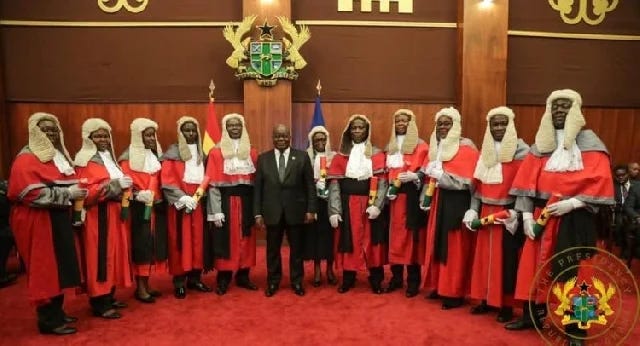
Ghana’s Supreme Court, once mockingly nicknamed “Unanimous FC” for its predictable rulings in politically charged cases, now faces unprecedented scrutiny over its impartiality. During the 2024 elections, then-candidate John Mahama accused outgoing President Akufo-Addo of “packing” the Court with partisan-aligned judges, vowing to reform the judiciary if elected. Four months into his presidency, Mr Mahama appears to be acting on that pledge—but in ways that have sparked alarm.
His administration has suspended Chief Justice Gertrude Torkornoo and nominated seven Appeals Court judges for elevation to the Supreme Court, pending parliamentary approval. While Ghana’s 1992 Constitution mandates a minimum of nine justices, the Court had expanded to fifteen under Mr Akufo-Addo, drawing criticism from Mahama’s NDC party at the time. Now, with roles reversed, the opposition New Patriotic Party (NPP) warns that these moves, coupled with petitions targeting the Electoral Commission Chair and the NDC’s parliamentary majority, could signal a broader power grab, potentially paving the way for a controversial third-term agenda.
The scale and timing of these nominations raise legitimate concerns. Appointing seven justices simultaneously is unprecedented; it suggests not routine replenishment but a deliberate reshaping of the Court’s ideological leanings. The suspension of the Chief Justice, opaque in its rationale, further fuels suspicions of executive overreach. For observers of African politics, this evokes troubling parallels—not least Zimbabwe under Robert Mugabe, where judicial packing in the 2000s neutered the courts ahead of contentious elections, eroding democracy under a veneer of legality.
Mahama’s invitation to Sahelian military leaders for his inauguration has compounded unease, hinting at symbolic alignment with regimes that have dismantled democratic norms. While the NDC dismisses claims of authoritarian drift, the cumulative effect is unmistakable: a judiciary increasingly entangled in political machinations.
Ghana’s reputation as a bastion of institutional stability in West Africa hinges on preserving judicial independence. Unlike neighbours where coups or blatant repression dominate headlines, Ghana’s risks are subtler—“strategic legalism,” where constitutional processes are weaponised to consolidate power. The international community, investors, and multilateral bodies closely monitor such shifts; trust in the rule of law is not easily restored once broken.
The responsibility now falls to Ghana’s Parliament and Judicial Council to scrutinise these nominations beyond technical qualifications. Their task is to safeguard the judiciary’s role as a co-equal branch of government. Public trust in the Court depends on the perception of its independence, not just the reality.
Ghana stands at a pivotal juncture: reinforce democratic checks and balances, or risk joining the ranks of nations where judicial independence is sacrificed to short-term political gains.