
Beyond data revisions
Nigeria's inflation rate drops to 24.48% in January 2025, down from 34.8% in December after a rebasing exercise.

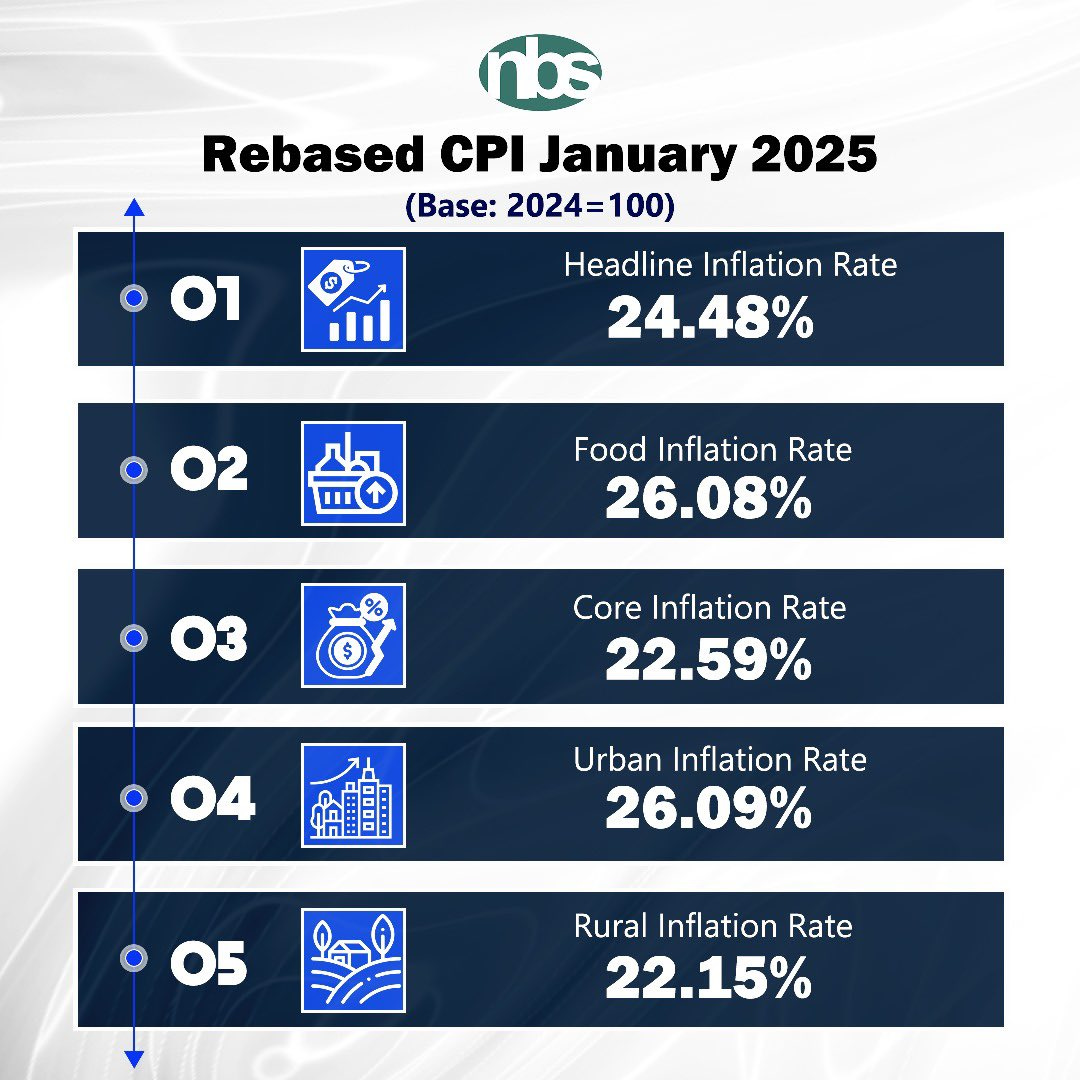
Nigeria’s inflation rate has decreased significantly, dropping to 24.48% in January 2025 from December’s 34.8% following the Consumer Price Index (CPI) rebasing exercise, which updated the base year from 2009 to 2024. As a result of the rebasing exercise, the weight of food and non-alcoholic beverages in the CPI basket decreased from 51.8% to 40%. The weights of housing and transport also shifted, reflecting changes in consumer patterns and the economy. The report also revealed the year-on-year food and core inflation rates to be 26.08% and 22.59%, respectively. Furthermore, the urban and rural inflation rates stood at 26.09% and 22.15%, respectively.
Firstly, It is essential to recognise that countries routinely rebase their inflation baskets to align with evolving economic realities. The United Nations Statistical Commission recommends that nations rebase their inflation data—measured by the Consumer Price Index (CPI)—every five years to accurately capture shifts in consumer spending patterns and structural changes within the economy. This rebasing exercise was long overdue in Nigeria, marking the first adjustment since 2009—15 years. The process also benefited from data and technical support from the World Bank and the International Monetary Fund (IMF).
Despite the adjustments, the results raise critical questions. The food inflation rate of 26.08% and the core inflation rate of 22.59% year-on-year remain substantial, even though many Nigerians argue that these figures do not reflect lived realities. One key explanation lies in the high base effect from the previous year, mainly as 2024 follows the post-devaluation period of the Naira. In January 2024, the official exchange rate stood at ₦1,456 per dollar—a marginal 3.5% difference from the current rate of ₦1,507.
While the government may argue that this represents Nigeria’s new economic baseline, it does not translate into tangible relief for households, as the prices of essential commodities remain elevated. The reported 10 percentage-point reduction in inflation appears largely statistical, offering little reprieve for struggling consumers whose purchasing power remains weak. Furthermore, historical trends indicate that the year’s first quarter typically experiences subdued economic activity compared to subsequent quarters. If last month’s inflation rate were measured using the previous methodology, it would be the lowest recorded since July 2023—when economic reforms initially began to fuel inflationary pressures.
The rebasing exercise follows a pattern established by the National Bureau of Statistics (NBS) in 2023, starting with revising Nigeria’s unemployment figures. This adjustment saw the official unemployment rate drop from double digits to single digits, and now inflation has ostensibly fallen by 10 percentage points. In theory, these revisions suggest a decline in economic hardship. In reality, however, they remain largely statistical constructs with little impact on Nigerians' daily struggles.
In response to the reported decline in inflation, the Central Bank of Nigeria’s (CBN) Monetary Policy Committee opted to maintain the country’s benchmark interest rate (Monetary Policy Rate, MPR) at 27.5% during its latest meeting. This marks the first time the MPR has been retained since May 2022, when it stood at 11.5% under the leadership of former CBN Governor Godwin Emefiele. While this decision signals cautious optimism, it does little to address the broader economic concerns of inflationary pressures, exchange rate volatility, and declining consumer purchasing power.
While Nigeria’s inflation rebasing exercise may offer a more contemporary statistical representation of economic conditions, it does not fundamentally alter the populace’s economic hardship. The government must go beyond statistical adjustments and implement policies that drive tangible improvements in living standards, ensuring economic recovery is felt beyond data revisions.