
Black and blue
Nigeria’s national grid collapsed once more on Tuesday when power generation crashed from a peak of 3,594.60 megawatts at midnight to an…

Nigeria’s national grid collapsed once more on Tuesday when power generation crashed from a peak of 3,594.60 megawatts at midnight to an alarming low of 42.7MW by midday. Subsequently, at noon, only the Delta Power plant was operational on the grid, contributing 41MW, while Afam generated 1.7MW. The grid failure particularly impacted the commercial hub of Lagos, where the power supply was lost at 11:32 a.m. This marks the third grid collapse in less than a month, following two incidents just five days ago, which left the country in total darkness for extended periods.
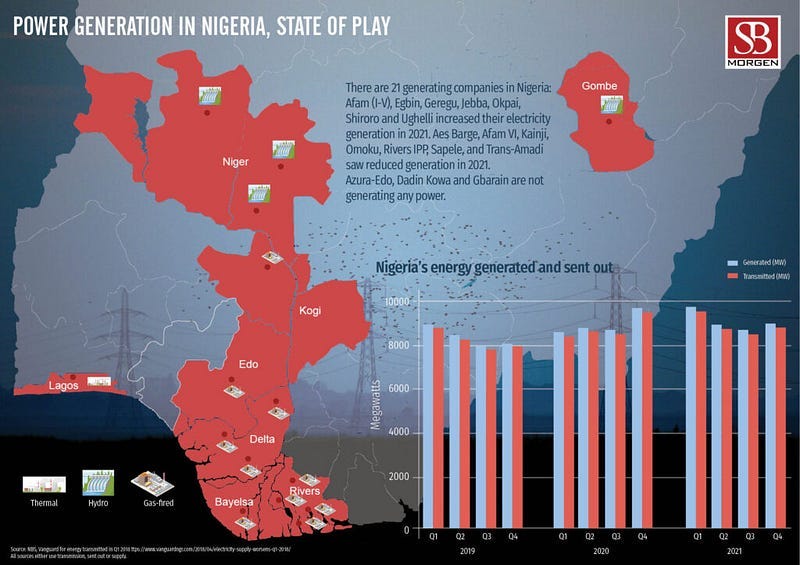
Nigeria’s power sector is beset with numerous challenges, including frequent grid collapses, lack of universal coverage, an undue reliance on a centralised system, ballooning legacy debt and poorly maintained infrastructure. These challenges are reflected in the country’s low per capita electricity consumption of 144 kWh in 2020, compared to 3,500 kWh in South Africa and 400 kWh in Ghana. Nigeria’s current installed electricity generation capacity is 12,522 MW, but due to gas supply issues and infrastructural limitations, the country is only able to generate around 4,000 MW daily, which is just one-third of its already paltry capacity. This means that Nigeria must meet 70% of its electricity demand through generator use, which is expensive and environmentally destructive. To address these challenges, Nigeria must invest significantly in its power sector and decentralise its energy system. By involving the private sector in the development and management of the power sector, the government can tap into the private sector’s efficiency and expertise to improve the reliability and affordability of electricity supply. Private sector companies are motivated by profit, which means that they have a strong incentive to maintain their infrastructure efficiently and effectively. They also have access to capital and expertise that can help them to implement new technologies and best practices. Private sector companies would be more likely to invest in new power generation plants and transmission lines, as well as properly maintain and repair their infrastructure. They would also be more likely to utilise new technologies and management practices to reduce the chances of downtime and ensure a decentralised system that negates the possibility of nationwide power outages. Overall, it is likely that Nigeria’s power infrastructure would have been better maintained and structured if the rigour associated with private sector motivation had been part of the framework from the beginning. Unfortunately, the approach of private sector integration in driving the country’s power strategy has been scattergun. Until that is sorted, blackouts and grid collapses will remain a clear and present reality.