
Bleeding oil
Nigeria lost a total of ₦500 billion in January due to low crude oil production, according to The Punch. Shipping data showed that the…

Nigeria lost a total of ₦500 billion in January due to low crude oil production, according to The Punch. Shipping data showed that the country exported 1.2mb/d against the 1.6mb/d quota assigned to it by OPEC, bringing January’s total export to 37.2 million barrels, as against 49.6 million expected if it had exported 1.6mb/d. Nigeria’s Bonny Light sold for $89 per barrel in January- +1 above Brent International, which was sold for $88 per barrel. This means that the country may have raked in ₦1.5 trillion from producing 37.2 million barrels exported in January as against the expected ₦2 trillion revenue.
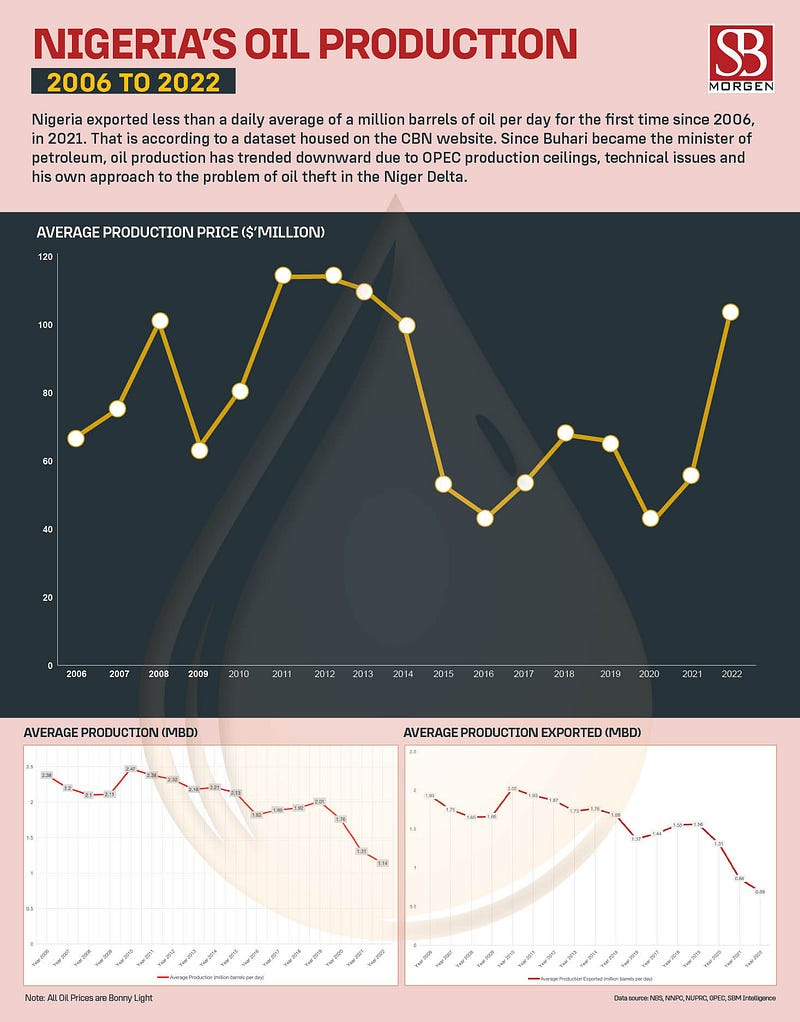
The NNPC boss, Mele Kyari, offered his favourite explanation for middling crude production: vandalism. According to him, Nigeria lost as much as 900,000 barrels daily to theft. CBN data showed Nigeria produced below two million barrels of oil per day just four times in the ten years spanning from 2006 to 2016. From 2016 to 2022, the country’s annual oil production averaged over two million just once in 2019. A spate of attacks on oil facilities in 2016 sent the Vice President scampering to the Niger Delta to offer a plenitude of promises the following year. One of those was that artisanal refiners in the swamps of the Delta, whose occupation is illegal by law, would be integrated into mainstream refining through the construction of modular refineries. The militants of the Delta were convinced that there would be a legitimate pathway to increasing access to petrol and associated revenue streams for their communities. They manifested that belief by initially allowing oil production to rise before the effect of pull forces brought industry efficiency back to earth. Nigeria has yet to deal with the fundamental issues of underinvestment in the oil and gas sector and industrial-scale oil theft, which even Mr Mele Kyari confirmed. It, therefore, means that whatever gains are recorded within the current structure are only temporary, and these issues will catch up with it and bring production below the country’s quota again. In simple terms, Nigeria is an asset-rich but revenue-poor country. A recent report by the African Union, in collaboration with the OECD and others, showed that Nigeria’s tax-to-GDP ratio in 2020 was a meagre 5.5%, which was lower than the average of 31 African countries (at 16%) studied by 10.4% points. By comparison, South Africa and Ghana were at 25.2% and 13.4%, respectively. This is due to two broad factors: The first is the underperformance as mentioned above despite having the capacity to have up to 2.4 mbpd. Even the conservative budgeted production of 1.88 mbpd in FY2022 might be a stretch too far. Second, the country’s productivity is abysmally low as the velocity of transactions in the real economy is quite slow. For example, agriculture is dominated by smallholder farmers, who barely produce enough to feed their families, much less commercial quantities for domestic and export consumption. Most traders operate small kiosks and can only achieve a daily turnover in tens of thousands of naira ($1 = ₦752, 09/02/2023). Back to crude, the current oil price boom is the first in which Nigeria has not benefited financially, a sad development in a period when the country desperately needs increased revenues to deal with its fiscal challenges. When militancy in the Delta was at the starting block in Olusegun Obasanjo’s second term, he undertook a tour of the region, chose a problem, fuel scarcity, and promised to build fuel pumps close to riverine communities. The NNPC has 12 floating stations in the Delta as a result. Mr Obasanjo commenced negotiations for an armistice, which was completed by his successor, Umaru Yar’Adua. On the other hand, Mr Buhari’s response to agitations in the Delta has been to adopt a version of the ‘divide and rule’ strategy. At least, that is how warlords like Asari Dokubo and a few others view the security contract offered to Tompolo. Unfortunately for Buhari and his government, Tompolo’s reach is limited, but the legacy of Buhari’s conflict management legacy in Nigeria’s petroleum industry will play out for years after his time in power.