
Body blow
Russia’s Wagner mercenary group said Monday that it suffered heavy losses fighting Tuareg rebels in northern Mali, with social media…

Russia’s Wagner mercenary group said Monday that it suffered heavy losses fighting Tuareg rebels in northern Mali, with social media videos showing dozens of bodies, mostly white men. Wagner was hired by Mali’s military junta after the 2020 coup to battle Tuareg separatists and Islamist insurgents. In a separate incident, militants attacked Benin’s National Park W, killing at least seven Beninese security forces and five conservation rangers. This attack is part of a surge in violence as jihadis from the Sahel region spread into West Africa, targeting coastal states like Benin. The park borders Burkina Faso and Niger, a region plagued by Islamist insurgency.
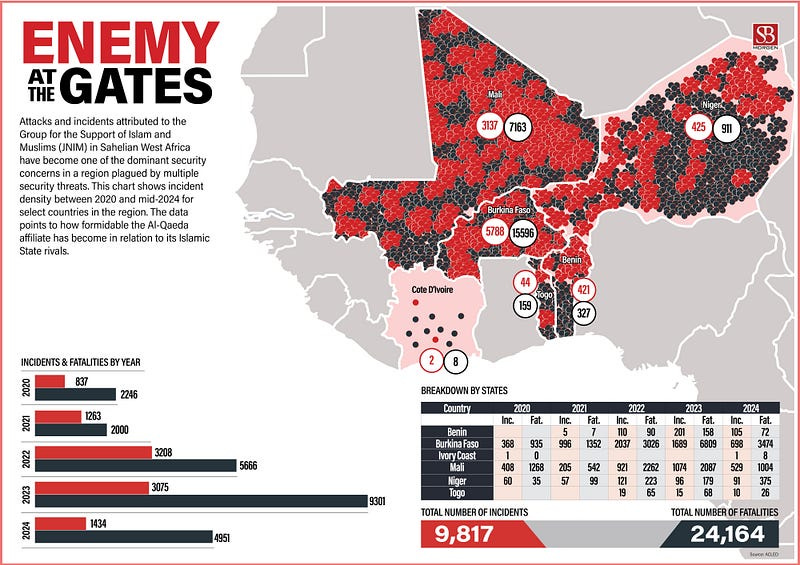
This development, which comes about eight months after the Malian military, in conjunction with Wagner, made gains by capturing towns leading to Northern Mali, such as Kidal, indicates that the war may be heading for another stalemate. Wagner forces were initially brought in to roll back the gains made by the Tuareg rebels in the self-proclaimed Azawad state. However, in recent times, they have found themselves fighting insurgencies on multiple fronts, complicated by the Al-Qaeda threat posed by its affiliate, JNIM, following multiple attacks in Central Mali, including one last week where 26 civilians were killed in Mopti. This situation has split the sparse Malian armed forces, which are only complemented by a Wagner private mercenary group that is primarily there to provide Praetorian Guard duties for the junta chief and to secure mines allocated to it. Russia officially holds Western PMCs responsible for this setback. It has blamed Academi (formerly known as Blackwater), a notorious American mercenary company implicated in human rights abuses during the Second Iraq War. However, such claims pale compared to the more plausible reality that Ukraine could be behind this sabotage. Earlier this week, the GUR, Ukrainian military intelligence, confirmed that they had passed intelligence to the Tuareg rebels, which proved detrimental to Wagner forces. This development globalised the war in Ukraine in ways not previously seen; away from the Black Sea, it has devolved quite literally into a shadow war being fought both in Sudan and Mali. Some of the spillover from the shadow war between the West and Russia regarding Ukraine in the Sahel has engulfed a coastal state like Benin, where its northern border with Niger and Burkina Faso has become home to Al-Qaeda affiliates such as Ansaru and JNIM. In a previous editorial, it was noted that the first indication of JNIM’s interest in Benin arrived in June 2020 when a group of fighters stopped at the W National Park to ask for directions to Zamfara in northwestern Nigeria. At that time, the militants were not interested in attacking the park because they aimed to help Ansaru regain its foothold in the Northwest, especially in Kaduna. However, recently settling into a violent space where JNIM is increasingly stronger than Islamic State affiliates means that the imperative to establish a caliphate looms larger than nomadism. This shift necessitates pillaging established economic centres to gain control of trade and raise revenues, which explains the motive for the attack on the park. Furthermore, trade between Nigeria and Benin flows through long-established, poorly manned, and insecure trade routes that the militants have exploited for safe passage and monopolisation, as seen in the border area between Alibori in Benin and Kebbi State in northwestern Nigeria. For the Benin government, managing this crisis means involving Rwandan troops — a deal that sees Rwandan forces fight these militants for an undisclosed fee. This development signifies that hopes for improved joint border security coordination between the affected states are as forlorn as they appear. One possible reason for the apparent lack of collaboration could be that Benin receives support from elsewhere. In April, European Union Council President Charles Michel announced that €50 million would be provided to Benin as security support for counterterrorism efforts and the purchase of drones. However, this assistance is unlikely to significantly change the region’s fortunes in the long term because Benin has a storied history of receiving international financial support with very little to show for it. What has proven more effective is improved collaboration between states that facilitates seamless counterterrorism operations across borders.