
Border closed, trade stops, virus spreads
Ebola emergency declared in DRC and Uganda as rare strain with no vaccine prompts regional border closures.

The World Health Organisation (WHO) has declared an Ebola outbreak in the Democratic Republic of Congo (DRC) and Uganda a Public Health Emergency of International Concern, following rising infections, suspected deaths, and confirmed cases linked to the Bundibugyo strain, which currently has no approved vaccine or specific treatment. Cases have been reported across eastern DRC, including Goma, Beni and Ituri province, with Uganda also confirming infections and at least one death. The outbreak has triggered border closures, including Rwanda’s suspension of crossings with Goma, disrupting trade and movement in the Great Lakes region. Health authorities warn of a high risk of regional transmission due to cross-border mobility. Meanwhile, the Canadian juggernaut, Barrick Mining, has tightened Ebola screening and surveillance at its Kibali gold mine in the DRC as a precaution, amid fears of wider spread across nearby mining and trading corridors.
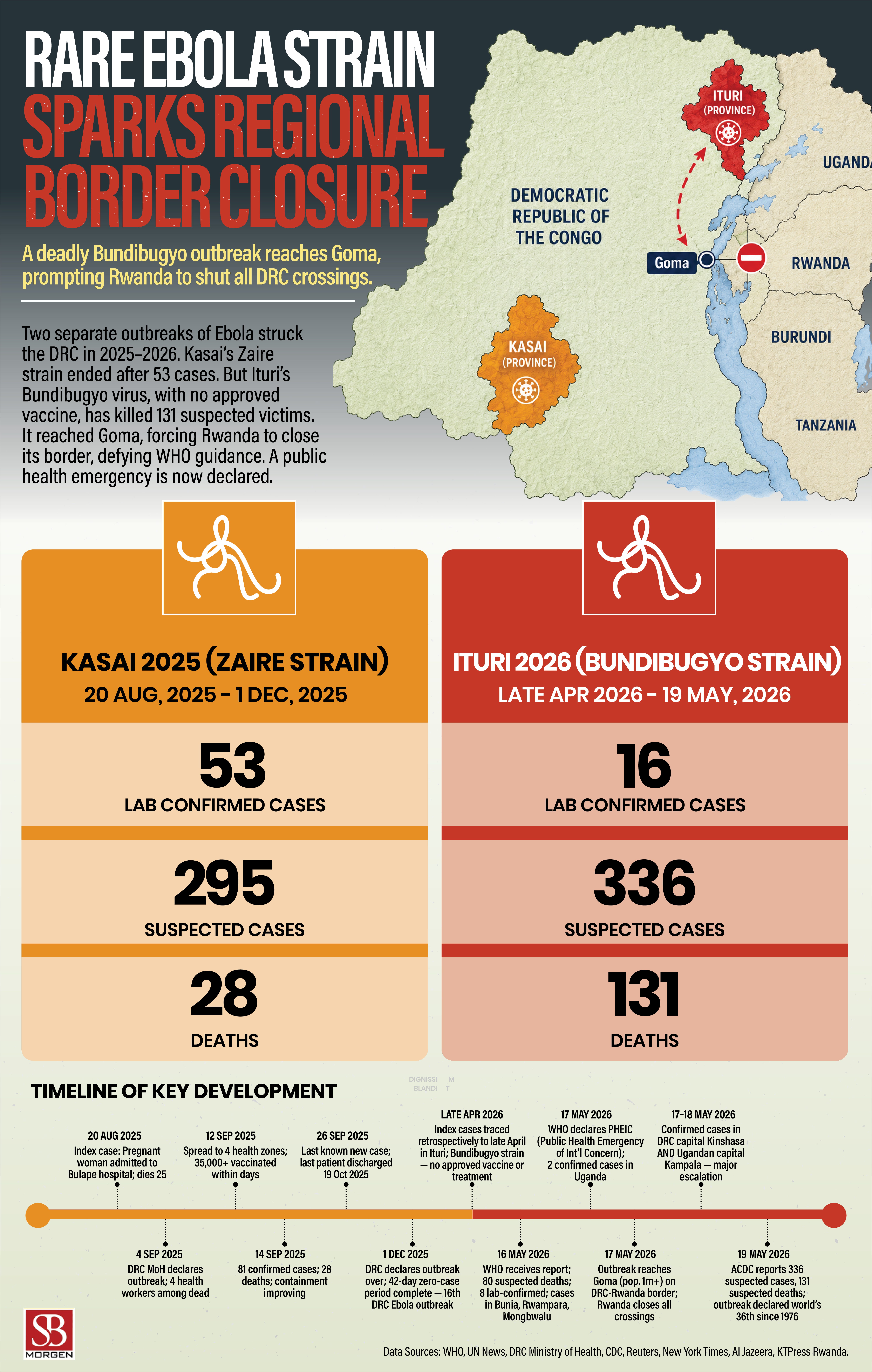
The latest Ebola outbreak in eastern DRC is driven by the Bundibugyo strain of the Ebola virus, for which there are currently no approved vaccines or targeted treatments. First reported in the Mongbwalu Health Zone of Ituri Province on 5 May, retrospective investigations suggest transmission likely began in late April. The virus has since spread through eastern DRC and into parts of Uganda, with at least 600 suspected cases and 139 reported deaths. The PHEIC declaration reflects concerns over cross-border transmission, weak visibility into the true scale of infections and severe operational constraints. It does not imply a pandemic or global travel shutdowns, but rather aims to trigger coordinated international support, accelerate surveillance and strengthen emergency response.
What distinguishes this crisis is the convergence of biological vulnerability, armed conflict, population displacement and institutional fragmentation. The Bundibugyo strain differs genetically from the common Zaire strain responsible for the 2014 West African epidemic. Existing vaccines and treatments developed for Zaire provide little or no protection against Bundibugyo Virus Disease. Experimental vaccine candidates exist but have not progressed to human trials. Many rapid field diagnostic tests calibrated for Zaire show reduced reliability against Bundibugyo, increasing false negatives and weakening surveillance. The WHO has warned that the outbreak is probably much larger than officially documented, citing unexplained deaths distant from epicentres.
The security environment in eastern DRC further complicates the response. Unlike stable regions where rapid contact tracing has historically contained Ebola within months, the eastern provinces remain deeply affected by armed conflict, political fragmentation and widespread mistrust of state institutions. Nearly three weeks elapsed between the first confirmed case on 24 April and the formal outbreak declaration, highlighting how insecurity undermines public health surveillance. Large sections of North Kivu and surrounding territories, including areas around Goma, remain under the control of the March 23 Movement (M23). This creates major obstacles for health officials and humanitarian agencies trying to access affected populations. Although M23 has reportedly established its own outbreak response structures, coordination between rebel authorities, the Congolese government and the WHO remains weak and highly politicised. Without secure access to rebel‑controlled territories, effective contact tracing, treatment deployment and community engagement become extremely difficult, increasing the probability of prolonged transmission.
The outbreak is also unfolding against a fragile geopolitical backdrop. Rwanda’s closure of the Petite Barrière and Grande Barrière crossings between Goma and Gisenyi has intensified diplomatic tensions with the DRC government. These crossings are among the busiest trade and mobility corridors in the Great Lakes region, supporting thousands of daily commercial and informal movements. Rwanda argues the restrictions are necessary to limit transmission risk, but Congolese authorities criticise the closures as inconsistent with WHO guidance, which explicitly does not mandate border shutdowns under the current PHEIC. A more proportionate approach would be targeted screening, strengthened referral systems and clear health declarations at points of entry, rather than blanket closures that damage livelihoods and push movement into informal channels. That lesson emerged from COVID-19 and earlier Ebola outbreaks, where full shutdowns often created hunger and hidden mobility without fully stopping transmission.
The diplomatic friction is particularly sensitive because both Rwanda and the DRC are signatories to a US‑ and Qatar‑brokered peace accord signed in June 2025, aimed at reducing conflict in eastern Congo. That agreement was already under strain following renewed clashes in late 2025 and early 2026, alongside continued allegations that Rwanda supports the M23 rebellion, claims Kigali denies. The Ebola outbreak now introduces an additional layer of instability. Neighbouring countries and international actors have responded with heightened border screening and travel restrictions. Nigeria, Zambia and the United States have introduced tighter monitoring measures for travellers arriving from affected zones. However, the effectiveness of these restrictions remains questionable. Experience shows that formal border closures often divert movement toward informal and unmonitored crossings, potentially worsening hidden transmission risks.
Beyond humanitarian implications, the outbreak poses growing economic risks for eastern Congo’s mining sector, a critical source of export earnings and regional employment. The epicentre overlaps with major gold mining corridors, including operations linked to Barrick Mining’s Kibali gold mine, jointly owned with AngloGold Ashanti and the Congolese state‑owned SOKIMO. Kibali produced approximately 673,000 ounces of gold in 2025 and remains one of Africa’s largest gold operations. Barrick has tightened screening protocols and Ebola‑related safety measures at the site, reflecting concerns over operational disruption. History offers a sobering precedent: the 2018‑2020 Ebola epidemic in North Kivu and Ituri lasted nearly two years and significantly disrupted mining, trade routes and regional economic activity. If the current outbreak follows a similar trajectory, especially under conditions of rebel control and weak institutional coordination, the consequences could extend far beyond public health, affecting mineral exports, trade corridors, fiscal revenues and investor confidence across the wider Great Lakes region.
Ultimately, the severity of the outbreak lies not only in the lethality of the virus but in the environment into which it has emerged. Eastern DRC combines virtually every condition that enables haemorrhagic diseases to spread rapidly: armed conflict, population displacement, weak healthcare infrastructure, porous borders, informal trade routes and low institutional trust. The challenge facing authorities is therefore not simply medical. It is simultaneously a public health emergency, a governance crisis, a regional security issue and an economic risk event. Whether the outbreak can be contained quickly will depend less on border closures and emergency declarations alone, and more on the ability of regional governments, international agencies and local authorities, including actors operating within rebel‑held territories, to coordinate effectively in one of the most politically fragmented and operationally difficult environments in the world.