
Breaking the bank
The Central Bank of Nigeria (CBN), in the year, ended 31 December 2022, advanced a ₦23.18 trillion loan to the federal government under its…

The Central Bank of Nigeria (CBN), in the year, ended 31 December 2022, advanced a ₦23.18 trillion loan to the federal government under its “Ways and Means” policy, exceeding the statutory limit by ₦22.9 trillion. Section 38 of the CBN Act limits the advance that the Bank can grant in any year to five percent of the actual government’s revenue in the preceding year. The 2022 financials also reported borrowing $7.5 billion from US banks JP Morgan and Goldman Sachs. The CBN also entered into 30-day forward contracts totalling ₦3.15 trillion in 2022 with undisclosed counterparties.
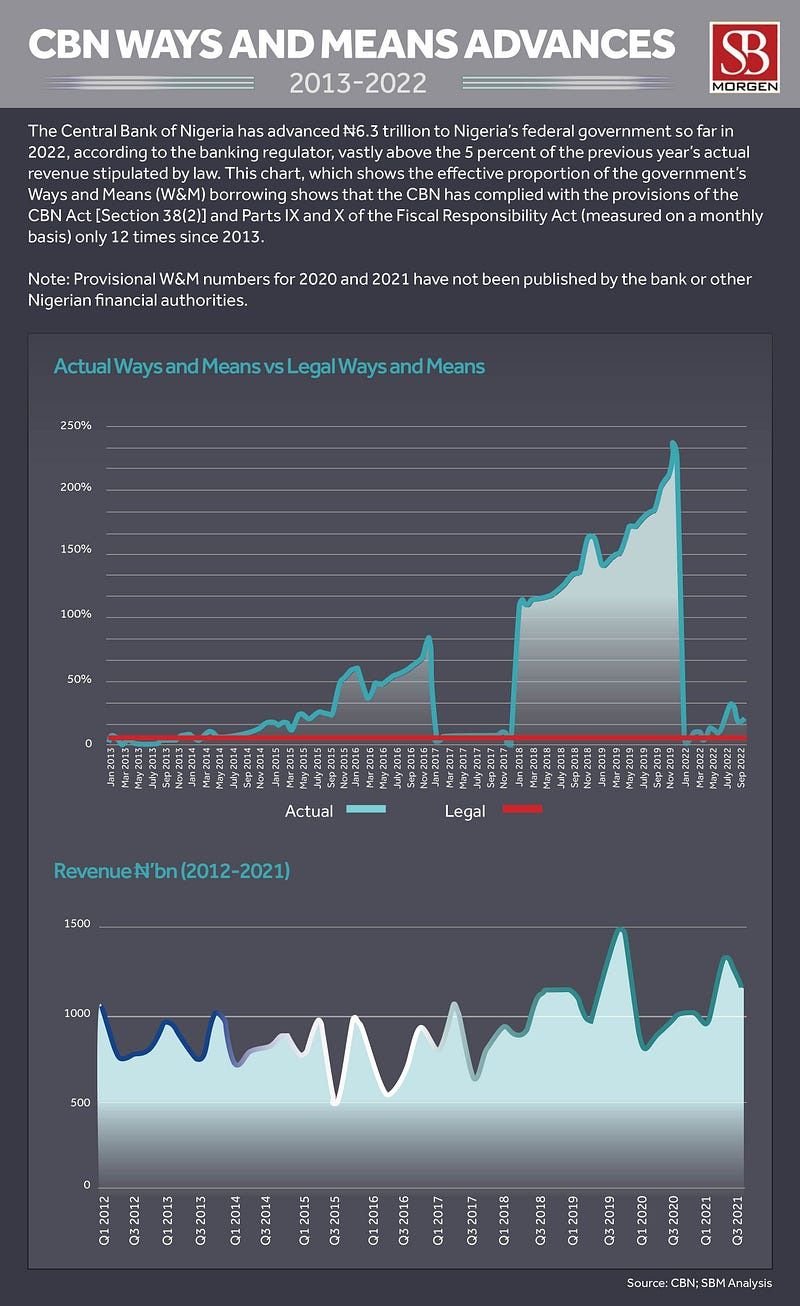
The departure of Mr Emefiele from the Central Bank of Nigeria (CBN)’s leadership has seen the recent release of the bank’s Consolidated Financial Statements for the past seven years, making it the first time since 2015. Within these statements lie several disheartening revelations. Notably, the CBN’s balance sheet expanded significantly, from ₦35.5 trillion in 2018 to approximately ₦57.9 trillion in 2022. Whilst the regulatory bank experienced an 80% surge in net interest income to ₦1.8 trillion in 2022, the major source of that income was from loans and advances (about ₦23.18 trillion) given to the federal government. The CBN exceeded its statutory limit on lending to the federal government by ₦22.9 trillion in 2022. The amount of this loan breached the provisions of the CBN Act, which strictly permits the regulatory bank to lend a maximum of 5% of the preceding year’s federal government revenues to the government. This is a serious breach of the CBN Act and could have far-reaching consequences for the Nigerian economy, causing increased inflation, depreciation of the Naira, escalating debt burden and higher taxes or cuts in public spending. Another worrisome matter is the ₦875.2 billion in credit losses (impairment from non-performing loans) suffered in 2022 from a loan portfolio of about ₦31.4 trillion. It is clear that initiatives like the Anchor Borrowers Loan Programme have been largely unsuccessful, strengthening the notion that the CBN should stick to its core role of monetary policy implementation. The lack of transparency exhibited by the CBN in not disclosing its financial statements during the Emefiele era was clearly an effort to conceal discrepancies like these. While most stakeholders had strong suspicions regarding the Ways and Means numbers, seeing it explicitly stated in the CBN’s own audited financials puts concrete evidence behind the illegal behaviour. The law is clear on the limits of the Ways and Means. The CBN flouted this law, introducing excess liquidity directly to the government while starving the financial sector of much-needed money to lend to the economy through elevated Cash Reserve Ratio (CRR) rates. These type of contradictions represent the epitome of the monetary policy during the Emefiele years, and its contribution to pushing Nigeria’s economy towards the cliff cannot be understated.