
Breaking the ice
Niger’s junta has agreed to talks with the Benin government to help restore relations after a Niger coup last year, which led to the border…

Niger’s junta has agreed to talks with the Benin government to help restore relations after a Niger coup last year, which led to the border closing and a China-backed oil pipeline shutdown. Niger agreed after a meeting between its leader General Abdourahamane Tiani and Benin’s former presidents, Thomas Yayi and Nicephore Soglo, on 24 June. Meanwhile, Niger, Mali and Burkina Faso ruled out returning to the Economic Community of West African States (ECOWAS). Niger’s military leader General Abdourahmane Tchiani said they will create the Alliance of Sahel States for the people, unlike ECOWAS, which he claims is influenced by foreign powers.
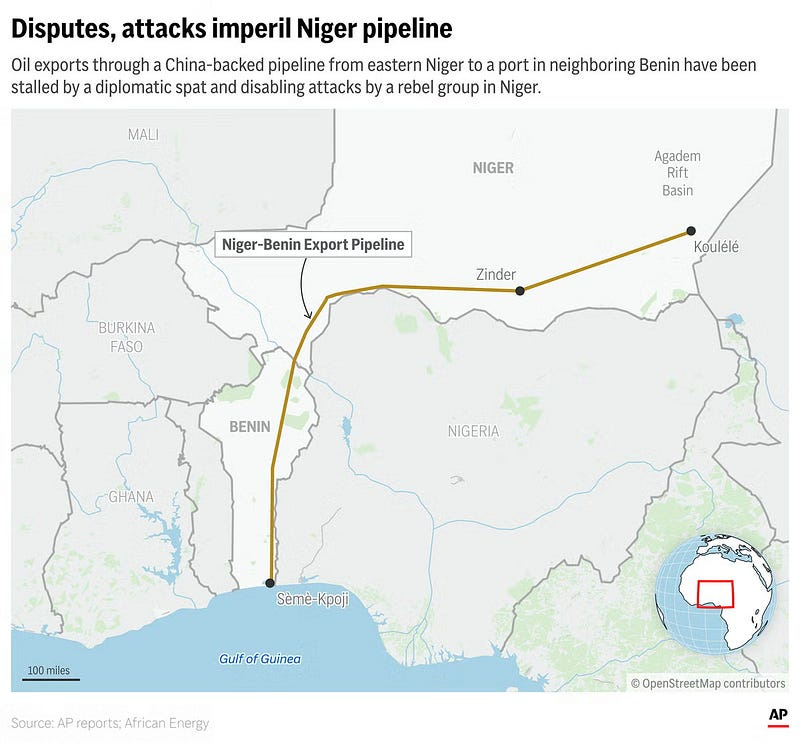
Although reactions and counterthreats hit the news in June, trouble began in May when Benin shut down the pipeline over what its President, Patrice Talon, considered uncooperative behaviour from Niger following the latter’s refusal to reopen the border with Benin after ECOWAS decided to lift sanctions. The contested pipeline is a 1,930-kilometre (1,200-mile) project connecting Niger’s Agadem oil field, built by China, to Benin’s port of Cotonou. The pipeline aims to boost Niger’s oil production fivefold through a $400 million agreement with China’s national petroleum corporation. However, the project has faced numerous obstacles, including a diplomatic dispute with Benin that led to the pipeline’s shutdown in mid-June. Additionally, the Patriotic Liberation Front, a rebel group formed in Niger to agitate for the reinstatement of ousted President Mohammed Bazoum, attacked the pipeline in late June, claiming to have damaged a section and threatening further attacks unless the deal with China is cancelled. To overcome these challenges, Niger’s military government explored alternative routes through neighbouring Chad and Cameroon, options that were initially considered before the original agreement with Benin was made. China’s involvement in getting the oil export deal back on track adds a new layer to international participation in a space where members are heralded for solving differences among themselves with minimal international involvement. Niger’s withdrawal from ECOWAS opens up this opportunity. However, its ability to exist outside of an ECOWAS security, political, and economic framework it has known for much of its independent history would have looked uncertain if it had not succeeded in playing the brinkmanship game with ECOWAS, which the latter lost by lifting all sanctions without getting anything concrete in return. Tchiani’s junta in Mali looks the most domestically stable among the three states in the Alliance of Sahel States. As such, it is possible that a coup in either Burkina Faso or Mali could undercut whatever substantial collaboration the AES may eke out in its rivalry with ECOWAS. This, of course, will largely depend on the persuasive power of Senegal’s President Bassurou Diomaye Faye, whom ECOWAS has appointed to lead the reconciliation talks. However, as long as Niger, through the AES, can get away with extracting maximum concessions from ECOWAS without giving anything in return, the current status quo is likely to be at play for the foreseeable future.