
Bullet rain
Boko Haram and ISWAP militants killed at least 40 people in two separate attacks in Borno State.

Boko Haram insurgents killed at least 20 fishermen in Gadan Gari, Borno State, on 22 January, attacking them while they worked. A resident said his child was killed in the attack, while locals have buried over 15 victims. However, officials have yet to comment. Meanwhile, ISWAP fighters attacked Nigeria’s 149 Battalion in Malam-Fatori on 24 January, killing at least 20 soldiers, including a commanding officer. One of the soldiers who survived the attack told Reuters that troops were taken by surprise as the militants “rained bullets everywhere.” The militants, arriving in gun trucks, overwhelmed troops after a three-hour battle, according to a survivor. Militants also burnt buildings, forcing residents to flee.
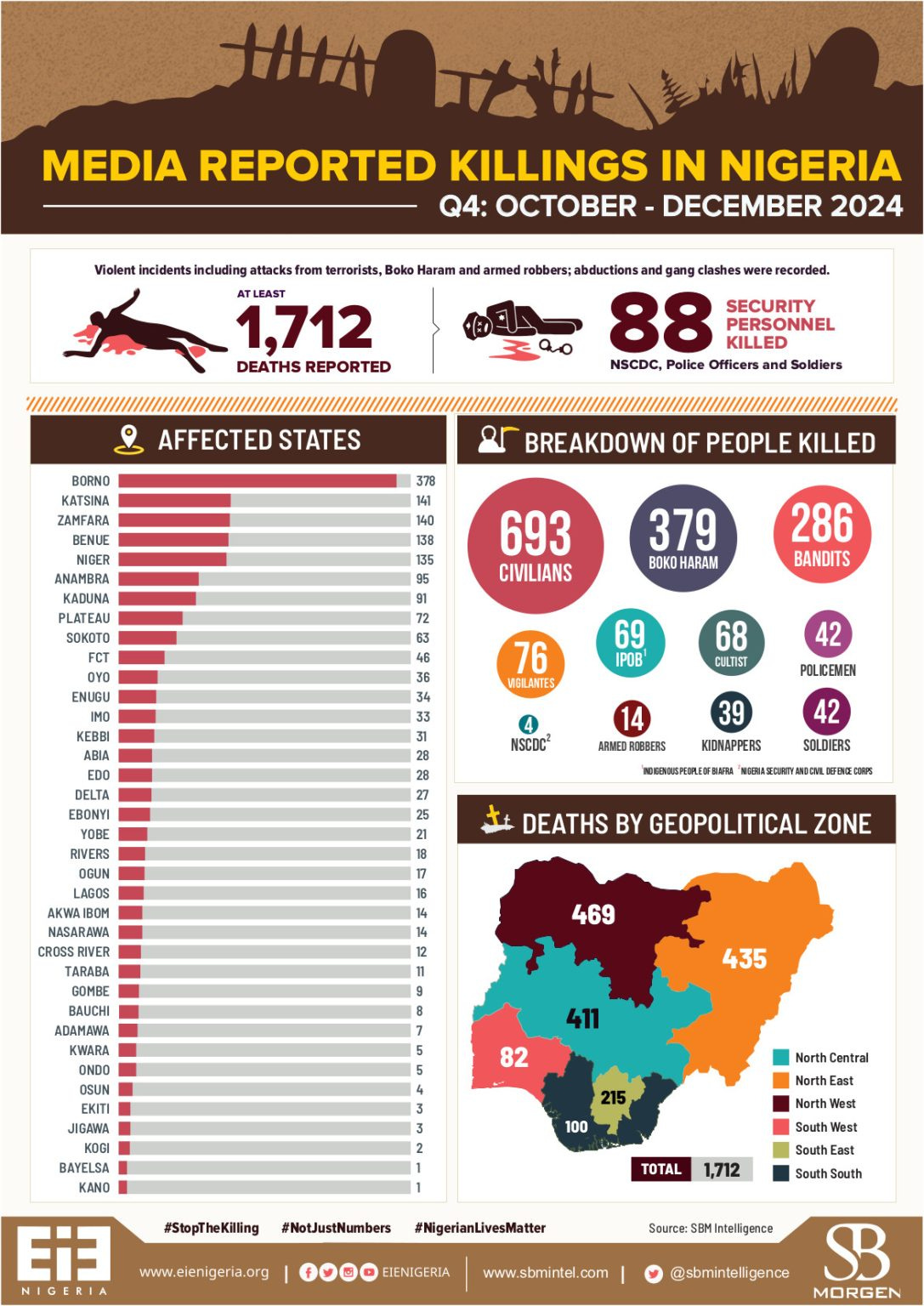
The latest wave of attacks in Borno State serves a dual purpose: instilling fear among civilians and restricting economic activities that sustain local populations. Since late December, both Boko Haram factions have recorded notable successes in their attacks, and it was only a matter of time before the military would get a piece of the pie, but this time, on the receiving end.
Two weeks ago, Amnesty International reported that the death toll from the JAS factions’s attack on the farmers was way over a hundred, highlighting the civilian toll of the military’s inability to deal with the insurgency problem decisively. We have noted previously that a major reason for insurgent attacks on civilians, especially fishermen and farmers, is the suspicion that they are information mules for the military operating in these areas for espionage. However, nowadays, it has become a little more complicated, as civilians have increasingly borne the brunt of the civil war between ISWAP and JAS factions. It is a pointer to how very fluid the situation is.
The attack on the Nigerian Army’s 149 Battalion in Malam-Fatori represents a significant escalation. The loss of 20 soldiers, including a lieutenant colonel, highlights both the ferocity of ISWAP’s operations and the persistent intelligence gaps that allow such ambushes to succeed. The use of gun trucks, sustained firepower for over three hours, and the militants’ ability to overrun the base suggest they were well-equipped and strategically prepared. This further indicates that ISWAP possesses the resources and operational capabilities to challenge state authority in northeastern Nigeria.
These incidents raise critical security and policy questions. First, how effective are current military strategies in preventing such attacks? The frequency and intensity of insurgent strikes suggest that counterinsurgency operations may need greater intelligence-sharing, improved response times, and better-equipped ground troops. Second, how can local communities be better protected? Civilians, particularly those dependent on fishing and farming, need stronger community-based security mechanisms to prevent mass casualties. Third, what role does regional cooperation play in containing the insurgency?
The military’s failure to quarantine the insurgents to the fringes of Lake Chad has come home to roost. The attack on the base—the latest in a series—in a way shows complacency. Some six years ago, there was a plan to minimise personnel losses by concentrating forces in a few locations, giving tonnes of space for the insurgents to operate while significantly drawing down forces to the northwestern frontier. The light contingent left has struggled to make any headway in fighting Boko Haram, relying mostly on aerial bombardments to move the needle.
Given Borno’s proximity to Chad, Niger and Cameroon, a coordinated approach among Lake Chad Basin countries is necessary to prevent insurgents from exploiting porous borders. It is possible that in the next few months, the insurgents will have the upper hand and retake more territory, a development that will be aided by Niger's withdrawal from the Multinational Joint Taskforce. The Nigerian government and military must reassess their security posture to prevent further loss of life and territory. Without decisive action, the humanitarian crisis in the region—already dire—will only deepen, leaving millions trapped in a cycle of violence, displacement, and economic despair.