
Business matters
Nigeria’s September Stanbic IBTC Purchasing Managers’ Index™ (PMI®) rose to 51.1 from August’s 50.2, indicating slight private sector…

Nigeria’s September Stanbic IBTC Purchasing Managers’ Index™ (PMI®) rose to 51.1 from August’s 50.2, indicating slight private sector improvement despite challenges. Businesses face strong cost pressures due to exchange rate weakness and fuel costs, leading to steep input price rises. The Guardian reports over 75% increase in essential building material prices in the past year, concerning built environment professionals for housing accessibility. Architects note 100–200% rises in materials and labour costs over two years. For instance, cement prices surged from ₦4,700 to ₦6,200-₦6,500 per 50kg bag, attributed to increased haulage costs and exchange rate fluctuations impacting raw material costs.
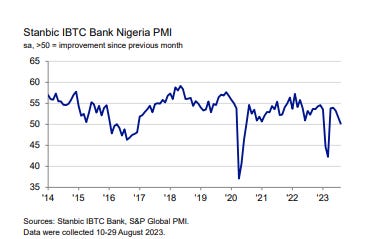
The Purchasing Managers Index (PMI) is a key indicator of economic health, providing information about current business conditions in the private sector. A PMI above 50 indicates an expansion in business activities, while a PMI below 50 signals a contraction. If the index reading is higher than 50, then it indicates an economic expansion. In Q3, 2023 Nigeria’s real GDP growth in the manufacturing sector was 0.4 percent Y/Y, which was higher than the same quarter of 2022 and lower than the preceding quarter by 2.39% points and 1.72% points respectively. Manufacturing activities have been hampered by FX unavailability, infrastructure deficit, higher input costs and consumers’ poor spending capacity, amongst others. It is important to note that strong cost pressures, driven by exchange rate weakness and higher fuel costs, have continued to affect firms operating in the private sector. The rise in the prices of essential building materials and the increase in input prices due to these cost pressures could worsen an already bad inflation situation, which would erode real income and purchasing power. This could harm consumer demand and economic growth. However, the fact that the PMI is above 50 and showing an upward trend suggests that businesses are adapting to these challenges and finding ways to grow despite the difficult economic environment. The upswing may also be likely due to the preparations to produce stock for the anticipated year-end demand bump that is driven by the festivities. This typical year-end distortion is also why SBM does not use December prices to produce the Jollof Index. Therefore, there will be a need to look at the PMI on an ongoing basis to see if there is a sustained upward trajectory. What all the indicators point to is that due to the flailing purchasing power on the demand side and record-level inflation, it is unlikely to be sustained, as producers struggle to find demand for their products. The CBN governor has stated that tackling inflation is one of his top priorities, and the February 2024 Monetary Policy Committee meeting is highly anticipated to see the actual policy actions that will tackle this.