
Carnage
In Zamfara, gunmen targeted two communities, killing eight people and abducting approximately 60 individuals, Reuters reported. Islamist…

In Zamfara, gunmen targeted two communities, killing eight people and abducting approximately 60 individuals, Reuters reported. Islamist insurgents ambushed a convoy under military escort, killing two soldiers and four civilians, while setting five vehicles on fire and taking one truck, a police source said. Residents said an attempted assault on an army base in Magami was repelled. The gunmen in three groups attacked the army base alongside Magami and Kabasa communities, primarily kidnapping women and children. These incidents followed the recent abduction at the Federal University, Gusau. Additionally, in Borno, Boko Haram militants killed 10 farmers and abducted several others in Mafa Local Government Area.
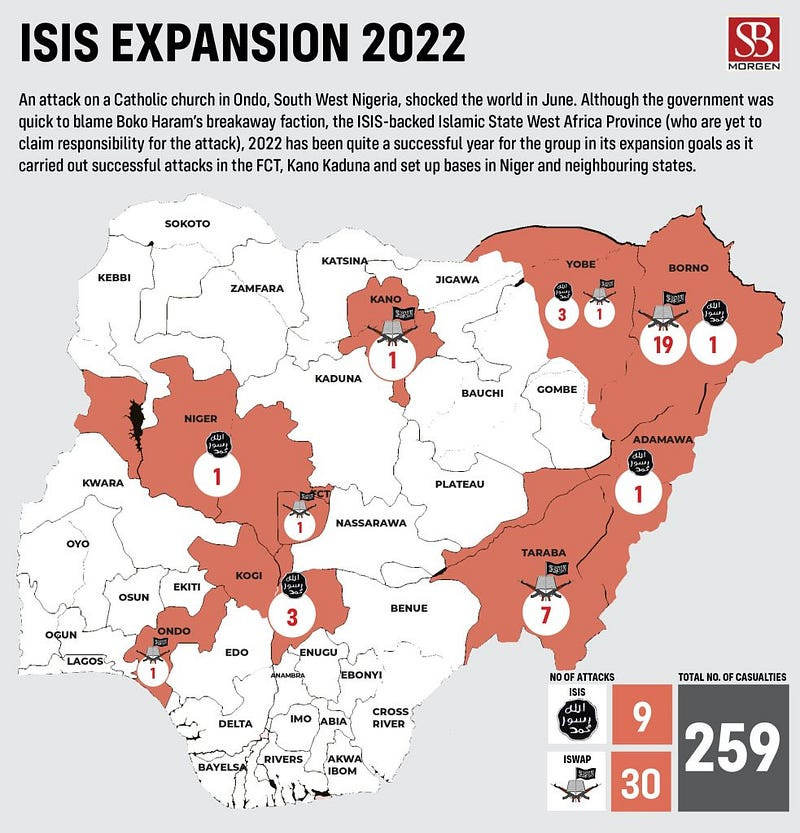
Banditry and insecurity in Nigeria’s North West is distinct from the security challenges blighting other geopolitical zones due to a number of (mostly) unique factors. Unlike the geographic East which is saddled primarily with security issues related to militants and separatists, the North West, particularly Zamfara, faces a different set of problems, chiefly stemming from the interplay between banditry and jihadism. Before 2022, bandits attacked mostly civilians and avoided security installations. This dynamic changed in late 2022 when the Islamic State West Africa Province (ISWAP) established camps in Mutu in Mada District, Gusau LGA, and started attacking Tsafe communities through the Danjibga-Kunchin Kalgo axis of the state. The distance between Magami where this week’s attack took place and Tsafe where the group has a base is 67 km. Since the revelation of ISIS presence in the two LGAs, not much has been done to dislodge them. They (ISWAP) have largely co-existed peacefully with the bandit groups in the locality, and it is likely that ISWAP is responsible for the attack on the base in Magami. This portends several problems for the military. The state government claims that the federal government is negotiating the release of the abducted university students without informing them, a charge Abuja firmly denies. This lack of coordination makes it difficult for the military to balance the demands of these two significant actors, whose disagreements could jeopardise any counterterrorism effort. The military’s credibility is also undermined when it announces the rescue of the girls while the federal government is ostensibly negotiating their release. The military already has its hands full with the spread of ISIS affiliates in the North West. It can only do so much when residents in its operational areas, people it is nominally called to serve, question official pronouncements.