
Catch-22
The National President of the Petroleum and Natural Gas Senior Staff Association of Nigeria (PENGASSAN), Festus Osifo, has said the…

The National President of the Petroleum and Natural Gas Senior Staff Association of Nigeria (PENGASSAN), Festus Osifo, has said the Nigerian government has reintroduced the petrol subsidy despite officially stopping it in May. Meanwhile, Mele Kyari, the Chief Executive Officer of the Nigerian National Petroleum Company Limited (NNPCL), said the government has not reintroduced the petrol subsidy despite the pump price stability since July amid a rise in oil prices. Mr Kyari told an energy conference that some fuel companies began imports in July but now struggle to get foreign currencies to import petrol, restoring the NNPCL as the sole petrol importer.
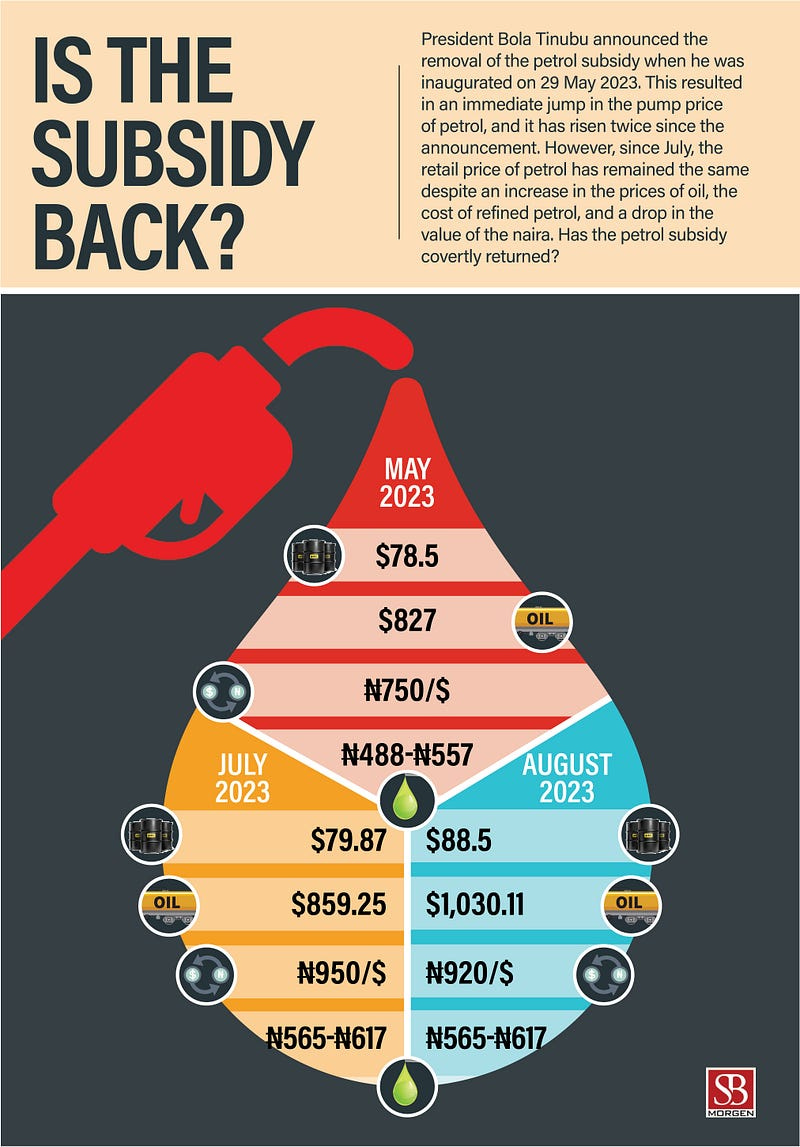
Whether or not Nigeria has restored the fuel subsidy is a simple question to answer. This is because the petrol price is currently fixed while the cost of importing it is not. In July 2023, the NNPCL, the sole importer of petrol in Nigeria, increased petrol prices to about ₦570 and ₦617 in Lagos and Abuja, respectively. The benchmark Brent Crude price was about $80 per barrel at that time. Today, the NNPCL’s pump price for petrol has remained unchanged, while the Brent Crude price has risen to about $87 per barrel. This means that the NNPCL is incurring losses on every litre of petrol it imports, suggesting that the government has resumed subsidising petrol. In an earlier analysis, we pointed out that the way President Tinubu went about the subsidy removal meant that it was bound to return. The FX policy that led to the return of the fuel subsidy was also implemented in a haphazard manner. This has caused both policies to revert to the status quo while creating new hardships for Nigerians. This will provide ammunition to those who will oppose future attempts to implement these important policy measures. Petrol subsidy is now a monster that is difficult to get rid of. In 2022 alone, the Nigerian government spent ₦4.39 trillion ($5.54 billion in December 2022) on subsidies — exceeding the combined spending on education, healthcare and infrastructure. Although the NNPCL boss denies the subsidy return, it is bewildering that the petrol price has remained the same despite the currency devaluation and rising crude oil prices. Possible reasons for the stable price could be that the NNPCL pegged the crude oil price at a higher rate when it was calculating the initial price of petrol in June or it is making up for the difference with its crude oil swap contracts — even though it announced that those contracts would be terminated. Either way, the monthly Federation Accounts Allocation Committee numbers will give a clearer picture of whether or not the subsidy has returned. The NNPCL has an undue advantage over the other independent oil marketers in accessing forex to import petrol since it sells crude oil on behalf of the Nigerian government. This is not how a fair market should work. Marketers who received licences to import petrol must be creative if they want to benefit from those licences. Moreover, conflicting public positions from major public institutions in Nigeria, particularly regarding the petrol subsidy, show reluctance to transition towards a more private sector-driven market. The complex situation surrounding the subsidy issue reflects the challenges and inefficiencies in the oil sector and the urgent need for reform. The evident lack of transparency often leads to confusion among stakeholders, including consumers and industry players, which can erode trust and hinder progress. A shift to market-driven pricing mechanisms, where private firms can play a significant role, could lead to increased competition, efficiency and accountability. This should be accompanied by targeted social safety nets for the most vulnerable, which can help mitigate the impact on consumers while promoting fiscal responsibility.