
Changing hands
Ghana recorded a 32% increase in gold production last year, enabling it to win back the top spot from South Africa as the largest gold…

Ghana recorded a 32% increase in gold production last year, enabling it to win back the top spot from South Africa as the largest gold producer on the continent, the president of the mines chamber said on Friday. Ghana lost its position to South Africa in 2021 after a drastic fall in output. Gold output rose to 3.7 million ounces in 2022 from 2.8 million ounces the previous year, making it the highest output in Ghana’s history, Joshua Mortoti, the President of the Ghana Chamber of Mines said. The growth was driven by increased output of both large and small-scale sectors.
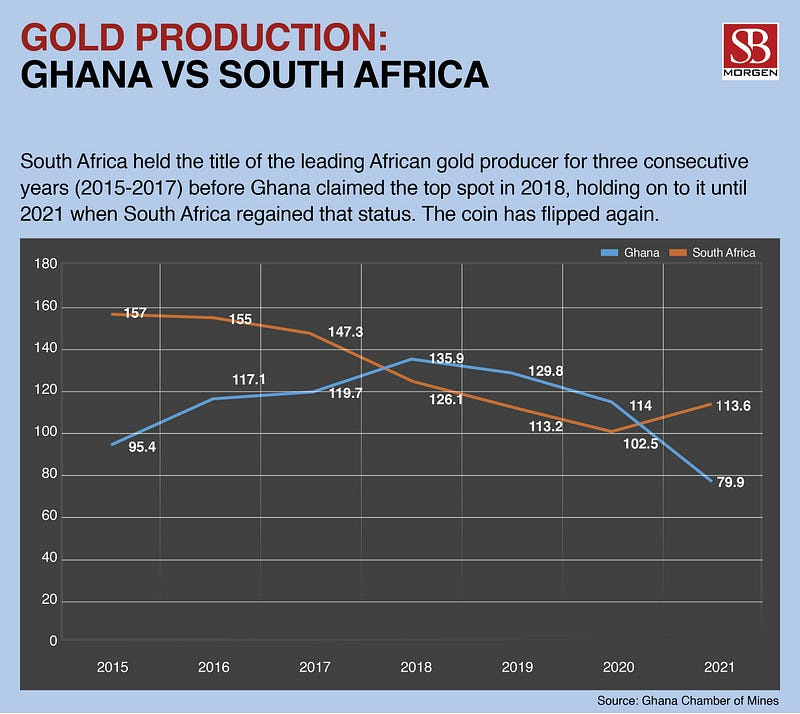
While some may be tempted to begin the victory lap, let’s all remember that Ghana, the leading gold producer on the continent, is currently facing a severe economic crisis, which has led the country to default on its debt obligations domestically and externally. Despite this challenging situation, Ghana regained its position as the top gold producer on the continent. Gold remains the primary source of foreign exchange inflows for Ghana, with gold exports reaching $6.6 billion in 2022, accounting for over 37% of total exports. Crude oil and cocoa followed, with exports of $5.4 billion and $2.3 billion, respectively. Although gold exports reached nearly $7 billion last year, the country’s international reserves have diminished precipitously, causing net import cover to fall to just under two months. The Bank of Ghana’s foreign reserves have steadily grown over the past 15 years, reaching almost $11 billion in 2021. However, these reserves declined to less than $6 billion in 2022. Interestingly, the portion of gold reserves remained unchanged at 8.77 tonnes, representing an average value of 3% of Gross International Reserves (GIR), highlighting the importance of gold to the economy. These trends are noteworthy considering Ghana’s long gold mining history spanning over three centuries. In 2019, Ghana was recognised as the largest gold producer in Africa and the seventh-largest globally. However, during the same year, other central banks acquired a record 670 tonnes of gold to bolster their reserves, according to the World Gold Council. Ghana’s achievement in reclaiming its top spot in gold production came at a high cost, especially at a time when illegal mining activities known as “galamsey” is causing environmental and economic hazards. As of 2017, it was estimated that over 200,000 people were involved in galamsey, with nearly three million depending on it. Surprisingly, Ghana attracted 50,000 gold seekers from China alone in 2017, and one galamsey kingpin reportedly employed over 300 Chinese migrant workers alongside numerous Ghanaians. The galamsey menace poses serious threats to the environment, food security, and the livelihoods of millions of people in Ghana. Galamsey operators employ heavy machinery, explosives and hazardous chemicals like mercury and cyanide to extract gold from the soil, destroying farmlands, forests and water bodies. This illegal small-scale mining has caused a 40% reduction in arable land available for farming. Water sources have become contaminated with heavy metals and chemicals, rendering irrigation impossible and negatively affecting crop quality and yield. A Bloomberg report showed that galamsey operators had destroyed more than 19,000 hectares, approximately 2% of Ghana’s cocoa plantations. Consequently, cocoa output declined by 34% in the first six months of 2022 compared to the previous year. There are projections that Ghana may eventually need to import water from neighbouring countries. If not addressed, galamsey’s impact on fertile agricultural land, reduced cultivable areas, diminished crop production, shortages of staple foods, increased food prices and the rise in consumption of unhealthy processed food could lead Ghana to a looming food crisis.