
Chaos across
DR Congo offers $5 million bounty for three M23 rebel leaders, amid escalating violence and regional instability.

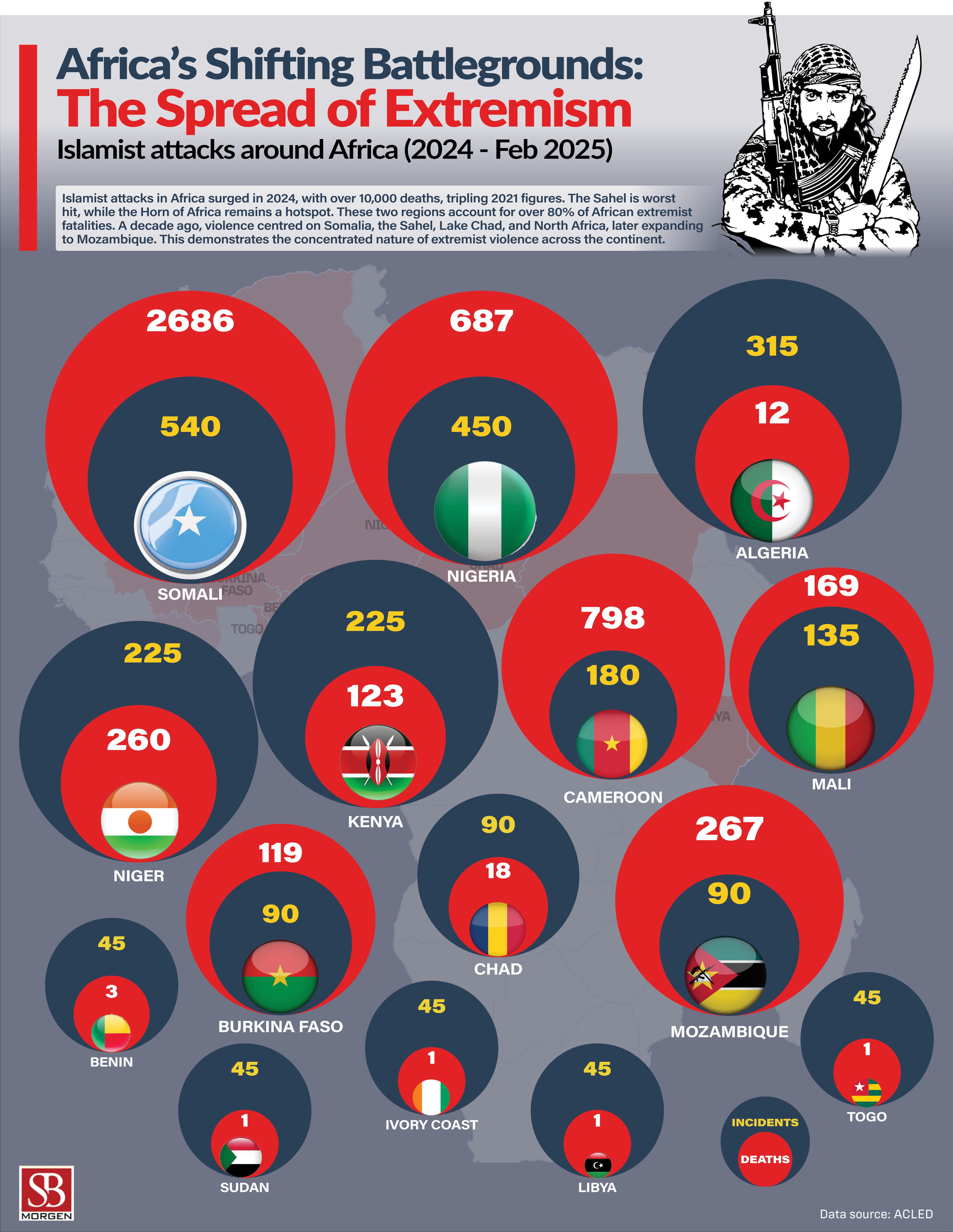
The DR Congo has placed a $5 million bounty on three M23 rebel leaders sentenced to death in absentia for treason, but their arrest is unlikely as Rwanda-backed M23 controls eastern cities, displacing thousands. President Tshisekedi seeks sanctions against Rwanda, accusing it of mineral smuggling. Meanwhile, the U.S. has evacuated staff from South Sudan due to escalating violence, threatening its fragile peace deal. In Somalia, al-Shabab militants stormed a hotel in Beledweyne, killing at least four (possibly 10) in a deadly assault involving car bombs and gunmen. Security forces continue operations to restore order amid ongoing instability in the region.
The three figures at the heart of this case are Corneille Nangaa, Sultani Makenga, and Bertrand Bisimwa, each playing a distinct yet interconnected role in the M23 rebellion. Corneille Nangaa, once the head of DR Congo’s Independent National Electoral Commission, reinvented himself as a rebel leader and is now steering the Congo River Alliance. This coalition binds M23 with other armed groups and political factions. His rhetoric is bold and unapologetic—he has publicly declared his mission to topple the Congolese government, railing against its alleged corruption and tyranny while rallying crowds in M23-controlled cities like Goma and Bukavu.
Meanwhile, Sultani Makenga serves as the military backbone of the movement, commanding M23’s armed forces with a strategist’s precision. Under his leadership, the rebels have notched significant victories, seizing Goma and Bukavu—the largest cities in eastern DR Congo—in a matter of weeks as of early March 2025. Complementing this martial prowess is Bertrand Bisimwa, the group’s political face and civilian president. Bisimwa manages M23’s messaging and oversees governance in territories under rebel control, working hand-in-hand with Nangaa to cement their authority through the Alliance.
The latest developments are important because this is the first time Rwanda has publicly acknowledged support for the rebels–a move that could be its way of bargaining for lesser sanctions from Washington as the Trump Administration deliberates on which side of the conflict to support.
Meanwhile, the latest flare-up in South Sudan, escalating in early 2025, centres on renewed tensions between President Salva Kiir and Vice President Riek Machar, threatening the fragile 2018 peace deal. The conflict reignited in February 2025 in Upper Nile state, where fighting broke out in Nasir County between the Sudanese Armed Forces (SAF) and an armed youth militia, possibly linked to Machar’s SPLM-IO. The violence, potentially sparked by rumours of forced disarmament, has since intensified, with reports of heavy weaponry use and a UN helicopter attack on 7 March, killing a South Sudanese general and dozens of soldiers. Kiir’s forces have arrested Machar's allies, including senior officials, and surrounded his Juba residence, signalling a deepening rift. Meanwhile, unpaid government troops have refused to fight, calling it a "war of self-interest," while Uganda deployed commandos to support Kiir’s forces. This escalation follows years of stalled peace reforms, including unifying armies and preparing for elections, now delayed to 2026. Compounded by flooding, food insecurity, and Sudan’s ongoing war driving refugees into South Sudan, the crisis risks plunging the world’s youngest country back into full-scale civil war, undoing years of progress.