
CJTF under fire
No fewer than 23 members of Nigeria’s Civilian Joint Task Force (CJTF) were killed by armed groups in separate attacks in Borno and Sokoto…

No fewer than 23 members of Nigeria’s Civilian Joint Task Force (CJTF) were killed by armed groups in separate attacks in Borno and Sokoto. Reuters reported. Suspected members of the Islamic State West Africa Province (ISWAP) used an Improvised Explosive Device (IED) to blow up a vehicle carrying some CTJF members in Borno. While en route to Maiduguri, their vehicle detonated an IED, resulting in the loss of nine lives and severe injuries to two others. Additionally, a second attack in Sokoto claimed the lives of 14 CJTF members, with several others reported missing.
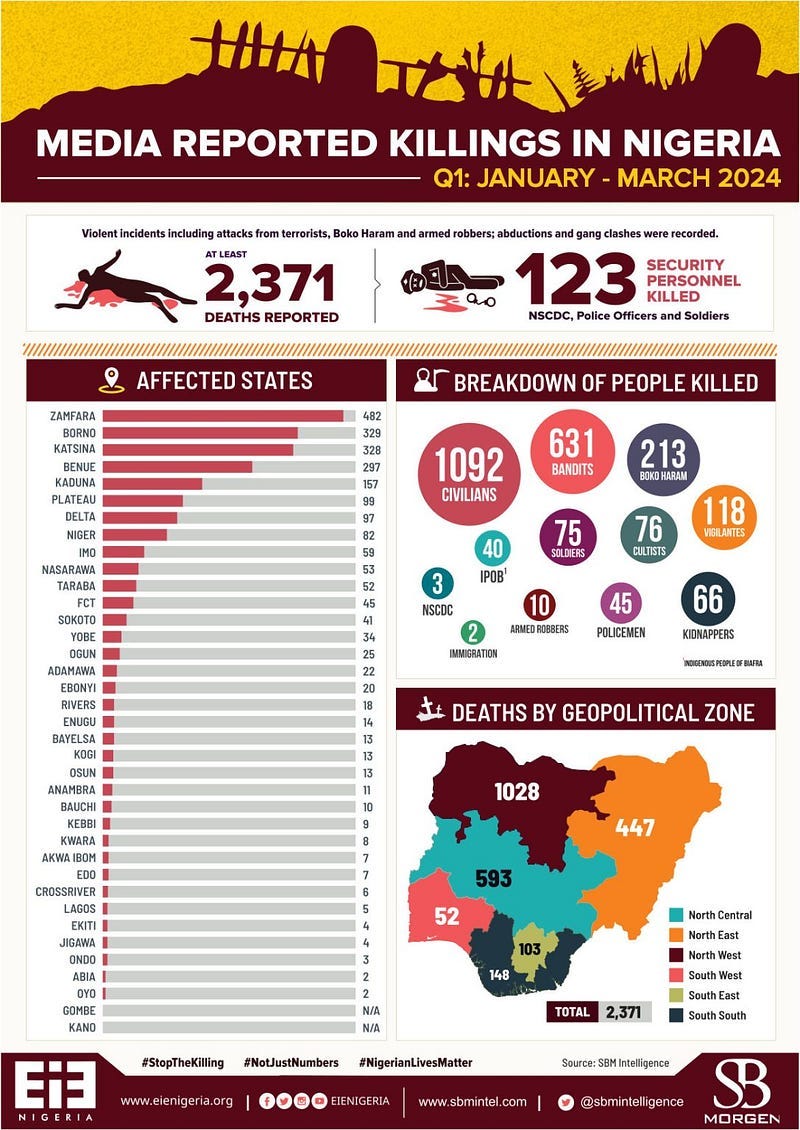
With conventional Nigerian security forces stretched to their limit, the incentive to use extra help was born. As a result, since 2013, community militias, starting with the creation of the CJTF in the Northeast, have joined state forces in a growing victims’ list. Initially embedded in different combat and logistics units of the Nigerian Army, within the last decade, the CJTF has grown to start acting independently with the support of the military that claims it has technically defeated Boko Haram. However, contrary to such claims, the threat both splinter factions of Boko Haram face remains potent, and with the increasing operational autonomy of CJTF fighters came increased ISWAP scrutiny. Over the past few years, pitched battles between Boko Haram/ISWAP and the Nigerian Army/CJTF have given way to opportunistic attacks aided by ambush tactics and the use of IEDs. To minimise its personnel losses, the military has encouraged the CJTF to take on more responsibilities, with the reward being potential enlistment into the army. This has come at a cost, which is more targeted attacks on the CJTF. With the military’s onslaught against Boko Haram in several offensives, many of the latter have shifted base to the Northwest, where bandit groups demand their weapon manufacturing skills. The situation across both northern geopolitical zones is largely the same. As in the Northeast, the military continues to rely on teeming community protection vigilantes to reach rural areas it has had difficulty reaching. The results have been mixed, and as with the Northeast, the bandits have adopted ambush tactics and direct attacks on the houses and families of commanders of these vigilante groups. In many ways, the fact that Nigeria’s security forces and their allies continue to suffer casualties from ambushes shows that its training doctrine requires a new approach. Recent attacks claiming the lives of CJTF members expose the dangers that untrained civilians face in the fight against terrorism. These deaths underscore the urgent need for Nigeria to establish professional state police forces equipped to tackle the growing threats posed by ISIS-linked groups and other militants. The CJTF lacks the training and weaponry to counter sophisticated terrorist tactics effectively. Conventional military and police forces undergo rigorous training in combat, firearms and military strategy that equips them to handle complex situations and operate effectively, even against ISIS-backed terrorists. If the CJTF could receive specialised counterinsurgency and counterterrorism training and be equipped with modern weaponry, communication systems and intelligence-gathering capabilities, they could collaborate seamlessly with the military to outmanoeuvre and overpower terrorist groups. The CJTF is a product of a sincere attempt to help, but it just does not have the capacity to deal with terrorist groups with experience in warfare across three continents. These tragedies should serve as a stark reminder of the urgency to invest in professional law enforcement capable of effectively countering this severe threat.