
Cocoa conundrum
The Ghana Cocoa Board (COCOBOD) plans to open Ghana’s new cocoa crop season on 10 September 2024, with a self-financing plan, while the…

The Ghana Cocoa Board (COCOBOD) plans to open Ghana’s new cocoa crop season on 10 September 2024, with a self-financing plan, while the government seeks external funding for the sector. COCOBOD’s target has been cut by 19.8% due to a dry spell, though efforts are underway to boost production by 200,000 metric tonnes over six years. Meanwhile, Ghana’s second-quarter 2024 revenue totalled GH¢74.65 billion, or 7.1% of GDP, falling short of the GH¢76.07 billion target. Tax revenue exceeded expectations, while non-tax revenue and other sources underperformed. Year-on-year revenue growth was 24.6%, driven by strong domestic and tax revenue performance.
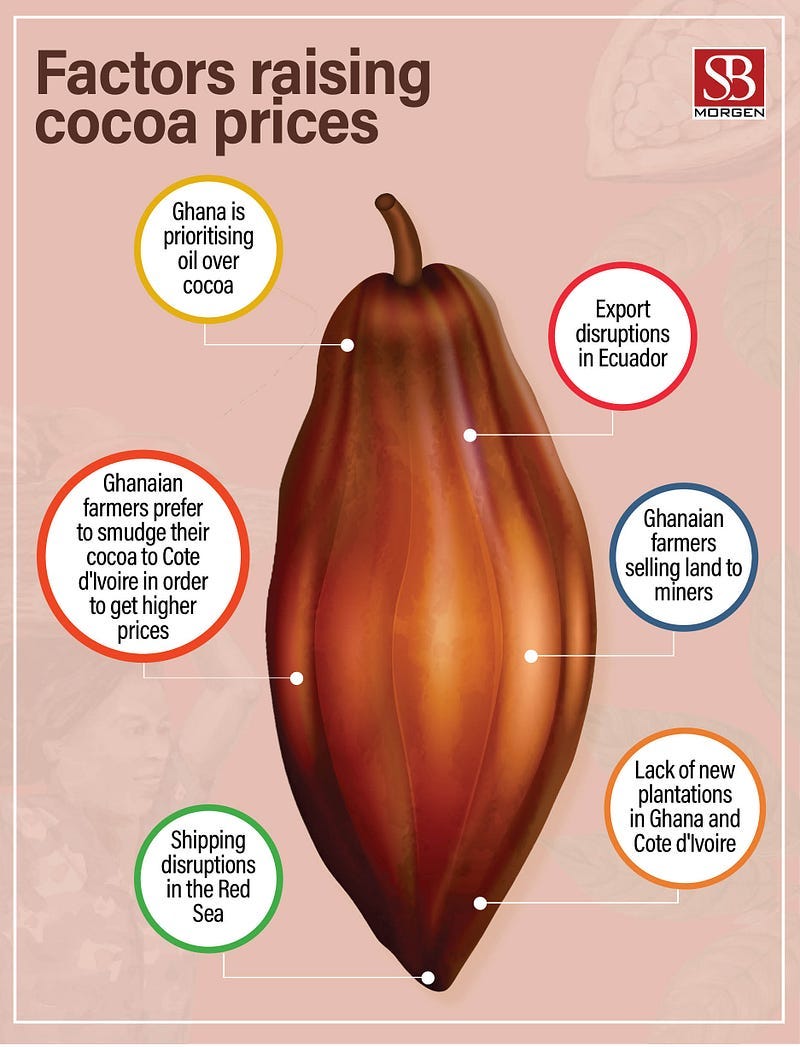
Ghana’s cocoa sector has long been overseen by COCOBOD. While COCOBOD has provided stability and support for farmers, recent challenges are sparking debate over whether government control is now a hindrance. Government-set prices often leave farmers earning less than they could in a freer market. COCOBOD is acutely aware of its deteriorating creditworthiness in the international syndicated loan market. As a result, it pivoted to domestic self-financing as a survival strategy. The near collapse of Ghana’s forward cocoa sales last season sent a clear message: a significant risk premium will now be placed on Ghana’s cocoa beans for this season and subsequent ones. This is partly because the country failed to meet its contractual obligations to cocoa buyers, leaving trading houses with losses exceeding $1 billion on cocoa derivatives, as they were forced to liquidate short positions amidst a rallying market, where prices surged to $10,000 per ton. The driving factors behind this uncertainty are multifaceted. Bad weather, crop diseases, smuggling, and illegal mining continue to disrupt Ghana’s cocoa production. These same challenges, compounded by last season’s default, have led to a surge in risk perception among investors and international buyers. While COCOBOD initially projected $1.5 billion in external funding for this season, these recent developments mean Ghana may be priced out of the market due to the steep interest rates associated with the perceived risk. Historically, cocoa has been the backbone of Ghana’s economy, providing critical foreign exchange earnings that stabilise the cedi, particularly against the US dollar. However, this year’s performance has been grim. In the second quarter of 2024, total government revenue and grants saw a significant decline, primarily due to the poor performance of key tax handles and a marked reduction in cocoa inflows. Export earnings from cocoa plunged by nearly 48% in the first half of the year, compared to the same period in 2023. In dollar terms, this represented a shortfall of more than $690 million, severely weakening the cedi, which has lost over 20% of its value against the US dollar since the start of the year. Ghana’s dependence on cocoa exports is thus facing a critical juncture, as domestic production remains challenged and international market confidence falters. COCOBOD’s pivot to domestic financing may serve as a stopgap. However, failure to address the underlying production and export issues will jeopardise the cocoa sector’s future and the country’s broader economic stability. Loosening COCOBOD’s control could lead to better prices and greater autonomy for farmers given the growing consensus that a reform is needed to boost productivity, adapt to climate risks and increase benefits for farmers. Ghana must balance COCOBOD’s stabilising role with the need for market-driven growth to secure the future of its cocoa industry as it prepares for the 2024–2025 cocoa season.