
Collateral policy
A count of media reports by the Nigerian daily Punch indicates that there have been at least nine incidents of miscalculated airstrikes by…

A count of media reports by the Nigerian daily Punch indicates that there have been at least nine incidents of miscalculated airstrikes by the Nigerian Air Force between September 2021 and January 2023. No fewer than 147 civilians, including children, were killed in those attacks, with at least 72 injuries. Kaduna, Katsina, Niger, Yobe and Zamfara are some states where incidents have occurred. The most recent occurred in Nasarawa, where at least 47 people, mainly Fulani pastoralists, were confirmed killed, according to reporting by Peoples Gazette. A day before the Nasarawa incident, an Air Force strike in Niger killed some hunters and residents, rendering another 8,000 residents homeless, according to the Niger State government.
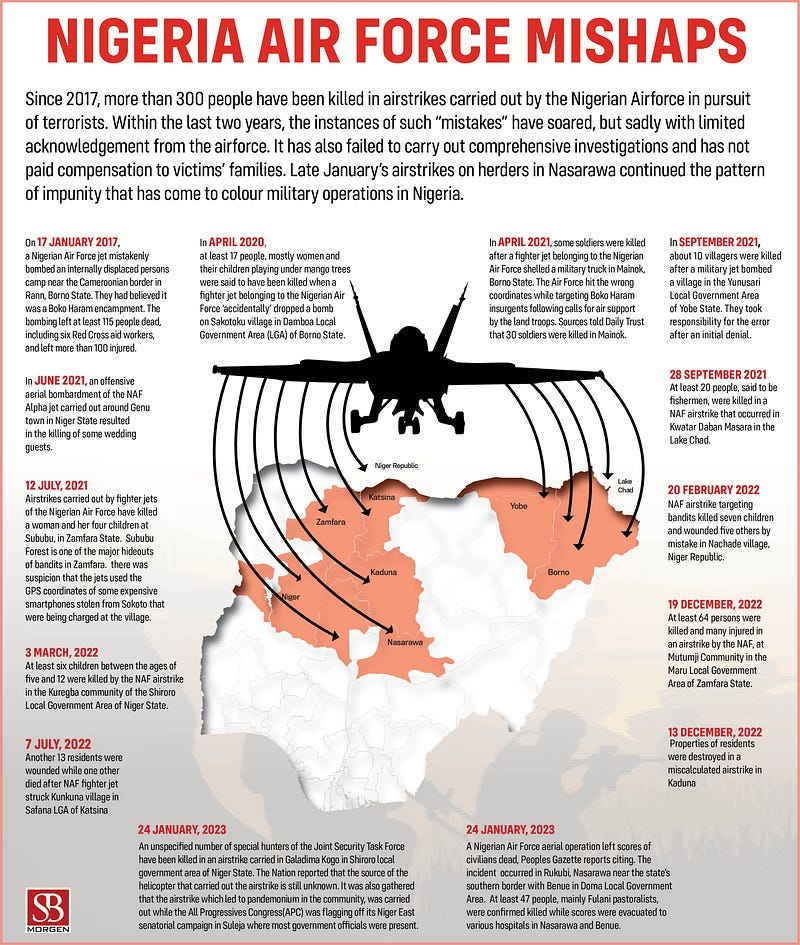
Nigeria’s well-documented affair with impunity shows up in every facet of national life, including politics and governance. An absence of will to tackle the air force’s impunity has led to more mishaps involving human lives than necessary. The first major incident of air force mishaps in recent years was the Rann bombing in January 2017 which killed over a hundred internally displaced persons in Borno. The air force was pressured to acknowledge that mistake but nothing more. Since then, the service appears to have construed that pressure as bullying and stopped responding to what the military establishment and its patronage systems have always termed “foreign meddling” or “interference.” Those terms have also served as a useful euphemism for the military when it criticises civil society groups baying for accountability. Failing to acknowledge this problem when it cared to respond, it often blamed incidents on faulty intelligence. The army has found itself in the firing line sometimes. In April 2021, a military source said that an Air Force fighter jet on a mission against Boko Haram extremists mistakenly bombed men of the Nigerian Army, killing over 20 officers. The soldiers who were reinforced from Ngandu village were said to be on their way to Mainok, headquarters of the Kaga Local Government Area of Borno State which was under attack by Islamic State West Africa Province (ISWAP) terrorists. This particular incident heightened the rivalry between the air force and the army, with the latter intensifying efforts to get its own air wing. In all of these incidents, the government has not mandated the air force to investigate. Even when NAF’s leadership promised one, it never materialised, at least not publicly. With more international attention on last week’s incident in Nasarawa, it will be hard for the military and the air force to secure international material support in its fight against terrorism. Despite assurances made in 2021 by the Chief of Air Staff to the US that jets will be used against terrorists in the North West, the air force has not exactly lived up to that promise, and with each incident, it digs itself into a corner that it should never have been in the first place.