
Combat-ready
The Nigerian Army intercepted an international smuggling syndicate transporting smuggled ammunition to Anambra State. Army spokesperson…

The Nigerian Army intercepted an international smuggling syndicate transporting smuggled ammunition to Anambra State. Army spokesperson, Onyema Nwachukwu, said the troops, acting on a tip-off, conducted a rigorous stop-and-search operation along Ajilete-Owode Road in Ogun State. In a related incident in Delta State, two Indigenous People of Biafra (IPOB) fighters were killed during a joint operation by the Nigerian Army, Police and Department of State Services. The IPOB members had attacked a community in Asaba, in Nigeria’s South-South region, leading to a fierce gun battle with security operatives. The criminals eventually withdrew due to the superior power of the security agents.
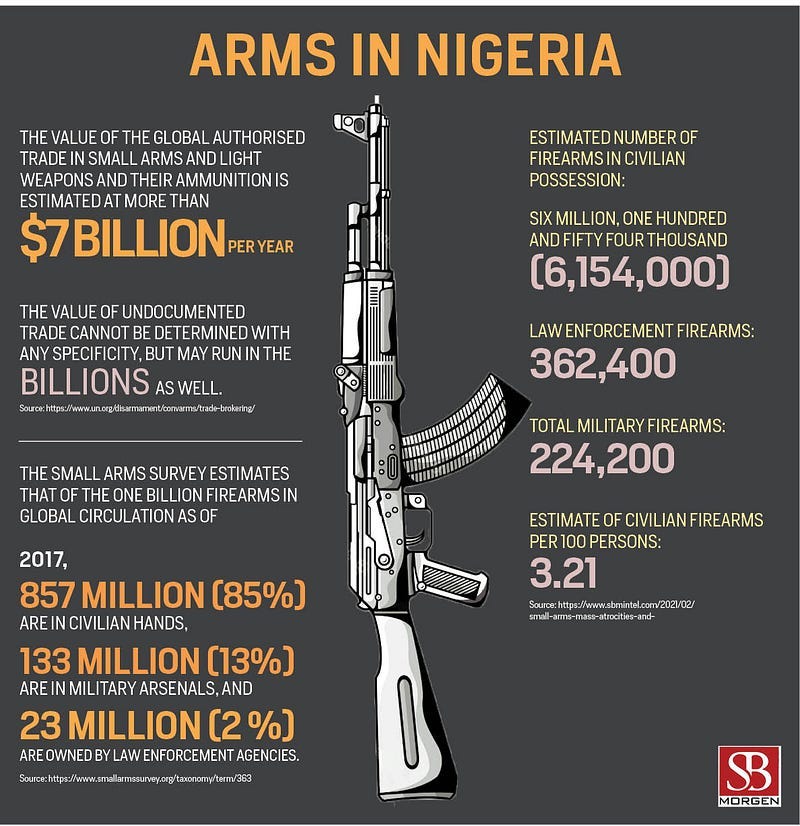
According to the Nigerian Customs Service, 21,548,608 arms and ammunition were shipped into Nigeria illegally between 2010 and 2017. The largest cache of 21,407,933 live ammunition was intercepted at the Apapa port in November 2010, while 1,100 pump action guns were seized at Tin-Can port in September 2017. Although security agencies regularly announce arms interception and seizure, the arms that slip away from interception could be more. There are at least 1499 illegal entry points into the country, adding to the problem of poorly manned official entry points. This latest cache was intercepted at Yewa North, a border local government in Nigeria’s South West which is among the most policed in the Western border area. Yewa North is one of the several local government areas in Nigeria’s West where insecurity is rife following poor security and unprofessional conduct of the Nigerian Customs Service and Immigration officials. Although a large majority of the seized arms are mostly imported, given the location of the seizures, domestic production of components and shipments by local gunrunners remain a headache. It is a whole industry that the government has ignored for years, looking away as some of its security agents were indicted in such practices. When the police elite’s operatives arrested prominent gunrunner Hamisu Bala Wadume in August 2019, army captain Tijjani Balarabe freed him from police custody, killing three police officers and two civilians in the process. For crimes ranging from armed robbery to gang clashes, Wadume’s expertise has proven instrumental, and his seven-year jail term, beginning in August 2022, only took one player away from the industry. The government finally realised that it had been sleeping on a goldmine of insecurity drivers last week when the South-West zonal coordinator of the National Centre for the Control of Small Arms and Light Weapons, Sola Akinlade, announced that the centre (created in 2021) would soon move against local manufacturers. Nigeria’s fragile security has shown that the state is bleeding on all sides. Coupled with the ammunition proliferation issues is the presence of IPOB, a group that has intensified attacks in the South East and aims to expand beyond it, posing a serious national security threat. To stall its spread and dominance, the Nigerian government must apprehend IPOB leaders, disrupt their operations, dismantle their infrastructure by deploying forces, and engage the communities to build trust with ethnic Igbos to make landmark progress. Curbing Nigeria’s multifaceted security issues requires a comprehensive approach, and mopping up locally-manufactured arms and tackling IPOB’s menace are two parts of a much bigger problem, and the commitment to attending to it is yet to be seen.