
Côte d’Ivoire searches for missing billions
Former Ivorian candidate Don Mello calls for an investigation into alleged CFA39bn embezzlement at the tax directorate.

Former Ivorian presidential candidate Ahoua Don Mello has called for an independent investigation into the alleged embezzlement of 39 billion CFA francs (about USD 68.7 million) at Côte d’Ivoire’s General Directorate of Taxes. He urged authorities to ensure transparency, due process and accountability while seeking the recovery of any stolen public funds. Don Mello also proposed an independent audit of tax administration and recommended using digital technologies, including artificial intelligence and blockchain, to strengthen transparency, combat corruption and improve public financial management.
The alleged 39 billion CFA franc affair remains far less settled than public debate suggests. No authority has established that 39 billion CFA actually disappeared from the Treasury. Rather, the figure represents an estimate of financial damage linked to allegedly fraudulent tax-relief operations contained in a complaint filed by the Tax Agents’ Union (SAGI) with the Economic and Financial Prosecution Pole (PPEF) on 21 July 2026. Two sharply competing narratives have since emerged. The director-general of the General Directorate of Taxes (DGI), Ouattara Sié Abou, categorically rejects accusations that his administration orchestrated the fraud. He argues that an internal review conducted during a February 2026 seminar in Yamoussoukro uncovered irregular tax reliefs granted outside any legal basis, after which the matter was referred by the DGI itself to the PPEF. Abou further maintains that he possesses no personal electronic signature capable of authorising online tax relief, insisting that such authority belongs to regional directors and heads of tax centres. According to his version, rogue officials forged secure electronic credentials and validated fraudulent files overnight from clandestine terminals. SAGI, however, portrays the leadership not as whistleblowers but as complicit in the scheme. The director-general later reinforced his position by publicly reprimanding a union official during a departmental seminar on 31 July for discussing the case, citing professional secrecy. Consequently, what the union characterises as a 39 billion CFA loss remains, at this stage, an estimate of damage arising from tax write-offs that investigators have yet to determine were fraudulent.
Regardless of which account ultimately proves accurate, former presidential candidate Ahoua Don Mello’s intervention identifies the broader structural vulnerability. His call for an independent investigation, recovery of any misappropriated public funds, and an audit supported by artificial intelligence and blockchain technology focuses on the abuse of *dégrèvements* and *exonérations*, tax reliefs and exemptions that remain among the least transparent elements of Côte d’Ivoire’s revenue administration. These discretionary mechanisms have repeatedly been highlighted by the IMF as major leakage points within the country’s tax system. While digital auditing tools could strengthen oversight, digitalisation alone cannot eliminate abuse, particularly if electronic validation systems themselves were allegedly exploited. The more meaningful safeguard is whether any forensic audit is conducted independently of the agencies under investigation and whether the PPEF ultimately publishes verifiable findings rather than confidential conclusions.
The timing significantly heightens the political sensitivity of the affair. Only days before the allegations became public, Finance Minister Adama Coulibaly and Justice Minister Sansan Kambilé toured the PPEF’s new headquarters on 25 July, presenting it as evidence of Côte d’Ivoire’s strengthened commitment to combating financial crime and satisfying the requirements of the Financial Action Task Force (FATF). In June 2026, the FATF concluded that Côte d’Ivoire had substantially completed its action plan, paving the way for an on-site assessment ahead of a possible removal from the organisation’s grey list. Allegations of large-scale fraud within the country’s tax administration therefore provide critics with an immediate challenge to those reform claims and increase pressure on prosecutors to demonstrate visible, impartial enforcement. The controversy also coincides with a separate alleged 50 billion CFA affair involving funds earmarked for local authorities, which the government disputes, while the Court of Auditors’ review of the 2024 budget identified nearly 43 billion CFA in rejected cheques and cumulative balances, including 9.61 billion CFA attributed to the DGI, reinforcing broader concerns over weaknesses in public financial management.
Although Côte d’Ivoire has made measurable progress in strengthening its anti-corruption institutions compared with many regional peers, its central challenge remains public confidence in enforcement rather than the absence of legal frameworks. The country has steadily improved its standing on Transparency International’s Corruption Perceptions Index since 2013 and has established specialised financial crime institutions, the High Authority for Good Governance, and an asset declaration regime. Hundreds of public officials have faced embezzlement-related charges over the years. Yet several high-profile prosecutions, including that of Jacques Ehouo, have been widely interpreted domestically as politically selective, fostering persistent scepticism that accountability depends less on evidence than on the status of those implicated. Correspondence from a cement company in December 2025 reportedly warning of questionable tax relief practices further suggests that concerns may have existed months before formal investigations began. Consequently, the credibility of the current investigation will depend not only on whether officials are prosecuted but also on whether companies that allegedly benefited from unlawful tax write-offs face comparable scrutiny.
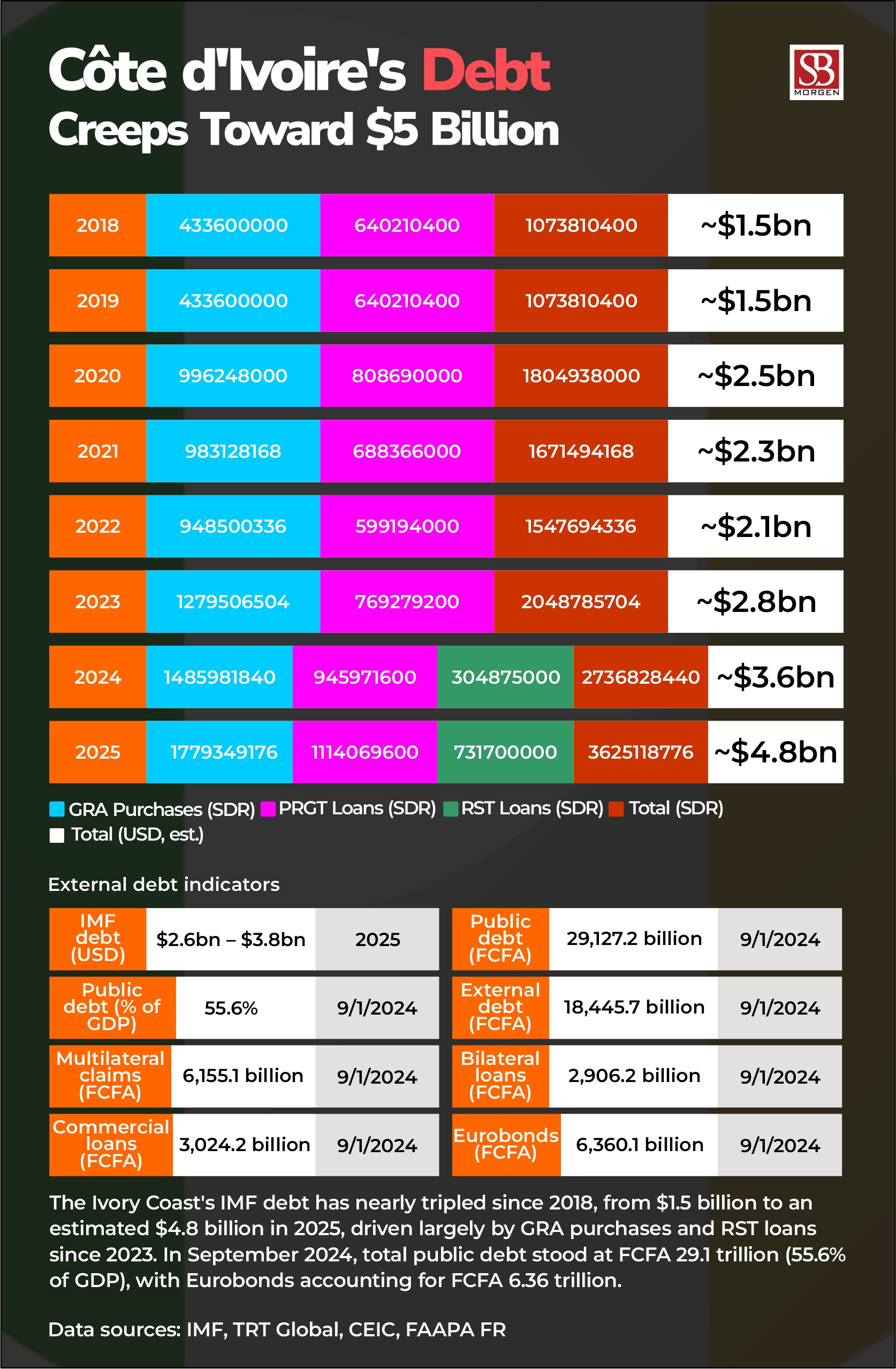
The fiscal implications extend well beyond governance concerns. Côte d’Ivoire’s tax-to-GDP ratio stood at approximately 14.9 percent in 2025, while its IMF-supported Medium-Term Revenue Mobilisation Strategy aims to raise that figure toward 18 percent through stronger compliance and a broader tax base. During the sixth review of the Extended Fund Facility and Extended Credit Facility programmes in June 2026, the IMF permitted a temporary widening of the fiscal deficit target to 3.8 percent of GDP to accommodate the economic effects of the Middle East conflict. However, the government simultaneously committed to restoring the deficit to the WAEMU convergence ceiling of 3 percent by 2028. That fiscal path leaves limited room for revenue losses arising from fraudulent tax exemptions or write-offs. For investors, therefore, the significance of this affair lies less in whether exactly 39 billion CFA ultimately proves missing than in what the investigation reveals about the fairness and predictability of Côte d’Ivoire’s tax administration. If unlawful tax relief enabled certain companies to reduce their liabilities while compliant businesses paid in full, the issue becomes one of competitive neutrality as much as public finance. A transparent prosecution accompanied by independently verifiable findings would reinforce the anti-corruption architecture the government has promoted to both the FATF and the IMF. Failure to do so would deepen perceptions that tax exemptions remain vulnerable to discretionary influence, benefiting well-connected interests while ordinary taxpayers shoulder the burden of financing an indebted state struggling to provide essential public services such as roads, water and healthcare.