
Crossfire
More than 60 people are feared to have been killed in a fierce fight between Boko Haram fighters and another jihadist group affiliated with…

More than 60 people are feared to have been killed in a fierce fight between Boko Haram fighters and another jihadist group affiliated with the Islamic State in the Lake Chad region. Sources said the fighting took place when the Islamic State’s West Africa Province (ISWAP) fighters ambushed a fleet of Boko Haram boats on the islet of Kaduna Ruwa in Lake Chad, which straddles Nigeria, Niger, Cameroon and Chad. “Nine Boko Haram boats and all the fighters on them were sunk,” AFP reported, adding that several hostages were also present on these boats.
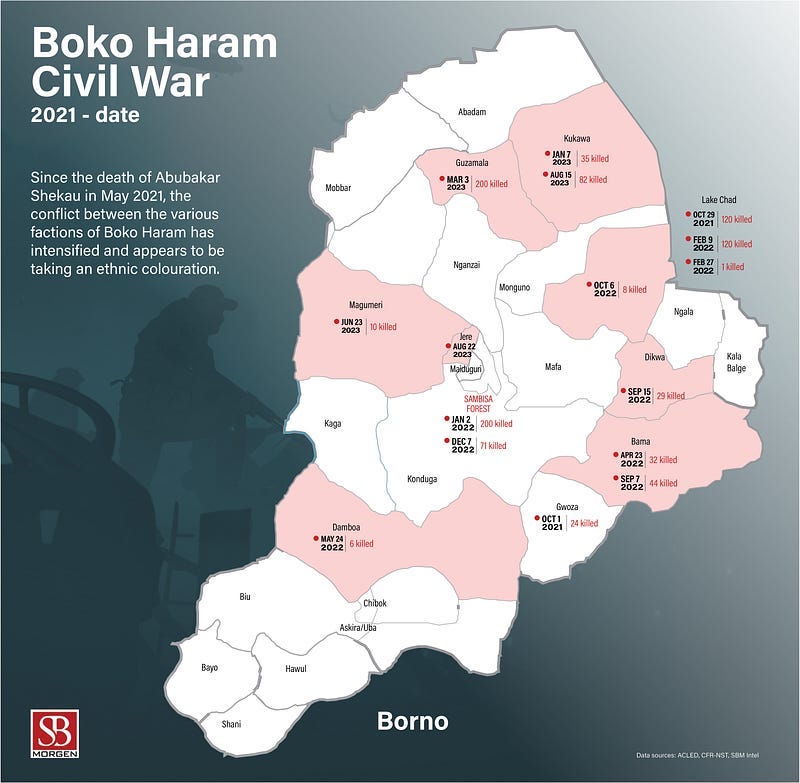
In the battle between the two major Boko Haram factions, one of the biggest casualties has been economic activities in the areas under their control. The Kaduna Ruwa islet links the area to the larger Lake Chad, whose basin is the primary source of economic activities for communities in the four countries bordering it. Since the insurgency hit full swing a decade ago, the displacement it has wrought has meant more people falling under the poverty line. In a way, the lack of fishing and other economic activities in the lake for years helped ecolife return, more importantly, the natural re-filling of the lake, which was at risk of a dry-up. However, the battle for control between both factions has robbed the resettled Internally displaced Persons (IDPs), especially in fishing communities such as Baga, of the opportunity for economic survival. This is largely because of the taxation systems the rival factions have instituted to control the trade. Before the death of Jamāʿat Ahl al-Sunnah (JAS) faction leader Abubakar Shekau in 2021, his group was considered the weaker faction, having suffered significant losses in terms of personnel, resources and territory to the Islamic State-backed faction and the Nigerian military. However, subsequent leadership changes and shifting towards a conservative survival strategy have helped JAS regain some of its strength. Under the leadership of Amir Bakura Buduma, the group has even taken the fight to its rival, ISWAP. Under normal circumstances, the ongoing clashes between JAS and ISWAP would benefit the Nigerian government, providing a foundation for its amnesty programmes, such as Operations Safe Corridor (military-run) and Sulhu (SSS-run). However, the frequency and intensity of these clashes, as well as the high death toll on both sides, indicate that the government’s strategy of decimating the groups is not yielding the desired results. Both factions continue to carry out successful attacks, demonstrating a resilience that policy planners must acknowledge and address. It underscores the alarming absence of effective governance and security measures in this volatile area. The ability of jihadist groups to operate freely, amassing fleets of boats and engaging in open warfare without fear of intervention, highlights the critical need for a more robust and proactive approach to curbing the proliferation of extremism in the region. The Lake Chad Basin, spanning Nigeria, Niger, Cameroon and Chad, has long been a breeding ground for jihadist activity. The vast and remote terrain, coupled with porous borders and weak government presence, has created an environment conducive to the growth and movement of terrorist groups. The lack of effective border control has allowed jihadists to move freely across the region, establishing strongholds, recruiting fighters and acquiring weapons without significant hindrance. Their ability to operate openly and engage in turf wars, as evidenced by the recent clash between Boko Haram and ISWAP, demonstrates the extent to which these groups have capitalised on the absence of effective governance. The need to strengthen border security, enhance local governance and invest in local infrastructure, education and employment opportunities to reduce the appeal of extremism and foster community resilience has never been more urgent.