
Cycles of violence
Recent attacks in Plateau, Niger, and Delta states left dozens dead or abducted, with ransom recoveries and arrests.

Recent security incidents across Nigeria highlight persistent challenges. In Niger State, bandits killed six farmers and abducted dozens in Rijau and Mariga LGAs over three weeks, also looting and rustling cattle, fuelling local fear. In Delta State, police recovered ₦5 million in ransom and arrested five suspected kidnappers linked to multiple abductions in Ogwashi Ukwu. A separate police operation along the Pantani-Ughelli Expressway killed six suspects in a shootout. In Plateau State, a suspected Fulani militia raid in Bindi killed at least 20 and injured many, with local groups accusing the government of neglect amid alleged displacement campaigns. Authorities remain silent.
The recent Bindi killings underscore the ongoing cycle of violence plaguing Plateau State and extending across Nigeria’s Middle Belt and North Central regions. These attacks are not isolated incidents but symptoms of a broader security collapse characterised by systemic failures and apparent negligence. Prior warnings of escalating violence in Riyom and Mangu Local Government Areas (LGAs), where smaller attacks by armed Fulani militias from Ganawuri and Fulani Bangwai communities persisted, were reportedly ignored. Survivors report a two-hour assault on Bindi-Jebbu on 15 July 2025, with only a feeble response from locally stationed Operation Safe Haven troops, whose reinforcements reportedly stood idle.
Such security paralysis, suspected to stem from willful negligence or collusion, fuels a siege mentality among ethnic groups who have resorted to forming vigilante unions to compensate for the state’s abdication of its protective role—particularly when Fulani militias perpetrate attacks. This phenomenon is part of a wider security vacuum across northern Nigeria, where ungoverned spaces allow armed groups to operate with impunity.
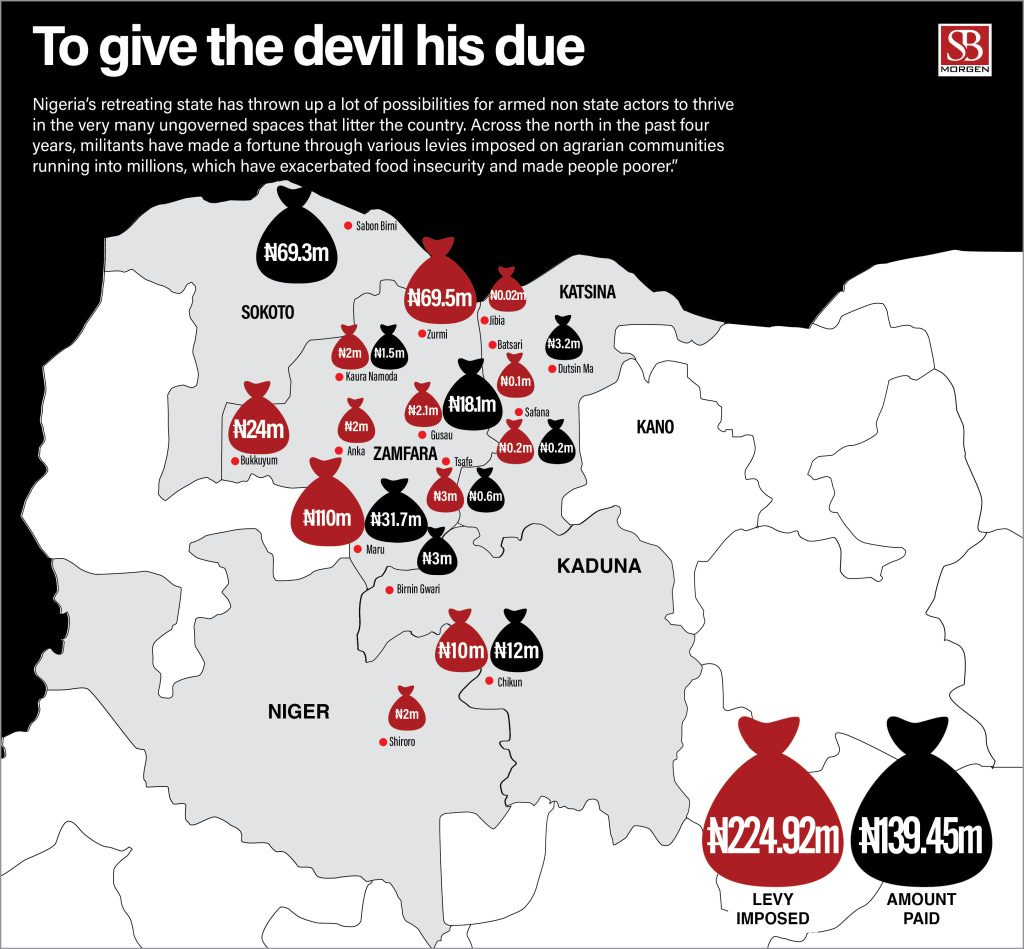
Despite isolated successes, such as the recovery of ransom payments in Delta State, confidence remains low, especially in Niger State, where banditry is intensifying. SBM Intel’s 2024 report, Levies or Lives: The Dilemma of Farmers in Northern Nigeria, documented that farming communities across the North West and North Central zones paid ₦224 million in levies to bandits—62% of demands totalling ₦339 million—exacerbating a food security crisis in Nigeria’s agricultural heartland. The absence of a coherent and sustainable security strategy not only undermines territorial control but also accelerates the erosion of state legitimacy.
Recent attacks in Mariga and Rijau LGAs, Niger State, typify this trend. In mid-July 2025, bandits mounted coordinated assaults involving over 200 motorcycles, armed with AK-47s and anti-aircraft ammunition, looting cattle, abducting dozens—including women—and terrorising communities. Security presence was minimal and delayed; no soldiers were present in Rijau at the time, with tactical teams arriving hours after the attacks. While Joint Task Forces claimed to have neutralised 30 attackers elsewhere, Mariga and Rijau remain vulnerable due to thin security infrastructure. The assaults have caused widespread trauma, displacement, and a halt in farming activities, deepening food insecurity. Bandits often exploit porous borders with Zamfara State, utilising forested routes to transport stolen cattle. Some are linked to jihadist groups, such as the ISGS-affiliated Lakurawa, which may provide funding, training, or coordination. Local vigilantes are active but poorly armed and outmatched, highlighting the need for formalised, well-equipped Forest Marshal units and community intelligence networks. Cross-border security cooperation with Zamfara and Kebbi is essential to disrupt bandit supply lines.
In Plateau State, the pattern of violence is similar but intensified by ethnic and religious dimensions. The Bindi-Jebbu attack on 15 July 2025, carried out by suspected Fulani militias, resulted in at least 20 deaths and numerous injuries, involving systematic house-to-house raids and arson. Local organisations accuse attackers of a coordinated displacement campaign aimed at land seizure, with prior intelligence warnings reportedly ignored. Despite the proximity of Operation Safe Haven units, reinforcements failed to intervene, reinforcing perceptions of security force complicity or paralysis. Plateau’s violence has escalated since December 2023, when over 160 were killed in mass killings across Bokkos and Barkin Ladi. Humanitarian groups report over 1,300 deaths and nearly 30,000 displaced in early 2025 alone. The conflict centres on land disputes, resource competition, and ethnic-religious tensions, disproportionately affecting indigenous Christian farming communities. Effective responses remain limited.
Recommendations include an independent inquiry into security failures and possible collusion, enhanced rural patrols with rapid response capabilities, formalisation and better equipping of local vigilante or agro-ranger units, targeted operations against known militia bases, and integrated humanitarian relief. Mediation programs to resolve land and grazing disputes are also critical.
Amid these challenges, law enforcement has recorded some tactical successes. In July 2025, coordinated raids by the Special Anti-Kidnapping and Cyber Crime Squad led to the arrest of multiple suspects linked to kidnappings in Delta State, recovering ransom funds and dismantling hideouts. A separate operation along the Patani–Ughelli Expressway resulted in a gunfight, killing six heavily armed suspects and seizing firearms. These operations suggest improvements in intelligence and response times but underscore the scale of organised criminal networks still at large. Overall, Nigeria faces a multifaceted security crisis marked by state retreat, insurgent and bandit proliferation, and ethnic violence. Without sustained, coordinated, and well-resourced strategies combining military, intelligence, community engagement, and humanitarian measures, the erosion of state authority and worsening humanitarian impact will continue unabated.