
Deadly rails
At least 30 people comprising the Nigerian Railway Corporation (NRC) staff and passengers were kidnapped at the Igueben train substation in…

At least 30 people comprising the Nigerian Railway Corporation (NRC) staff and passengers were kidnapped at the Igueben train substation in Edo State. On Saturday night, the Edo State Police Command announced that scores of travellers waiting to board a train from Igueben in Igueben Local Government Area of the state to Warri in Delta State were kidnapped by suspected herdsmen. Police and the state government, on Tuesday, said seven victims had been rescued so far, and two suspects on the police’s wanted list had been arrested. The police, in a press statement, stated that the incident happened at about 4.00 pm on Saturday. According to the statement, the suspected herdsmen, armed with Kalashnikov rifles, invaded the train station and shot sporadically into the air before herding an unspecified number of intending travellers into the bush. The police said that bush combing and rescue operations had begun. The Nigeria Railway Corporation (NRC) announced the station’s closure in a short message on Sunday.
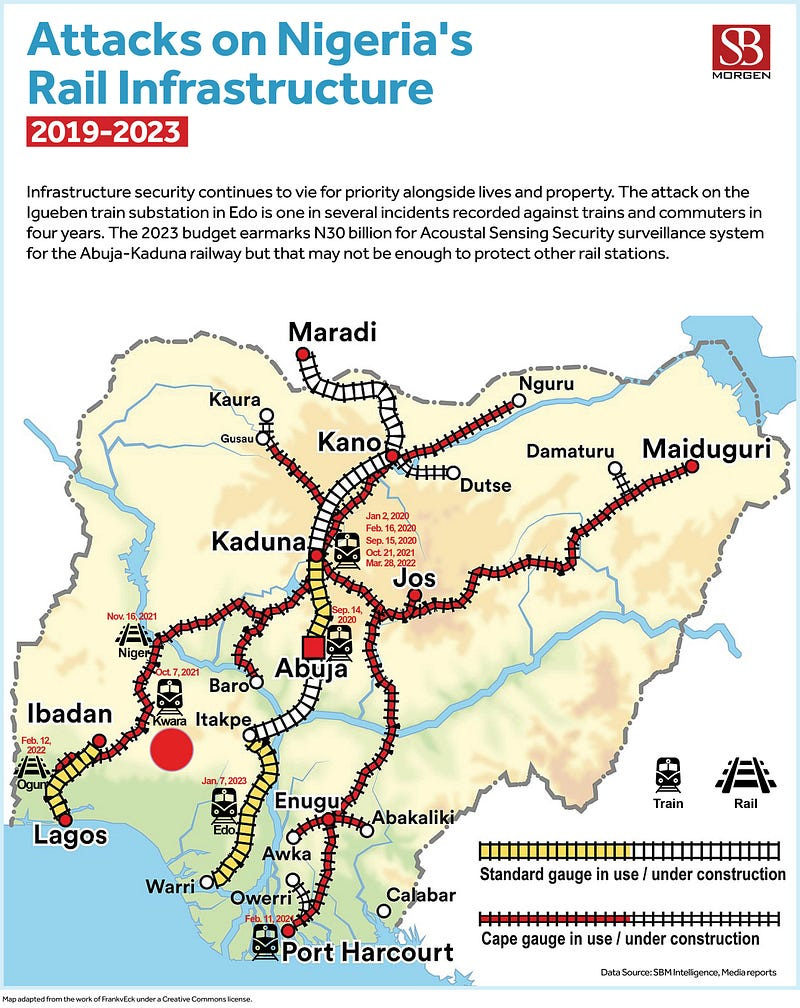
As more sectors become victims of Nigeria’s rising insecurity, no sector has attracted more umbrage than transport which has weathered repeated sabotage by armed groups hoping to land a huge score. Fresh from attacking airports and roads, criminal groups have taken to rail services to drive home the point. What makes the Igueben train abduction different from the infamous 2022 Abuja-Kaduna train attack is that in the latter, the perpetrators worked as a consortium of interests, with factional Boko Haram groups such as Al Qaeda-backed Ansaru, and the Islamic State West Africa Province (ISWAP) banding together with smaller allied groups such as Darul al-Salaam to press home demands that ranged from the economic to the political. With Edo, assigning ₦20 million per person in a collection of 32 victims indicates that the act is purely economic. However, as failures go, this abduction is emblematic of state failure in protecting critical infrastructure like rail services and failing to read the signs and plug holes where necessary. The location where the incident happened has been subject to sustained attacks by criminal groups for at least four years, with near-weekly abductions of road commuters. The Igarra section of Edo North and deep into the Ethiope areas of neighbouring Delta State have been occupied by suspected armed herders who engaged in kidnap for ransom. Failure to engage these various groups has ensured their continued dominance in the area, preparing the way for a score this big to happen. For one, citing infrastructure in a high-security risk environment belies the logic of securing billions of dollars in foreign infrastructure loans and hoping to recoup when such projects go live. In addition, the political pressures the state is put under to ensure infrastructure delivery in even the most volatile areas does no good when it is constrained to commit even more resources to securing them. Taken in a more general context, there is sadly no good time to improve infrastructure given how resigned the state is to the current situation. The show must go on after all.