
Deadly strikes
At least 69 people were killed in three separate incidents, including an airstrike, a herder attack, and an Islamist militant attack.

A Nigerian Air Force airstrike in Tungar Kara, Zamfara State, mistakenly killed at least 20 people, including members of the Zamfara Community Protection Guard, during a joint operation against terrorists. Meanwhile, suspected cattle herders attacked Tattara in Karu LGA, Nasarawa State, killing nine and injuring several others. In Borno State, Islamist militants killed 40 farmers in Dumba, outside military-designated safe zones. The attack exacerbated Borno’s food crisis, worsened by flooding and insurgency. Governor Babagana Zulum condemned the attack, urging decisive military action. Authorities are investigating and imploring residents to adhere to safety corridors established by security forces.
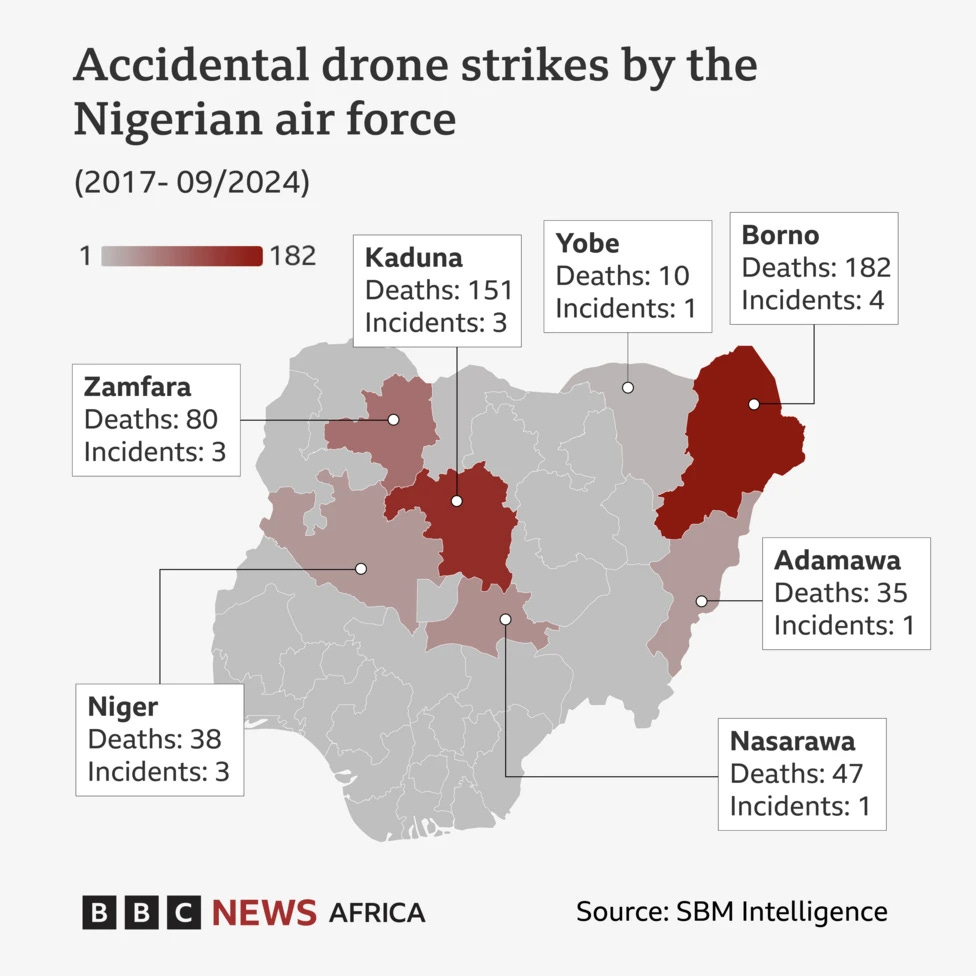
Since 2017, when misguided attacks on civilians by the military became a thing, the Nigerian military, which in this case includes the airforce as well as the army’s aviation wing, has killed no less than 581 civilians and friendlies alike in 20 of these incidents. At first, it was a rare event that happened once in a year or two, but these events have seen a near frequency and spike since 2021.
The development can be attributed to the evolutionary strategy of personnel preservation in the face of a proliferation of ungoverned spaces, which, in the military’s view, could only be accessed operationally from the sky. More importantly, operational challenges such as faulty intelligence and logistical impasses have been the bane of these developments. However, these strikes persist not because the military lacks alternative methods for prosecuting its war on terror but because it has failed to reassess the growing toll of casualties, even when military personnel are among the victims. This was evident in April 2021, when an accidental strike killed 30 ground troops in Mainok, Borno, during an operation against the Islamic State.
Although the group’s potency remains, this latest massacre was carried out by its JAS rivals. Dumba is said to be controlled by ISWAP, but JAS maintains interest even after being dislodged from there by its rivals. ISWAP collects revenues, but JAS is angry at the people for not remitting to it even though fishing activities in the area are tightly controlled and regulated by ISWAP.
This latest massacre, which eyewitnesses say has more than a hundred people missing, contradicts the state government’s claim that much of the state is safe enough for IDPs to return. The Dumba victims were IDPs from Baga, Doron Baga, Gwoza, Maiduguri, and people from Kebbi and Sokoto states in the Northwest. Also, it is a reminder that the worst of the rivalry between both Boko Haram factions is not necessarily felt by the belligerents themselves but by civilians who are forced to pick a side.