
Despite reforms, poverty persists
The World Bank warns Nigeria's economic reforms are failing its people, as poverty remains rife and UN data shows the world's lowest life expectancy.

The World Bank has urged Nigeria to ensure ongoing reforms improve citizens’ welfare, warning that 139 million Nigerians still live in poverty despite signs of economic stability. At the launch of the Nigeria Development Update in Abuja, Country Director Mathew Verghis said exchange rate and fuel subsidy reforms have set a foundation for growth but must now “deliver for the people.” Meanwhile, the UN’s 2025 Global Health Report ranked Nigeria lowest globally in life expectancy at 54.9 years — far below the world average of 73.7. The report linked the decline to poor healthcare, insecurity, and poverty. Experts are calling for stronger health and social protection investment to match the government’s economic reform efforts.
The latest World Bank warning that Nigeria’s reforms must begin to deliver tangible improvements in citizens’ welfare exposes a troubling paradox at the heart of Africa’s largest population. While officials in Abuja tout the removal of fuel subsidies and the liberalisation of the exchange rate as evidence of fiscal courage, the reality that most Nigerians live in remains one of deepening hardship. With 139 million people still trapped in poverty and life expectancy now the lowest in the world at 54.9 years, Nigeria’s so-called “reform momentum” risks becoming a technocratic illusion, growth without development, stability without inclusion.
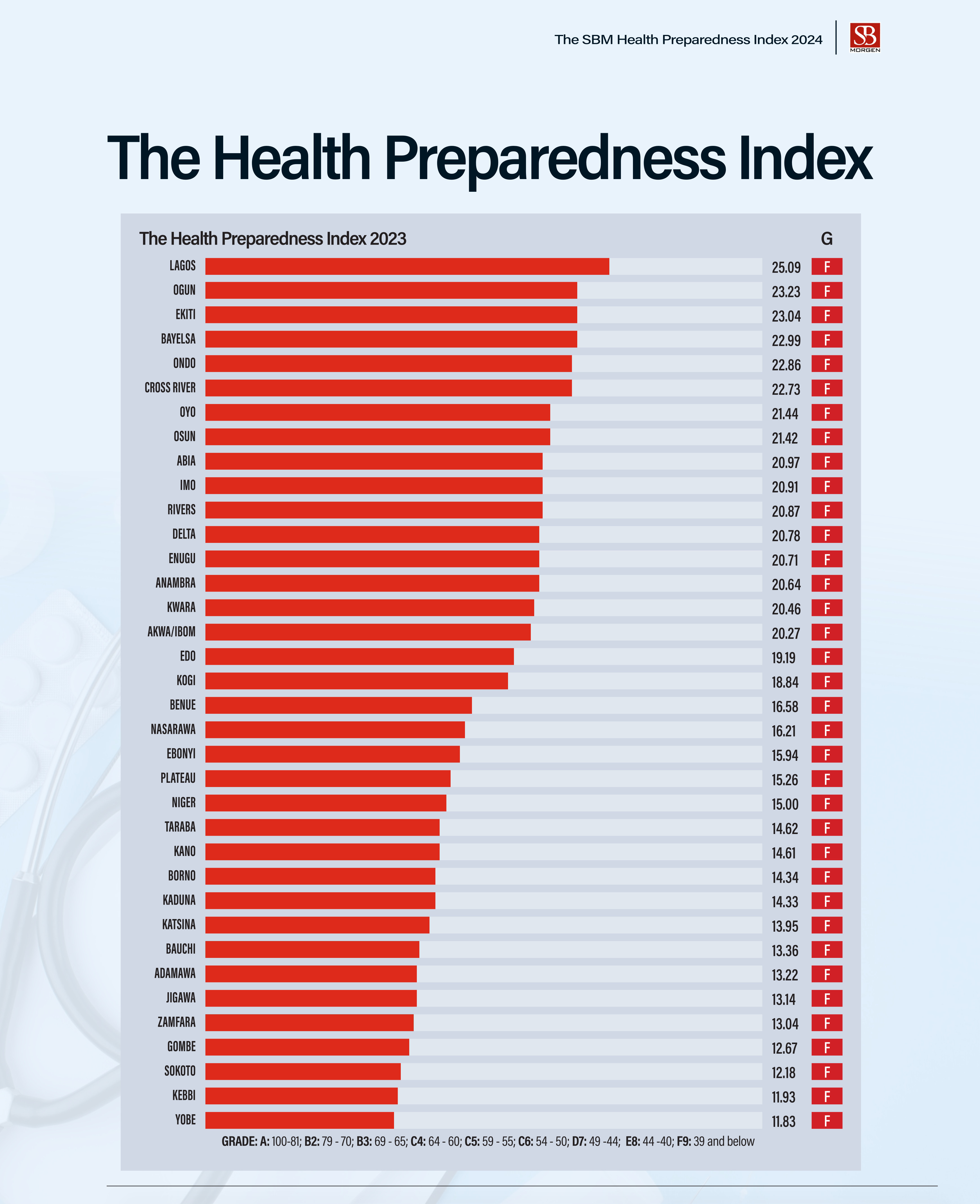
This crisis is starkly illustrated by the 2024 SBM Health Preparedness Index (HPI), which reveals a healthcare system in profound distress. According to the report, the national life expectancy figure, a mere 54 years, is not an abstract statistic but a direct consequence of systemic failure. The HPI highlights alarming indicators: an under-five mortality rate of 107 per 1,000 live births and a maternal mortality ratio of 1,047 per 100,000. These figures are compounded by persistent outbreaks of diseases like diphtheria and cholera, a crippling brain drain of medical professionals, and skyrocketing drug prices that have made basic care inaccessible for many. Alarmingly, early indications suggest that the forthcoming 2025 HPI, due for publication in November, will show no meaningful improvement, with the underlying trends pointing to a further deterioration in the country’s health security.
Last year’s HPI further underscores a critical funding gap at the subnational level, where healthcare is primarily delivered. While the average state health budget allocation improved to 9.29% in 2023, this remains below the 2020 average of 11.80% and is wildly insufficient. The HPI rankings reveal a country of two halves: southern states like Lagos, Ogun, and Ekiti lead the index, albeit with modest scores, while northern states such as Yobe, Kebbi, and Sokoto occupy the bottom positions, indicating a severe regional disparity in health outcomes and infrastructure.
The crisis is further illuminated by a continental comparison. According to the latest UNDP data, Nigeria ranks a lowly 29th in Africa on the Human Development Index. More tellingly, its life expectancy of 54.8 years is not just the continent’s worst, but it languishes far behind nations with similar economic standings, from Ghana to Kenya, and is eclipsed by over two decades in North African countries like Tunisia and Algeria. This confirms that Nigeria’s plight is not merely one of poverty, but a profound failure to convert national resources into longer, healthier lives for its population.
The truth is that most of the reforms undertaken over the last two years have been crisis management measures, not prosperity-oriented policies. Their removal, though fiscally logical, has thrust millions into deeper distress without an adequate social protection framework. Inflation and food insecurity have eroded livelihoods, while the collapse in life expectancy is a glaring indictment of policy failure. Poor healthcare infrastructure, malnutrition, and chronic insecurity have created a cycle where poverty fuels ill health, and ill health entrenches poverty. This is the APC report card, particularly for the Buhari years. Nigeria became, and remains, the poverty capital of the world. On virtually all Human Development Indicators, the country is failing its people.
We expect the usual rebuttals from government officials, but they cannot erase the facts on the ground. Nigeria needs a decade-long, China- or India-style drive to reverse this trend and lift millions out of poverty. It must abandon its obsession with protecting oligarchs who hide inefficiency behind slogans of patriotism and focus instead on what delivers goods and services to Nigerians at the lowest possible cost. Economic planning must shift from emergency stabilisation to structural transformation, building productive capacity, creating jobs, revitalising agriculture, and strengthening the social safety net. A government’s success should not be judged by how well it balances books or attracts investment, but by whether its citizens can live longer, healthier, and more dignified lives. Anything less will leave Nigeria trapped in an endless cycle of poverty and crisis management.