
Device check
The Supreme Court, on Tuesday, affirmed Ademola Adeleke of the Peoples Democratic Party (PDP) as the validly elected Governor of Osun…

The Supreme Court, on Tuesday, affirmed Ademola Adeleke of the Peoples Democratic Party (PDP) as the validly elected Governor of Osun State. In its lead judgement delivered by Justice Emmanuel Agim, the apex court dismissed an appeal lodged against Adeleke’s election victory by Adegboyega Oyetola, the All Progressives Congress (APC) candidate. It held that though Oyetola alleged that Adeleke won through over-voting in 774 polling units in the state, he failed to produce any Bimodal Voters Accreditation System (BVAS), a machine that was used in any of the polling units to prove his allegation.
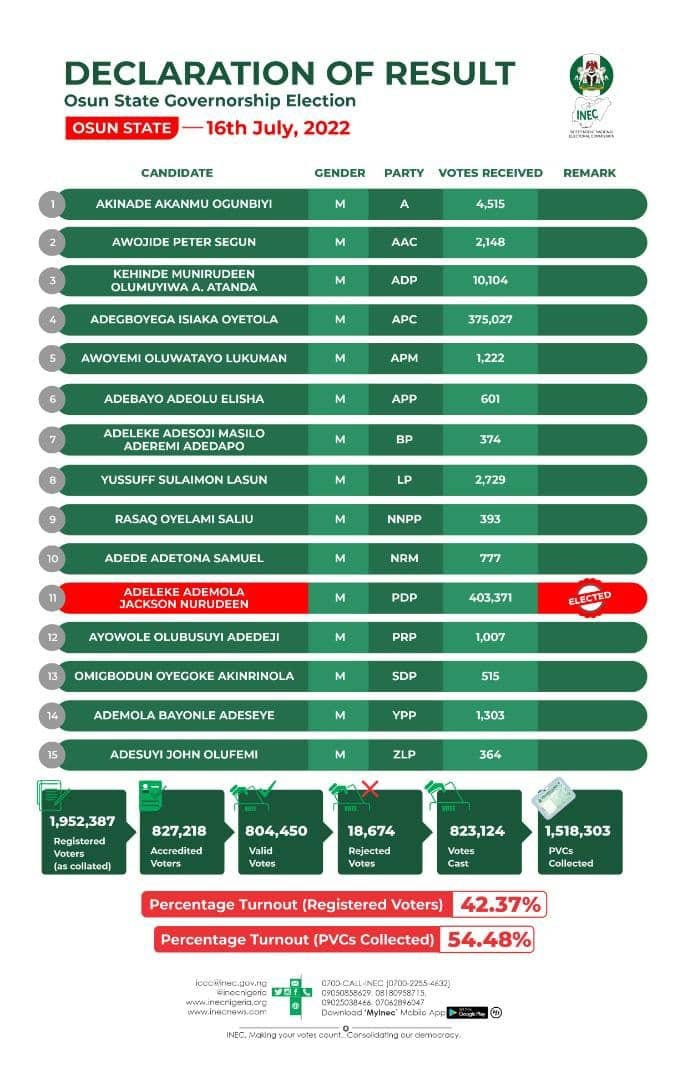
The Biometric Voter Accreditation System (BVAS) is the signature piece of technology used by the Independent National Electoral Commission (INEC) for voter identification and accreditation during elections to prevent multiple voting, minimise electoral fraud and improve the electoral process. As a result, it has never strayed far from the headlines. Zooming in on Osun, the APC’s Oyetola lost because he could not provide proof from BVAS to prove his allegation that there was over-voting in the state’s 774 polling units. This judgement implies that BVAS evidence has become the primary basis upon which elections may be challenged. It also means that access to the BVAS and its accompanying technology, the INEC Result Viewing Portal (IReV), will become even more important in subsequent elections. Considering how INEC performed with these technologies during the recent national elections, underdelivering despite a whirlwind of promises, we hope they will be scrutinised closely. This is important for enhancing the health of Nigeria’s democracy. The Osun verdict may be a significant indicator of how the major election tribunals in the 2023 cycle will view the petitions before them, especially if the Supreme Court remains consistent when disputes are inevitably brought before it. Ideally, this should suggest that the BVAS would be allowed to shape the direction of post-election litigation concerning the presidential election. However, that would depend on the human element and to what extent the Nigerian judiciary would be willing to be principled about letting the evidence guide their decision-making. History does not offer an optimistic guide with respect to the presidential tribunal, but all we have to traffic on is hope. In many ways, that has been the story of Nigeria’s democracy — hope.