
Divided, they fall
Fighting resumes between Boko Haram and ISWAP in Nigeria, weakening both groups.

Fighting has resumed between Boko Haram and ISWAP in Borno State, Nigeria, just two weeks after a failed reconciliation attempt. The clash occurred around ISWAP camps in Toumbun Gini and Toumbun Ali, with ISWAP reportedly suffering heavy casualties. This rivalry dates back to ISWAP’s split from Boko Haram in 2016 over ideological differences. Past reconciliation efforts have failed. This renewed fighting is considered a positive development for Nigerian and regional forces. Experts suggest Boko Haram’s push for reconciliation may stem from ISWAP’s greater international recognition and access to resources, including foreign trainers. Both groups now employ guerrilla tactics and IEDs, indicating weakened combat strength. However, instability persists in the Lake Chad region.
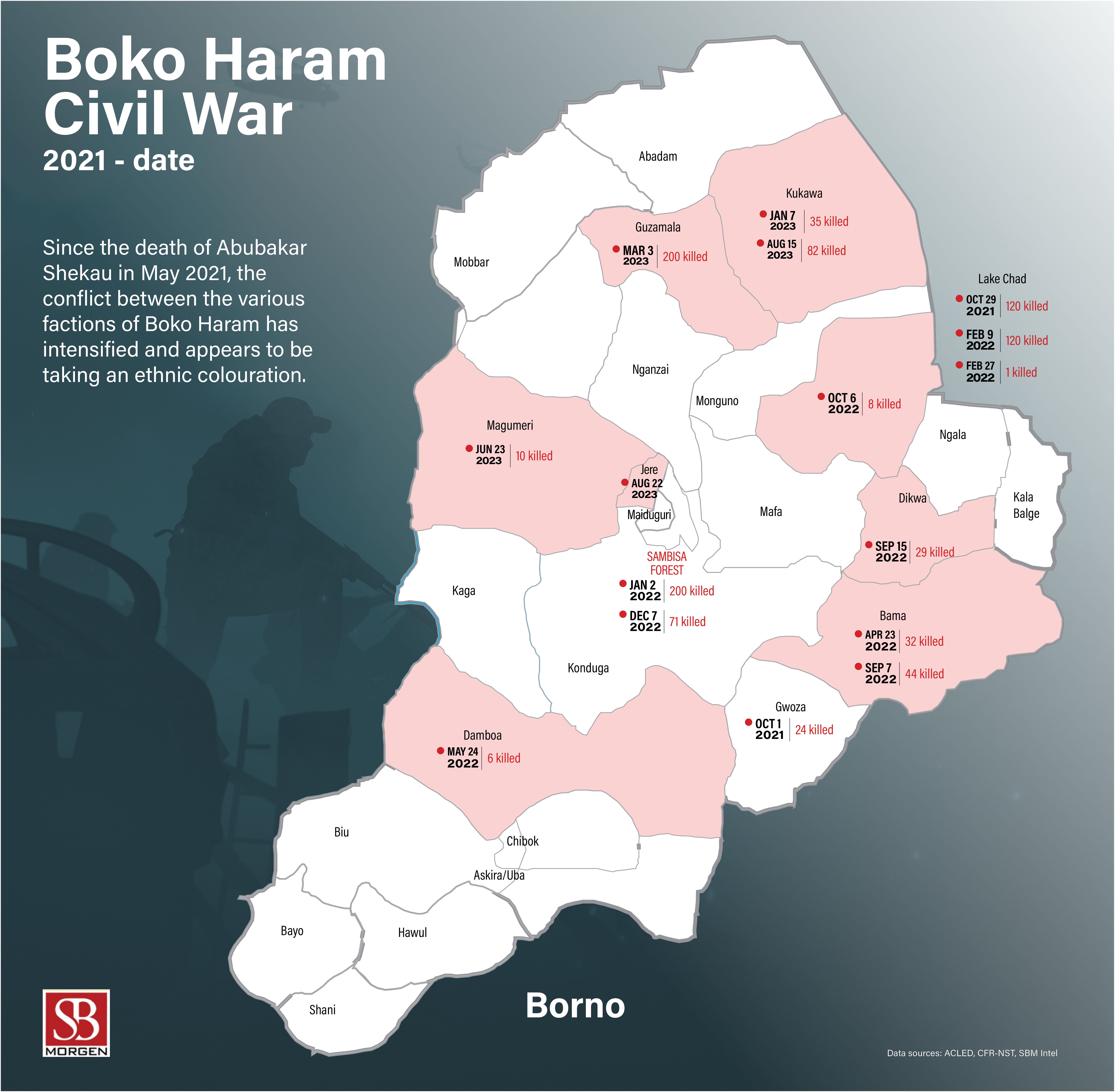
Some of the earliest clashes between both factions began in 2020 but intensified in early 2021. The clashes culminated in the killing of long-time Boko Haram leader Abubakar Shekau during an ISWAP onslaught on his base in Taye village of Sambisa forest in April of that year. At the time, assessments were near unanimous in beliefs that the JAS faction would be reduced to a rump subservient to the then-more superior ISWAP. Indeed, this dichotomy held until the uneasy peace was shattered in August 2021 when ISWAP, angered by the rate of desertion in northern Abadam, ambushed scores of Boko Haram members who were on their way to surrender to the multinational joint task force.
Between 2021 and mid-2023, the JAS faction avoided such confrontations until they launched the first salvo in June of that year between Gajiganna and Gajiram. Some of the Boko Haram fighters on motorcycles staged an ambush to attack two ISWAP vehicles, which led to heavy fighting that caused 10 fatalities on both sides. Since then, such clashes have become regular, weakening ISWAP in much of 2024. The meeting at the behest of Boko Haram amir Bakura ‘Machina’ Doro and ISWAP wali Sani Shuwaram, who have been at their positions for three and two years, respectively, may have been called to iron out differences, but what divides the group is a lot more than what unifies them.
For one, the ethnic composition of both groups is a prime obstacle mitigating against integration. A major reason for the first Boko Haram split in 2012 was ethnicity. Shekau’s Kanuri loyalists were given more precedence over the Fulani members of the group, which broke away to create Ansaru–Al Qaeda’s first prominent ally in Northcentral Nigeria. That ethnic rivalry has not dissipated. Although both Shuwaram and Doro are ethnically Kanuri, ISWAP is known to have a more significant presence of Fulani members compared to the Boko Haram faction. ISWAP has made efforts to mitigate conflicts between Fulani herders and other groups, including non-Fulani farmers, in its areas of control, which has attracted many Fulani individuals to join or ally with the group.
This contrasts with the Boko Haram faction, which has been less focused on integrating or addressing the specific concerns of the Fulani community. Furthermore, ideological divides regarding attacks on Muslims, although a historical sore point, remain a source of contention. While the attacks are expected to become more intense given the renewed strength ISWAP has received from its sister affiliates in the ISIS-West Africa franchise, the overarching question centres around the Nigerian forces’ ability to influence the rivalry into its intensification–a feat it can achieve better with collaboration with its Lake Chad Basin Commission members whose countries are used as safe havens by both factions when the other turns up the heat a little too much.