
Dollar still king for now
China's tariff removal on African imports and growing trade are expected to boost yuan use, though not replace the dollar.

China’s growing trade ties with Africa and the removal of tariffs on imports from 53 African countries are expected to boost yuan use across the continent. Rising trade volumes are increasing demand for yuan-denominated transactions, while banks such as Standard Bank, Ecobank, and the Bank of China are expanding payment infrastructure to support the currency. Countries including Kenya and Zambia are also adopting the yuan to lower borrowing costs and reduce foreign exchange risks. However, analysts say the yuan is more likely to complement rather than replace the U.S. dollar in Africa’s financial system.
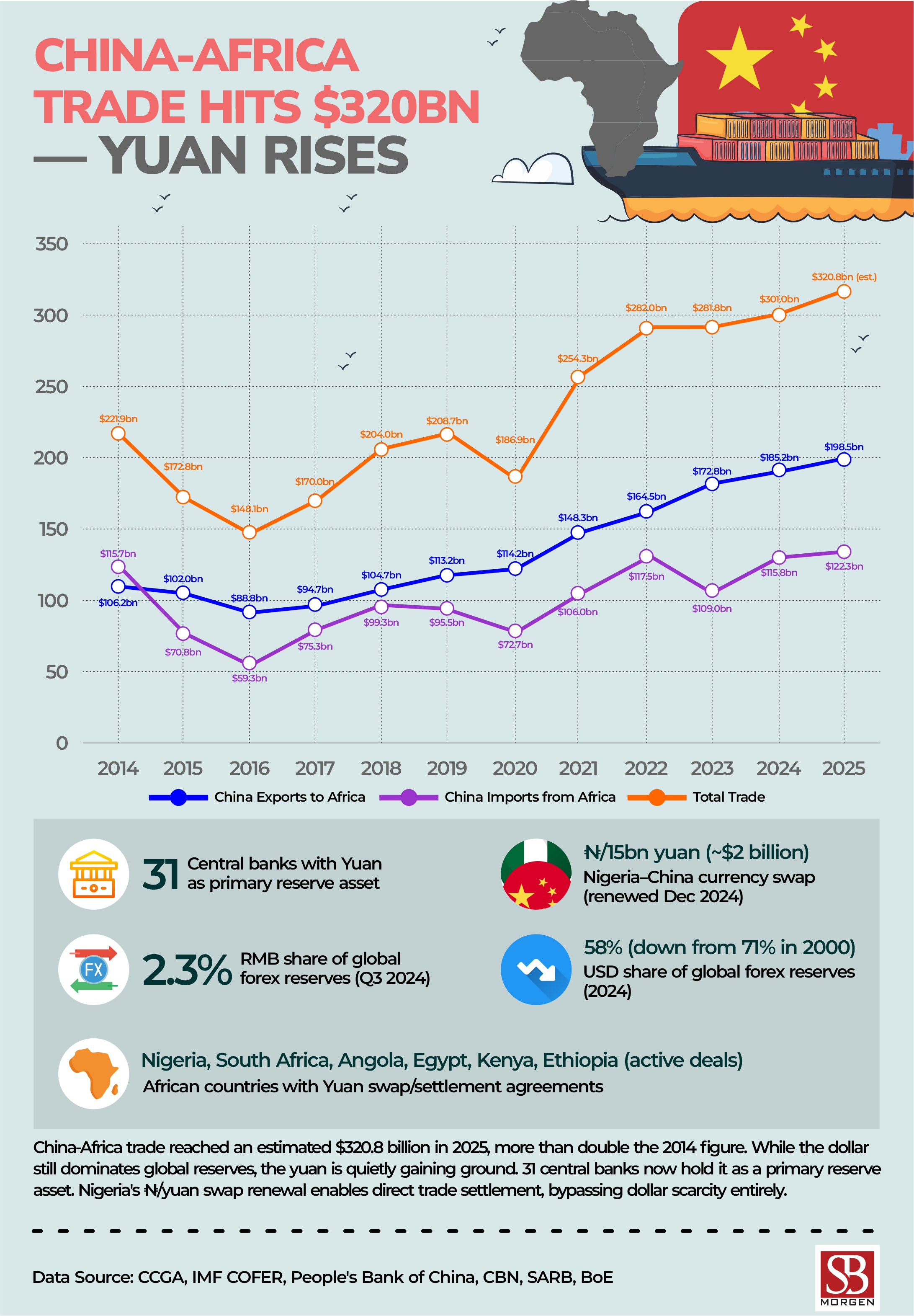
China’s removal of tariffs on imports from 53 African countries and the growing use of the yuan reflect a broader strategy to deepen its economic influence in Africa at a time when the United States appears increasingly focused on domestic priorities and trade recalibration.
The trend is unsurprising given that China is Africa’s largest trading partner. Chinese-manufactured goods dominate consumer markets from Nigeria to South Africa, while Africa supplies the raw materials that power China’s industrial and green-energy ambitions. In 2024, Africa exported $115.8 billion worth of goods to China, rising to an estimated $122.3 billion in 2025, with crude oil accounting for 41 percent of the export value, refined copper 15 percent, and iron and aluminium ores another 10 percent. The continent also supplies more than 96 percent of China’s cobalt imports and the majority of its chromium and manganese ore needs.
The tariff-free initiative serves both economic and strategic purposes. It secures access to vital commodities while strengthening Beijing’s political influence. The exclusion of Eswatini, the only African country with formal diplomatic ties to Taiwan, highlights how China uses trade incentives to reinforce its One China policy. The broader push also supports China’s long-term effort to internationalise the yuan. Historically, China dominated global commerce before the Opium Wars and the rise of the United States. Today, Beijing aims to reclaim a larger role by promoting yuan-based settlement systems, currency swaps and alternative payment infrastructure such as CIPS. In 2023, CIPS processed $6.6 trillion in transactions, up 73 percent year-on-year. Nigeria, South Africa, Angola, Egypt, Kenya and Ethiopia have active yuan swap agreements, and 31 central banks now hold the yuan as a primary reserve asset.
However, the rise of the yuan should not be mistaken for an imminent challenge to the dollar’s dominance. The dollar remains the backbone of global finance and accounts for roughly 55 percent of African trade transactions. Deep and liquid US financial markets, strong regulatory institutions, dollar-denominated debt obligations and the central role of multilateral institutions such as the IMF continue to underpin its reserve currency status. The yuan’s share of global reserves stands at just 2.3 percent, compared to the dollar’s 58 percent.
China’s capital controls also limit the yuan’s attractiveness as a global reserve currency. As a result, the yuan is more likely to emerge as a regional trade and settlement currency among China’s trading partners and Belt and Road participants rather than a direct replacement for the dollar. For now, Beijing’s strategy is less about overthrowing the dollar-based system and more about reducing its dependence while expanding its economic and geopolitical influence across Africa.