
Dwindling fuel
In Q2, West African monthly petrol imports dropped 56%, Refinitiv Eikon reported. June shipments from Amsterdam-Rotterdam-Antwerp to West…

In Q2, West African monthly petrol imports dropped 56%, Refinitiv Eikon reported. June shipments from Amsterdam-Rotterdam-Antwerp to West Africa fell to 629,000 tonnes from 895,000 tonnes last year; July loadings dropped to 627,000 tonnes from 1.5 million tonnes in 2022. Declining demand is evident, attributed partly to the removal of Nigeria’s petrol subsidies on 29 May. Nevertheless, foreign refiners from Europe, the Middle East and Russia are competing to boost refined petrol exports to Nigeria. Last week, The Punch reported that Russian petrol imports surged 84% in the past year.
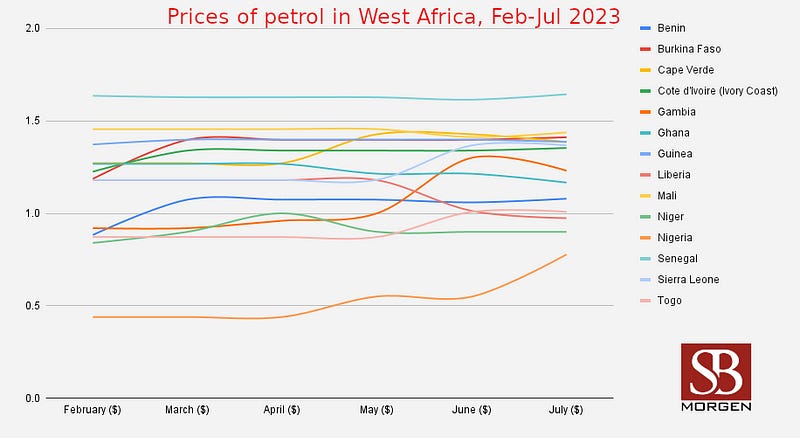
The EU family is straining its collective muscles to keep Baby Ukraine locked in a stalemate with Mother Russia. It is nice to know that while their problem worsened life for uninvolved and unthinking countries like Nigeria, there are some crumbs of benefits — in this case, cheaper fuel. At the end of 2022, EU countries stopped buying petroleum products from Russia, much of that fuel supply from last year came through Latvia and ports on the Black Sea, depriving Moscow of its major market. In the last month of that year, the G7 countries and Australia barred insurance firms registered in their countries from underwriting any Russian oil-bearing tanker selling its produce above $60. For refined petroleum, the price of what can be insured is capped at $100. This market owns more than 80% of the maritime insurance industry. Russia, however, is not the monolith of the Soviet days. It found a new market and new insurers; business has continued to boom since then, purely in terms of turnover; Russia sold 46.15% more fuel in the first quarter of 2023 than it did in 2022. Since Russia took the maritime route out of commission, new ports and storage facilities have emerged in the Middle East. The G7’s price cap on Russian hydrocarbon products came into force in the first week of February. The EU followed it up with an outright ban on refined petroleum from Russia two days later. By March, the Latvia to Africa petrol route had dried up. The severe sanctions have compelled Russia to redirect its hydrocarbon exports to the Middle East, which subsequently served as a transit point for these products to reach Nigeria. The traders that source refined fuel for Nigeria have read the market and shunned boys in Belgium, Latvia and the Netherlands. In the first quarter of this year, they imported 38,000 tonnes more of Russian petrol than they did in the previous period. In fact, 60% of Moscow’s record supply of 812,000 tonnes of gasoline came to Nigeria. The other reason Nigerian traders are turning to the Middle East and Russia for fuel is that the conscience of the Dutch government has finally been pricked. After several investigations uncovering the high volume of benzene — a cancerogenic substance in fuel blends from the Netherlands and Belgium — the Dutch government decided in April that exports will now have reduced sulphur, benzene and manganese amounts. However, this development hasn’t had any noticeable impact on the ethical considerations of Nigerian traders. Even if their ethical stance were to change, the inevitable consequence would be an escalation in the cost of higher-quality fuel — a lamentable reality. On the other hand, the decline in European refining capacities underscores the fact that African countries can reclaim certain aspects of their energy landscape if they choose to invest in the necessary infrastructure. By 2040, many European countries will likely significantly reduce their refined petroleum needs because of the anticipated bans on automobile engines. Despite this shift, European nations might still be willing to keep serving African markets. Refined petroleum is a low-hanging mango that countries like Nigeria could use to wean themselves of excess import dependence. We hope that the Tinubu government can foster the private sector to produce two million barrels of fuel daily as promised. The longstanding petrol subsidy regime in Nigeria, which spanned 50 years, has been widely recognised for creating an imbalance across West Africa and squandering the country’s resources. The effects of removing this subsidy have become evident in just a brief span of two months. On the downside, the petrol price at the pump has surged by as much as 300% in certain regions of Nigeria, causing transportation costs to rise by up to 200%. This increase has occurred without a corresponding boost in wages or income, reducing consumers’ disposable income and causing numerous businesses to cease operations. However, on a positive note, the Nigerian National Petroleum Corporation (NNPC) has commenced remitting funds to the federation account and the Federation Account Allocation Committee (FAAC), resulting in a growth of over 100% in June. There is hope that a portion of these released resources will be allocated towards raising workers’ minimum wage and addressing critical infrastructure deficiencies, which would yield lasting benefits for the country. The potential for energy poverty in Nigeria stems from the decline in petrol imports across West Africa. This downward trend could trigger elevated petrol costs, shortages, and a shift towards less efficient and environmentally detrimental energy sources. Considering Nigeria’s already substantial energy poverty rate, this reduction in imports could significantly impact the population. Nigeria’s government should invest in renewables, enhance energy sector efficiency, and provide subsidies for nationwide conversion to locally produced fuels to counter declining imports and potential energy poverty. By adopting these strategies, Nigeria can navigate the challenges of its evolving energy landscape while ensuring a more sustainable and prosperous future for its citizens.