
Echoes from the past
Gabon's post-coup election saw Nguema win overwhelmingly, though scepticism persists about genuine reform due to his regime's links and economic woes.

Gabon’s presidential election on 12 April marked its first since the 2023 coup that ended the Bongo dynasty. Transitional leader Brice Oligui Nguema, who led the coup and later declared his candidacy, won with 90.35% of the vote. His main rival, Alain Claude Bilie By Nze, garnered just 3.02%. Nguema campaigned for anti-corruption and economic diversification, but faces scepticism due to his links to the former regime. Analysts note key institutions remain under his control. Despite pledges to restore dignity and fight poverty, doubts persist about genuine reform in a country facing a $3 billion debt and high youth unemployment.
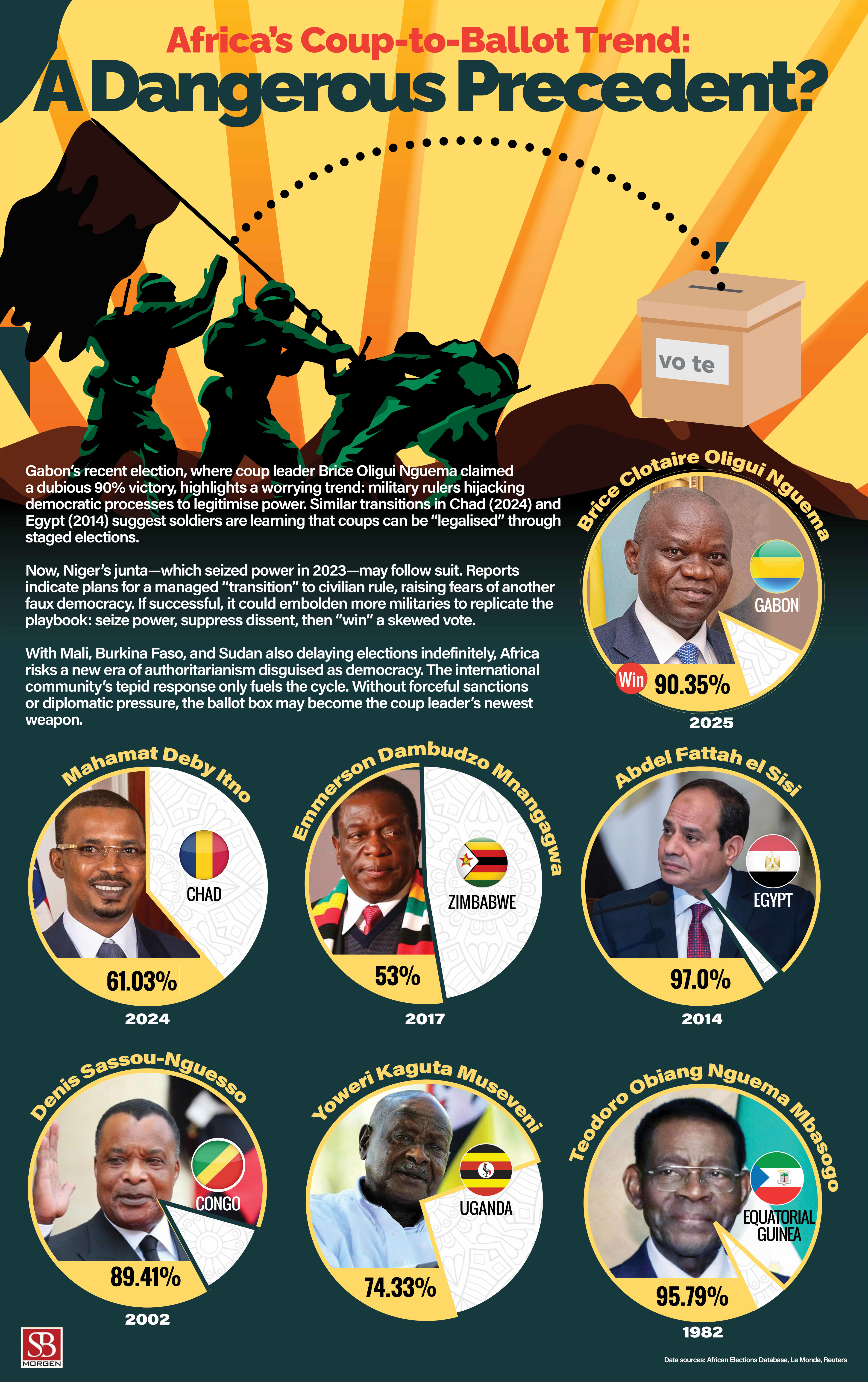
General Brice Oligui Nguema's 90.35% electoral victory formalises his 2023 coup but underscores continuity rather than rupture from the Bongo dynasty's 55-year rule. With opposition candidate Alain Claude Bilie By Nze polling just 3.02%, this lopsided result follows a worrying regional pattern where military rulers increasingly hijack democratic processes to legitimise power. Similar transitions in Chad (2024), Egypt (2014), and potentially Niger's junta - which is apparently planning its own managed "transition" after seizing power in 2023 - suggest soldiers are perfecting a playbook of coups followed by staged elections.
Mr Nguema's regime combines military backing with old-guard Bongo-era connections, ensuring short-term control but eroding democratic credibility. The near-absent opposition makes genuine political pluralism unlikely, with centralised power structures and patronage networks poised to stifle dissent. This risks provoking unrest among Gabon's urban youth, who face 20% unemployment and growing scepticism of leadership tied to the previous regime.
Economically, Gabon faces significant constraints that may undermine Nguema's ambitions. The country's $3 billion international debt and 80% reliance on oil exports severely limit diversification efforts. Proposed expansions in agriculture and tourism confront weak infrastructure and a bloated public sector, while debt servicing threatens to crowd out essential social spending, particularly concerning given that a third of Gabon's 2.5 million citizens live in poverty. Foreign investors, already wary since the coup, remain cautious about Gabon's small domestic market and logistical challenges, with elite resource capture posing additional reform risks.
Regionally, Gabon's transition aligns with military-led regimes in Burkina Faso, Mali, and Niger, potentially influencing coup-prone elites in neighbouring Cameroon and Congo. However, Gabon's relatively small population and stable history limit its regional impact compared to Sahelian hotspots. Its foreign policy will likely focus inward on regime security rather than regional leadership.
This emerging pattern across Africa, where juntas in Burkina Faso, Mali, and Sudan indefinitely delay elections while others stage-managed votes, risks ushering in a new era of authoritarianism disguised as democracy. The international community's tepid response, lacking forceful sanctions or consistent diplomatic pressure, inadvertently enables this cycle.
Nguema's fundamental challenge lies in balancing elite expectations with public demands for economic relief. Failure to deliver jobs or reduce poverty could spark urban unrest, while success requires navigating creditor pressures and investor hesitancy - a difficult task given Gabon's entrenched patronage networks. Ultimately, the election represents not the birth of a new era but the democratisation of autocratic rule. As Niger's junta considers its own "transition," Africa faces a critical juncture: will the ballot box become the coup leader's newest weapon, or can genuine pluralism withstand this militarised approach to power? Constrained by its internal dynamics, Gabon's trajectory may prove more indicative than influential in this regional struggle.