
EFCC learns about election timing the hard way
Osun State challenges EFCC in court over a $7.8 million account freeze, calling it politically motivated before the election.

The Osun State Government is challenging the EFCC in court over the freezing of its bank accounts, which the agency linked to suspected diversion of about ₦11 billion. Governor Ademola Adeleke called the action unlawful and politically motivated ahead of the August 15 governorship election. President Bola Tinubu ordered the EFCC to reverse the restriction and seek a court order, citing concerns over election interference. The dispute has triggered political and legal controversy, with opposition parties, lawyers and civil society groups questioning the independence and timing of the EFCC’s action.
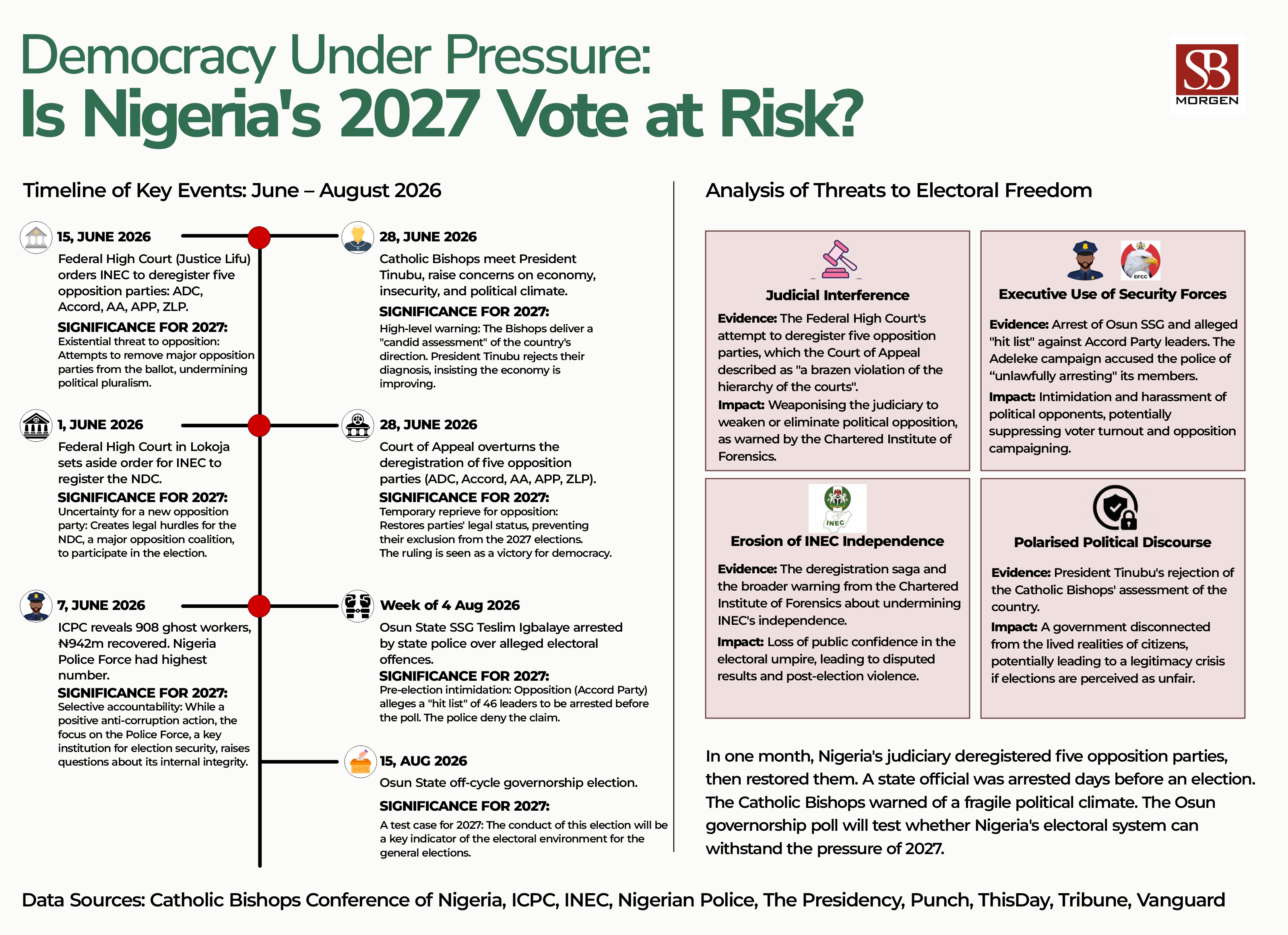
The EFCC’s decision to restrict Osun State’s statutory allocation account 10 days before a governorship election has produced a controversy that is simultaneously legal, political and constitutional, and none of those dimensions can be understood in isolation.
The commission’s own timeline is the first problem. The EFCC had been investigating the Osun State Government since March 2026. The suspicious transactions it cited as triggering the restriction were detected from 2 August 2026. The agency had five months to act and chose to do so in the 10-day window before an election in a state where the ruling party is desperate to reclaim power. Its spokesperson, Wilson Uwujaren, argued that the commission would have faced public criticism had it ignored the transactions. That may be true, but the more relevant question is why five months of investigation produced no restriction until the campaign entered its final stretch. The commission’s insistence that it acted “not minding the fact that there is an election process in place” is not a defence.
President Tinubu’s intervention deepened rather than resolved the controversy. He described himself as “deeply embarrassed” by the timing and noted that actions taken by federal institutions are frequently attributed to him personally. His directive to reverse the restriction was welcomed by Osun’s state government and the Accord Party as a victory for due process. The opposition, including former Vice President Atiku Abubakar and the ADC, has drawn the opposite conclusion: that a president who orders an anti-corruption agency to reverse a court-backed restriction confirms that such agencies do not operate independently of the presidency. They are right: Mr Tinubu cannot simultaneously insist on the operational independence of anti-corruption agencies and order one to stand down days before an election, as both positions cancel each other out.
The legal dimensions remain unresolved. The EFCC has defended its action under sections 38(1) and (2) of its Establishment Act and section 24 of the Money Laundering (Prohibition) Act. The Court of Appeal has previously held that the commission may place a stop order on a suspected account for a short period, reported as 72 hours, without prior judicial approval. The distinction between an administrative stop order and a court-ordered freeze is not a technicality. It is the central legal question. If the EFCC acted without a court order, the restriction was procedurally defective. If it obtained a court order, the presidential directive to vacate it raises a more serious question about executive interference in judicial processes.
In all of this, Governor Adeleke filed a ₦2 billion suit against the EFCC, a case that will take months to resolve. The election will not wait.
The political economy of the dispute is equally significant. SBM’s Voter Sentiment Tracker identifies the Southwest as Nigeria’s most critical electoral battleground for 2027. The region has the lowest high-turnout intention of any zone at 44 percent, the largest undecided electorate at 23 percent, and is the only zone where the APC retains a meaningful vote base at 22 percent. The NDC leads the region with 45 percent vote intention. Tinubu’s net favourability in the Southwest stands at positive 15.1, against Peter Obi’s positive 28.9. The home-base advantage is real but eroding. Dissatisfaction with the administration in the Southwest, at 60.3 percent, is lower than every other zone except the Northeast at 63.5 percent, but it is still a majority. The Osun account freeze will accelerate that drift. Southwest voters, already the most sceptical about electoral integrity, have now witnessed a federal agency restrict an opposition governor’s primary operating account during an election campaign, followed by a presidential directive to reverse it within 24 hours. Neither the action nor the reversal inspires confidence in institutional independence.
Whatever the result of tomorrow’s vote, the controversy will persist beyond it. If Mr Adeleke wins, the opposition will argue that federal institutions attempted to subvert democratic will. If Mr Oyebamiji wins, the opposition will argue that the restriction succeeded in crippling the incumbent during the critical final days. Either narrative reinforces the perception that federal agencies can be deployed against opposition-controlled states, and that only presidential favour can offer relief. That perception does not require proof of intent to take hold. The timing alone is sufficient.
For investors and analysts, the episode is a useful indicator of system risk. A regulatory environment in which a federal agency can restrict a state government’s primary account without clear judicial authorisation, and in which only executive intervention provides a remedy, is not a stable environment for commercial planning or democratic consolidation. The legal boundaries between administrative action and judicial oversight are blurred. The perception of partisanship is established. Both conditions will persist beyond the Osun election and into the 2027 cycle. The account freeze is not an isolated pre-election controversy but a stress test of Nigeria’s federalism, exposing weaknesses that will not disappear when the polls close.