
Egg on the face
The Poultry Association of Nigeria (PAN) has urged the Federal Government to intervene in the current egg glut forcing farmers to reduce…

The Poultry Association of Nigeria (PAN) has urged the Federal Government to intervene in the current egg glut forcing farmers to reduce prices. Godwin Egbebe, PAN’s national spokesman, said that states like Lagos, Ogun and Plateau have come to the rescue of farmers, but their help is insufficient. The association is yet to receive any intervention from the Federal Government. He said the government could mop up the eggs completely and take them to prisons, government-owned hospitals and Internal Displaced Persons camps.
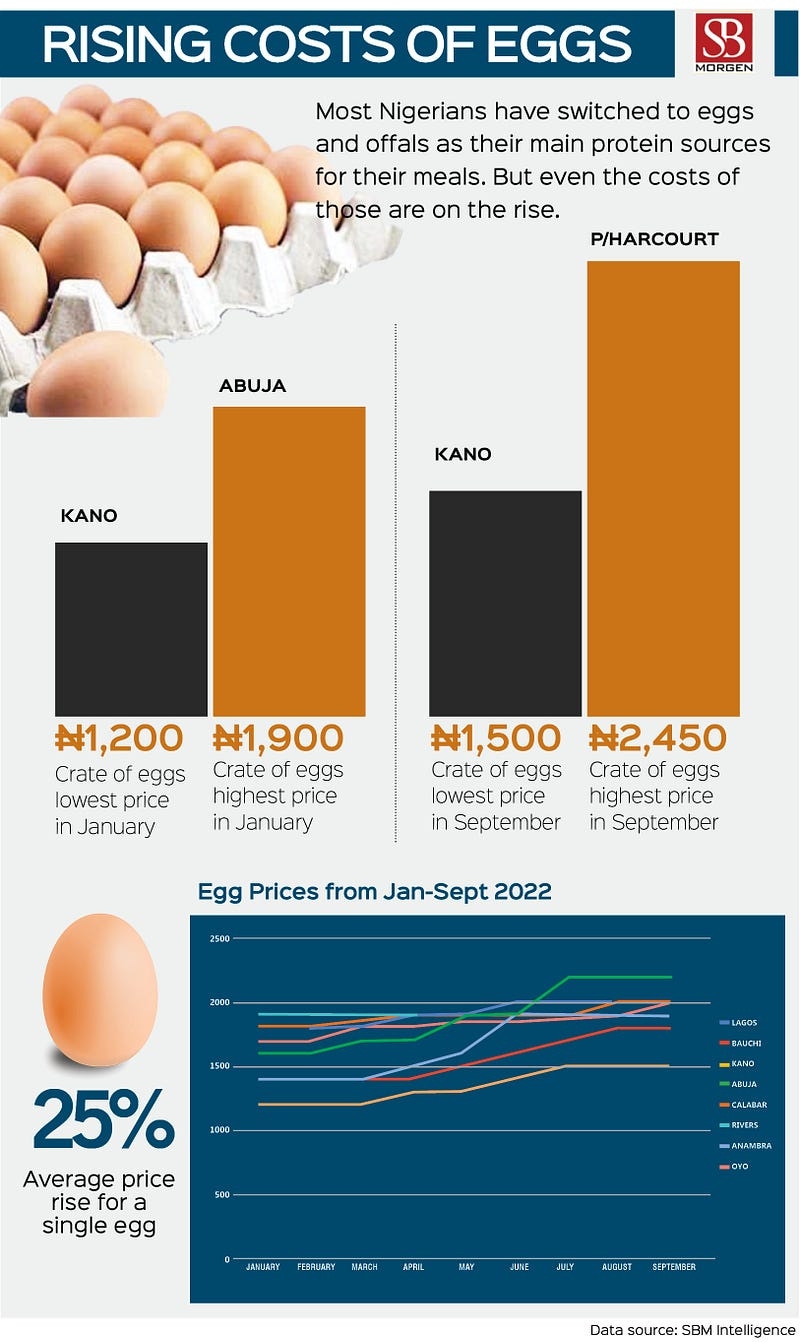
Nigeria is not among the top ten egg producers globally, which has China with 586 billion chicken eggs in first place and Turkey closing out the list with 19 billion chicken eggs. What is troublesome about the situation in Nigeria is that the industry faces seasonal gluts (periods when there are too many eggs on the market and not enough demand), thus creating a lot of waste as the eggs cannot be adequately preserved or processed for alternative uses due to infrastructural deficiencies. In Nigeria, the cyclical egg glut spans four months each year between March and June, while recovery post-glut takes another six months. During these periods, farmers are forced to sell live birds and eggs at prices below marginal cost or even dispose of stale eggs. The source of the current glut derives partly from the poorly thought-out implementation of the Naira redesign policy by the Federal Government and the Central Bank of Nigeria (CBN). Considering this, we might presume that the farmers are right to demand the government’s intervention to keep their businesses from going under. However, “the government should…” as a solution template for every sector in Nigeria is not exactly productive. Normally, excess demand should help pull prices down; but despite known excess demand, the retail cost of an egg consistently remained around ₦100 in most urban centres compared to the less than ₦30 price point just four years ago. One major reason prices have barely budged is that producers ramped up capacity at the start of the school-feeding programme pioneered by the current administration. Nevertheless, the Poultry Association of Nigeria could be more creative with addressing these structural — but seasonal — challenges. Why is it, for example, not helping its members seek new markets? Why is it not forging collaborations with corporate players that can readily soak up excess demand? Involving the government should not be the first step, as they are not obliged to mop up excesses. Poultry farmers have historically preferred to bury eggs like hatchets instead of making peace with the idea that a well-publicised price slash could boost short-term demand and limit their exposure to losses. As much as we would like to empathise with the poultry farmers, it is clear that market operators are unwilling to be flexible in managing industry risks during downturns but have no problem increasing prices when the business case calls for it. With supply outstripping demand, they should reduce egg prices. This is not to say that players in the agricultural sector are undeserving of support, but it has to happen alongside a price slash so that financial exposure is constrained on both the public and private ends of the equation. This might appear to be a classic chicken-and-egg situation, but something has to give. Our pick would be the egg.