
Eject
The United States (US) President Joe Biden has said that he intends to end the participation of the Central African Republic, Gabon, Niger…

The United States (US) President Joe Biden has said that he intends to end the participation of the Central African Republic, Gabon, Niger and Uganda in the African Growth and Opportunity Act (AGOA) trade programme. Mr Biden said he was taking the step because of “gross violations” of internationally recognised human rights by the Central African Republic and Uganda. He also cited Niger and Gabon’s failure to establish or make continual progress toward the protection of political pluralism and the rule of law. Biden said he intends to terminate the designation of these countries as AGOA beneficiaries, effective 1 January 2024.
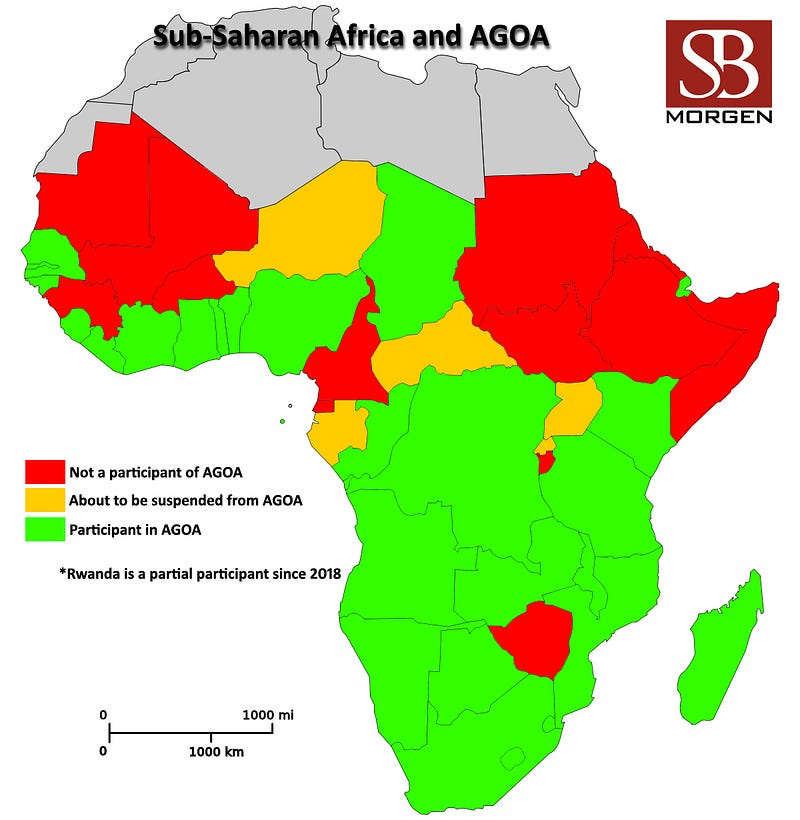
According to the US Trade Department, AGOA provides eligible sub-Saharan African countries with duty-free access to the US market for over 1,800 products, in addition to the more than 5,000 products eligible for duty-free access under the Generalised System of Preferences programme. However, as CAR, Gabon, Niger and Uganda are now finding out, the scheme extends beyond just trade and is laced with the typical conditions often attached to Western aid that African countries have criticised and struggled to comply with. The department’s statement says that applicant countries must establish or make continual progress toward establishing a market-based economy, the rule of law, political pluralism and the right to due process. Additionally, countries must eliminate barriers to US trade and investment, enact policies to reduce poverty, combat corruption and protect human rights. Niger and Gabon got on the wrong side of the US with the military’s coups against civilian governments. Uganda, however, has long squabbled with the US over its recently passed anti-gay legislation which mandated stringent punishment for Lesbian, Gay, Bisexual and Transgender (LGBT) people and their advocates. From one perspective, excluding these nations from AGOA is primarily symbolic and might not significantly impact their economies, as the United States aims to avoid economic harm, as evident in its ongoing security collaboration with the sanctioned countries. From another perspective, the Biden administration is using this measure to discipline countries, such as the Central African Republic, that have been engaging with the Russian-backed private military contractor Mercenary Group. While some nations may be hesitant to reverse their democratic decline, the Central African Republic has an opportunity to be removed from the list of non-compliant countries if it cuts ties with Wagner. However, for regime security reasons, this task appears to be a tall order. Ultimately, and within the context of geopolitical realignments, some observers from will note that the US is silent when it comes to dealing with autocratic regimes in the Gulf, which all have a track record of abuses towards LGBT communities. The direction of travel in thinking is that American human rights concerns are only skin deep, and some of these countries may find that they have partners willing to, for the moment at least, fill the gap that Uncle Sam is voluntarily creating.