
Fleeing the rainbow
Thousands of migrants are leaving South Africa after an unofficial June 30 deadline for undocumented foreigners

Thousands of migrants are leaving South Africa as anti-immigrant tensions intensify following an unofficial June 30 deadline issued by anti-migrant groups for undocumented foreigners to leave the country. Many Malawians and other African nationals have gathered at temporary camps awaiting repatriation, while several governments are organising buses and flights for voluntary returns. Police maintained a strong presence during protests across major cities to prevent widespread violence, although isolated looting and attacks were reported. At least four foreign nationals have been killed in recent weeks, with rights groups warning of worsening humanitarian conditions as fear, evictions and job losses continue to drive departures.
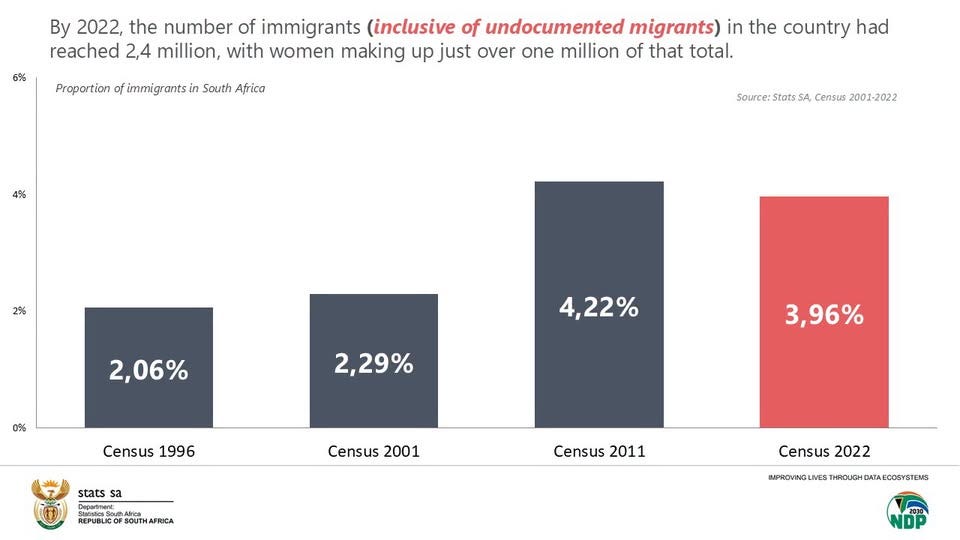
Source: Stats South Africa
The June 30 deadline passed without the mass violence many had feared, though the damage was already considerable by then. Mozambique had documented five of its citizens killed in what it described as xenophobic attacks, a Malawian man was killed by a mob in Pietermaritzburg, and South Africa’s Border Management Authority had repatriated or deported over 13,000 foreign nationals, including roughly 9,000 Malawians and 3,000 Zimbabweans, in the fortnight preceding the deadline. Thousands more remained in temporary camps in winter conditions, turned away from clinics and evicted from homes, while police maintained a presence sufficient to prevent large-scale massacres but insufficient to stop the cumulative violence of weeks of mob intimidation.
The reputational damage arrived at a peculiarly exposed moment. When Bafana Bafana lost their World Cup opener 2-0 to Mexico, captain Ronwen Williams expressed surprise and hurt that African fans from Nigeria, Ghana, Kenya and Zimbabwe had visibly backed the opposition, interpreting it as a failure of continental solidarity. He subsequently clarified he had been targeted over fabricated quotes and reiterated that he had always said Africa is one, though the clarification landed poorly. The episode was revealing in what it showed about the disconnect between how South Africa’s political class and its footballers understand continental belonging. Williams asking for African unity while his compatriots drove African migrants from their homes at gunpoint was not a communications failure that it may have been spun as. Rather, it was the logical product of a country that has never reconciled its Pan-Africanist founding mythology with the economic anxieties that periodically turn that mythology into a liability.
The continental response, as usual, was characteristically, inadequate. The African Union condemned the use of racialist language during Tunisia’s 2023 crackdown on sub-Saharan migrants and took no further action thereafter, precisely the same playbook it would deploy here. Following Tunisia’s February 2023 episode, the African Union condemned the use of racialised hate speech but took no further action, with regional economic institutions remaining silent throughout. Given that Morocco has expelled sub-Saharan migrants en masse, Libya has subjected them to slavery and torture, and multiple Sahel states have used migrants as political pawns, the continental moral authority to censure Pretoria was always going to be thin. The AU’s migration frameworks and the African Charter impose obligations that no enforcement mechanism exists to honour, and member states know it. The result is a pattern in which statements of concern are issued, repatriation flights are organised by the victimised countries themselves at their own expense, and the structural conditions producing the violence are left entirely untouched.
Ramaphosa’s proposed reforms - border strengthening, crackdowns on employers of undocumented workers, and a National Action Plan against xenophobia - address the symptoms rather than the animating condition. South Africa’s unemployment rate hit 32% in the first quarter of 2026, after 350,000 jobs were lost, with young people hardest hit, and with local government elections scheduled for November, the parties stoking anti-migrant sentiment, including the Patriotic Alliance, ActionSA and uMkhonto we Sizwe, are calculating correctly that it wins votes.
A National Action Plan circulated among a political class that is actively weaponising xenophobia for electoral advantage is not a plan; it is documentation. South Africa’s own foreign ministry has acknowledged that the attacks are hurting the country’s brand, and South African artists are losing bookings across the continent, an early economic signal that the reputational cost is beginning to materialise in concrete terms. Whether that cost reaches a threshold capable of changing domestic political incentives is the only question that matters, and on the current trajectory, the answer is no.