
Fragile peace
DRC and Rwanda sign peace deal addressing eastern Congo conflict, disarmament, and refugee return, as DRC extends cobalt export ban to stabilise markets.

The Democratic Republic of the Congo (DRC) and Rwanda have signed a provisional agreement in Washington, DC, to address the ongoing conflict in eastern DRC. The deal includes provisions on disarmament, integrating non-state armed groups, and facilitating the return of refugees. The region has long suffered violence over natural resources, with widespread human rights abuses by rebels, DRC forces, and allied militias, according to the UN. Meanwhile, the DRC has extended its cobalt export ban by three months to address market oversupply. The ban, initially imposed in February due to record-low prices, aims to stabilise the vital EV battery material market.
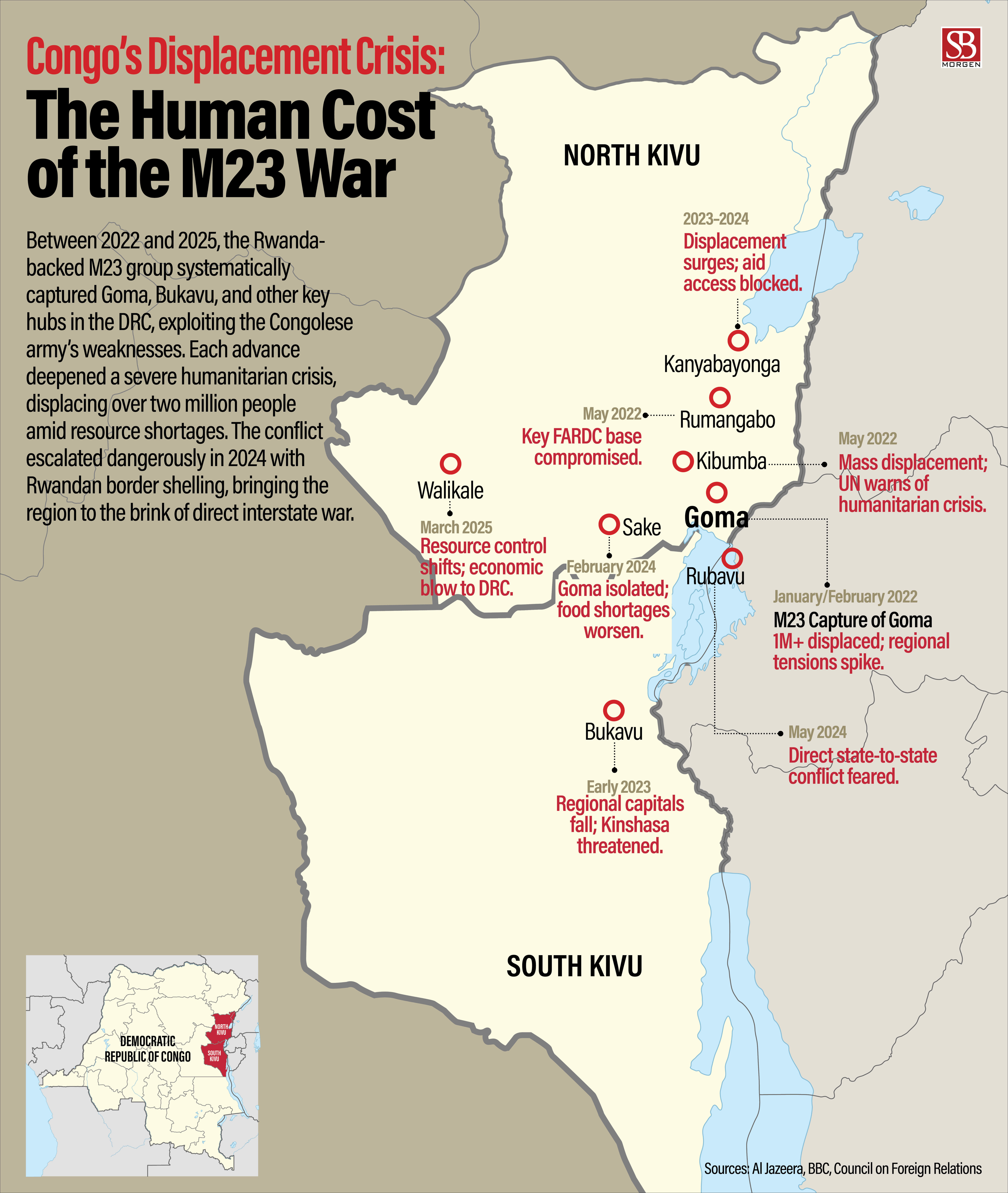
The ongoing conflict in the eastern Democratic Republic of Congo (DRC), rooted in the early 1990s and severely intensified by the First and Second Congo Wars—often referred to as Africa's World War—is now seeing an unusual shift in mediation. Unlike the traditional approach where regional bodies like the East African Community (EAC) lead peace efforts, the United States has stepped in, spearheading a provisional agreement between the DRC and Rwanda in Washington, DC, with further talks in Qatar. This mediation coincides with a return to power of the Trump administration in January 2025, signalling a more transactional approach to US foreign policy.
Eastern DRC has been a hotspot for decades, plagued by violence driven by control over lucrative natural resources like cobalt, coltan, gold, and lithium. The M23 offensive, escalating since late 2024, aligns with these geopolitical shifts. The UN has extensively documented widespread human rights abuses committed by various actors, including rebels, Congolese forces, and foreign-backed militias like the Rwanda-aligned M23 rebels. Kinshasa adamantly accuses Kigali of supporting M23, a claim Rwanda consistently denies, despite UN evidence suggesting the presence of 7,000 to 12,000 Rwandan troops in the DRC. Previous UN investigations into M23's abuses have done little to alter the situation on the ground. The conflict has displaced millions and created a dire humanitarian crisis, with M23's capture of Goma and Bukavu in early 2025 alone displacing over 500,000 people.
The US-facilitated agreement offers potential gains for all parties. For the United States, securing mining rights in the DRC's mineral-rich east strengthens American companies against China's significant dominance in the region's cobalt market. Rwanda stands to gain economic benefits, including continued access to Congolese minerals like coltan, which reportedly generates M23 $800,000 monthly, and an opportunity to formalise its influence in eastern DRC without direct military action. The DRC, under President Félix Tshisekedi, seeks crucial security assurances to halt M23's advances, while simultaneously leveraging mineral deals to support its economy and political stability.
However, this fragile deal faces significant hurdles due to entrenched distrust and conflicting goals. Rwanda's denial of supporting M23 infuriates Kinshasa, which views the group as a Rwandan proxy. Tshisekedi's resistance to granting M23 political legitimacy—a key Rwandan condition—has previously threatened to derail negotiations. The US demand for Rwanda to withdraw its troops before the agreement is formally signed may also irritate Kigali, which perceives Congolese-based Hutu militias like the FDLR (including remnants of Rwanda’s genocidal forces) as serious threats to its security. With Burundi backing the DRC and Uganda's unclear stance (accused by the UN of aiding M23), complex regional dynamics add further complexity. If M23 continues to capture territory despite ceasefires, as seen in Walikale in March 2025, or if the DRC's public opposes mineral concessions, the agreement could collapse. The deal risks becoming another failed initiative without robust third-party enforcement and transparent disarmament mechanisms.
Separately but related, the DRC has extended its cobalt export ban by three months in 2025. This move aims to address market oversupply and stabilise prices for the vital electric vehicle (EV) battery material. As the world's largest cobalt producer, supplying approximately 70% of global output, the DRC's ban—initially imposed in February after prices hit record lows—reflects its growing assertiveness in managing this critical resource. The ban intends to pressure foreign powers and retain economic control during the ongoing conflict. The DRC hopes to extract concessions from the US and China in peace talks by limiting cobalt, which is essential for electronics and EV batteries.
However, this policy carries considerable risks. While it might temporarily buoy prices, prolonged restrictions could incentivise smuggling or push international buyers toward alternative suppliers, such as Indonesia. Moreover, artisanal miners, who often endure hazardous conditions, may suffer further economic strain due to lost income. A more sustainable solution would require better supply chain governance, ethical mining reforms, and coordinated global demand management.
The DRC-Rwanda agreement represents a positive but inherently fragile diplomatic development. Its success hinges on genuine political will, robust regional cooperation, and uncompromising accountability for all armed groups. Simultaneously, the cobalt ban underscores the DRC’s strategic leverage and highlights the pressing need for long-term market stabilisation policies. Both issues collectively reflect the broader struggle to balance immediate crisis response with sustainable solutions in a region historically exploited for its resources.