
Fuel to fire
On Tuesday, the Nigerian National Petroleum Corporation (NNPC) increased its fuel pump price from ₦617 to ₦897 per litre, two days after it…

On Tuesday, the Nigerian National Petroleum Corporation (NNPC) increased its fuel pump price from ₦617 to ₦897 per litre, two days after it admitted to owing suppliers more than $6 billion. In response, the Nigeria Labour Congress (NLC) has said it feels betrayed because it accepted the ₦70,000 minimum wage, expecting that petrol prices would remain stable. Meanwhile, the Nigerian Midstream and Downstream Petroleum Regulatory Authority (NMDPRA) has announced that starting in September, the Dangote Refinery will supply 25 million litres of petrol daily, increasing to 30 million litres daily in October. This follows Dangote’s announcement of the first petrol rollout from the refinery.
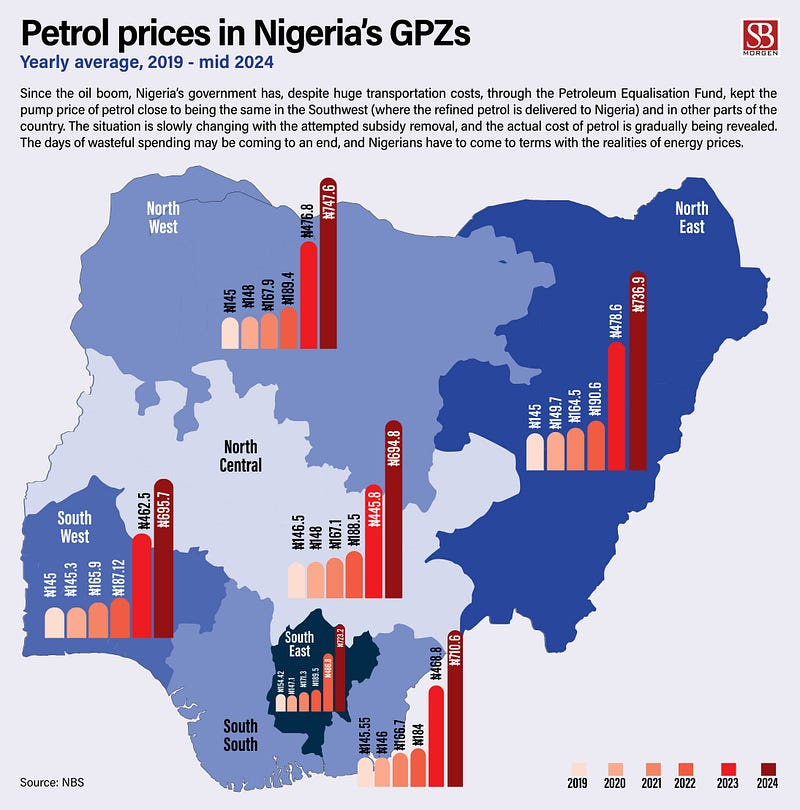
Nigerians understand that once petrol pump prices go up in our country, they do not come down. Also, it is a fact that demand and supply are two of the most significant forces in economics. A study conducted by SBM in 2022 revealed that at the time, Nigeria’s petrol pump price, equivalent to $0.40, was an anomaly in West Africa, with our neighbouring countries selling the product for the equivalent of $0.89 — $1.09. Consequently, arbitrage opportunities opened up, leading to the prevalence of smuggling the product out of Nigeria to sell for almost twice the price in Benin, Cameroon, Chad, Niger and Togo. Following the devaluation of the Naira (currently at $1/₦1,660), Nigeria’s pump price is still 1.78 times the price in neighbouring countries, implying that there is still a subsidy on the product and opportunities for arbitrage. Nigeria’s insistence on maintaining a pseudo-market-driven regime without fully committing to market-determined prices for petrol and foreign exchange is leading to another opaque setup for petrol supply. This approach fails to address the subsidy issue and risks concentrating its rising costs into even fewer hands. The much-maligned crude swap arrangements with foreigners will now be substituted with a crude-for-Naira arrangement with Dangote. At the same time, the government continues to decide the retail price, effectively paying the subsidy difference to its chosen suppliers — formerly licensed fuel importers, then solely NNPC, and now largely Dangote, with NNPC inserting itself in the middle as the sole off-taker. All these result from the faulty and flawed implementation of the needed policies of petrol and FX subsidy removal. In essence, the country has gone in a circle to end up back at square one. Perhaps a more reasonable, although painful, course of action would be full deregulation of the product price and, simultaneously, doubling the proposed minimum wage.